
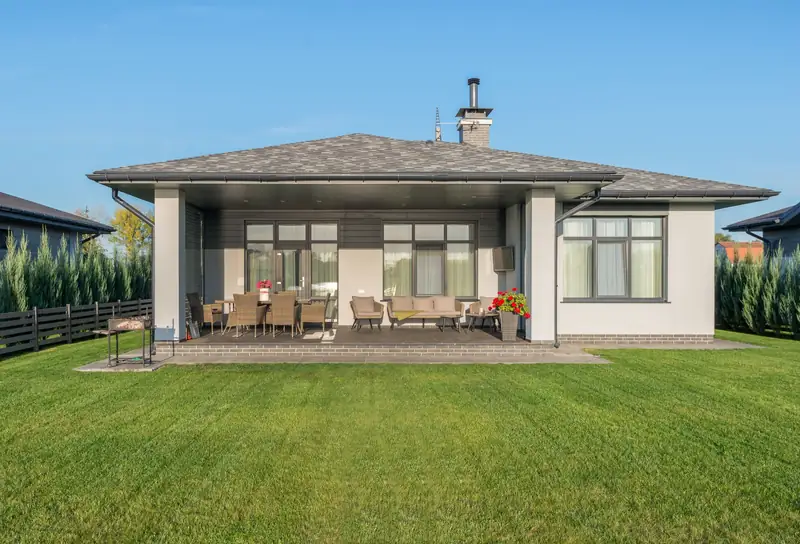
Concrete Patios · Winter Springs, FL
Building a Concrete Patio in Winter Springs
A concrete patio in Winter Springs falls between $6–$13 per sq ft installed as of October 2026. The city's Site Work Permit covers “Paving, Grading, and Drainage” as one of its listed work types, and the flatwoods soil under much of Seminole County shapes how that patio needs to be pitched.
By the Opera Concrete & Pavers estimating team · Updated October 1, 2026
Get a free estimate
Tell us about the project and we'll call to set up a free site visit.
A patio pour falls under the city's paving-and-drainage permit category
Winter Springs' Site Work Permit application, revised May 2024, lists “Paving, Grading, and Drainage” as one of the project types a homeowner checks off alongside clearing and grubbing or a temporary construction fence (City of Winter Springs, Site Work Permit Application). Work has to start within 60 days of the permit being issued and finish within one year, or the permit expires, the same clock the city puts on its driveway permits. A backyard patio addition is paving work in the plainest sense, so it falls inside that category rather than skating past permitting because it sits on private ground.
Routing a Control Joint Around a Column Instead of Through It
Control joints on an open slab can run in a simple grid, but a lanai's support columns break that grid up, and a joint that would otherwise cross right through a post has to be routed around it instead. Panel-shape guidance still applies at every column: each section stays close to square, with the length no more than about one and a half times the width, rather than tapering into a long sliver next to a post. On a Winter Springs patio with four or more columns, that means planning the joint layout around the columns before the pour, not sawing a standard grid afterward and hoping it lines up.
An outdoor-kitchen pad off a lanai, priced by the square foot
A homeowner wants a 220 sq ft pad for an outdoor kitchen built onto the side of an existing lanai, on a lot where the backyard holds water a day or two after a hard summer storm. Quoted at $6–$13 per sq ft installed, the pour comes to roughly $1,320 to $2,860 before any counter or grill structure is added on top. Because this is new paved surface, the Site Work Permit's paving-and-drainage category applies the same as it would to a driveway, and the extra base thickness that flatwoods soil calls for gets built into the quote rather than discovered mid-pour.
On flatwoods ground, the base gets built thicker, not just graded differently
Myakka fine sand, the flatwoods soil common across Seminole County, became Florida's official state soil in 1989 (Florida Dept. of State, State Soil). Industry guidance for paver bases (ICPI Tech Spec 2) calls for adding 2 to 4 extra inches of compacted aggregate specifically on continually wet or weak soils, the category flatwoods ground with a shallow water table falls into; the same logic carries over to how much fill a crew compacts under a concrete patio before the forms go up, even though the finished slab looks identical either way once it's poured.
A Patio Sloped Toward the House Finds the Sliding Door First
A patio that slopes even slightly toward the house instead of away from it sends every storm straight at whatever is closest, a sliding glass door, a lanai threshold, a foundation wall, rather than out into the yard where it belongs. On flatwoods soils already holding water near the surface for part of the year, a Winter Springs patio with the wrong fall does not just puddle, it keeps that water sitting against the house through an entire rainy season instead of one storm. The fix almost always traces back to grading decided at the subgrade stage, not the finish, which is why checking the fall before the forms go up matters more than checking it after the pour.
Footers for a Lanai Go in Before the Patio Slab
A lanai or screen enclosure attached to a new patio needs its own footings for the support posts, sized and poured as a separate structural element from the flatwork around them. Several Winter Springs-area permit categories draw exactly that line: a plain patio slab without footers often clears a lighter review than a slab with footers, because adding footings changes what the job is in the eyes of the permitting office. Practically, that means the footer holes get excavated, formed and poured before the surrounding patio base goes in, not worked in afterward around a finished slab. Treating the footers as an afterthought is how a screen enclosure crew shows up to a patio that isn't ready for posts.
Why Footer Inspections Happen Before the Slab Pour
Where a Winter Springs patio includes footings for a lanai or screen enclosure, those footers get excavated, formed and typically inspected before the surrounding patio base and slab go in, not folded into the same pour as an afterthought. That sequencing matters because a footer inspector needs to see the hole, the forms and any reinforcement before concrete covers them, the same logic that applies to a driveway's base inspection, just for a different structural element. Scheduling the footer work as its own step, ahead of grading the rest of the patio, keeps the whole job from stalling while an inspection gets arranged around concrete that has already been poured over.
What Salt Air Adds to a Coastal Patio's Checklist
A patio within reach of salt air, more of a factor on the coastal side of Sarasota and Manatee than on the Orlando side of the service area, benefits from an occasional check of any exposed rebar or wire mesh near a chip or a crack, since airborne salt speeds up corrosion once metal is exposed to it. Outdoor furniture hardware, a screen enclosure's fasteners and any metal edging near a Winter Springs patio age faster in that same salt air, so a yearly look at the whole setup, not just the concrete, catches small problems before they spread. Coastal exposure does not change how the patio was built, only how closely it is worth watching afterward.
Frequently asked questions
What permit covers a new concrete patio in Winter Springs?
The city's Site Work Permit, which lists “Paving, Grading, and Drainage” as one of its project types, covers a patio addition along with other paving and grading work.
How long is a Winter Springs Site Work Permit valid for?
Work must commence within 60 days of issuance and be completed within one year, or the permit expires.
Does flatwoods soil change how a Winter Springs patio gets built, not just how it looks?
It can change the base thickness. Industry guidance adds 2 to 4 extra inches of compacted aggregate under paving on continually wet or weak soils, a category that includes the flatwoods ground common across Seminole County, even though the finished slab on top looks no different.
Sources
- Census Bureau PEP, City and Town Population Totals, Vintage 2025 (July 1, 2025)
- SJRWMD Watering Restrictions
- Florida Dept. of State - State Soil
- Florida Administrative Code — Rule 62-308.100, Synthetic Turf (effective May 19, 2026)
- Florida Statutes §125.572 — synthetic turf on single-family lots
- City of Winter Springs Code of Ordinances §20-439, Parking Areas on Residential Lots (via Zoneomics)
- City of Winter Springs, Site Work Permit Application
- City of Winter Springs, Building & Permits
- Country Club Village at Tuscawilla, ACC Request (Bylaws Exhibit IX, Driveway Pavers)
- Wikipedia, Winter Springs, Florida
- Wikipedia, Lake Jesup
- Play Orlando North, Central Winds Park
- Census Reporter, Winter Springs, FL (ACS 2024 5-yr, B25035)
Ready for a price on your project?
Request a free estimate
Tell us about the project and we'll call to set up a free site visit.