
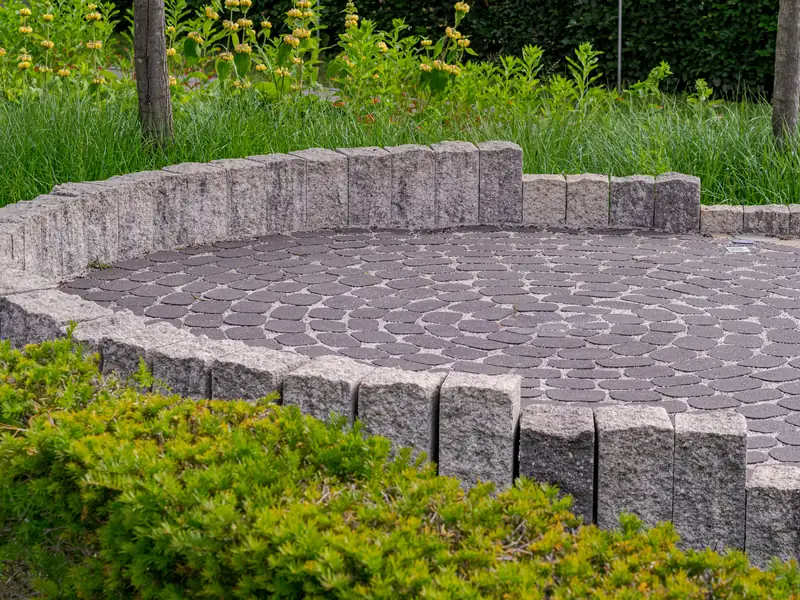
Paver Patios & Walkways · Longwood, FL
Paver Patios and Walkways for a Longwood Yard
A paver patio or walkway in Longwood runs $10–$17 per sq ft installed as of October 2026. The same 55 percent impervious ceiling that governs a driveway in the city's low-density zone applies to a backyard patio, and a front walkway that meets a driveway apron follows its own thickness rule.
By the Opera Concrete & Pavers estimating team · Updated October 1, 2026
Get a free estimate
Tell us about the project and we'll call to set up a free site visit.
A patio competes with the driveway for the same coverage headroom
Longwood's impervious-area worksheet doesn't carve out a separate allowance for a patio; house, driveway, patio and pool deck are added together against the same 55 percent ceiling in the low-density district (City of Longwood, Impervious Surface Calculation Form). On a lot that already has a wide driveway and a full-footprint house, adding a sizable paver patio out back is sometimes the addition that pushes the total closest to that limit, a math problem worth running before the layout is drawn rather than after.
Bedding sand and joint sand aren't the same material
Bedding sand is the thin layer the pavers actually sit in, screeded to an uncompacted 1 inch before a single unit goes down. Joint sand is swept into the narrow gaps between pavers afterward and compacted in with a plate compactor, and ICPI specifies joints no wider than about 1/8 inch. Using the wrong sand in either layer, or skipping the compaction pass that locks joint sand in place, is one of the more common reasons a Longwood patio feels loose or individual pavers rock underfoot within the first year. Getting both layers right is a small part of the job in material cost and a large part of it in feel.
A backyard patio and front walkway on one lot, worked out in square feet
Picture a Longwood home adding a 14 by 16 foot paver patio off the back door, 224 square feet, plus relaying a 3-foot-wide, 30-foot front walkway, 90 square feet, where it crosses the driveway apron. At $10–$17 per sq ft installed for the combined 314 square feet, that lands between roughly $3,140 and $5,024, with the walkway's crossing section built to the thicker driveway-grade base rather than the lighter spec used for the rest of the path.
Where a walkway crosses a driveway, the concrete underneath gets thicker
Longwood's public-works manual sets ordinary sidewalks at a minimum 4 inches of portland cement concrete, 5 feet wide, but doubles that to 6 inches wherever the walk crosses a driveway, since that section also has to bear vehicle loads (City of Longwood, Manual of Standards). A front paver walkway that ties into the driveway apron inherits that same reinforced-base expectation at the crossing point, even though the rest of the walk sits on a lighter base.
Mold and algae on a shaded patio
A patio tucked under a tree canopy or on the north side of a house stays damp longer after each rain, and that moisture, combined with organic debris like leaf litter and pollen, feeds mold and algae growth on the paver surface. Beyond the look of it, a green or black film on a walking surface gets slick, and a shaded Longwood patio near a pool or a lanai door is exactly where a slip matters most. Good drainage through the base and joints helps the surface dry faster between rains, but a shaded patio will still need more frequent cleaning than one in full sun.
Flatwoods soil and why the base sometimes gets thicker
A lot of the territory we work in sits on flatwoods soils such as Myakka, Florida's official state soil, where a seasonal high water table can sit within 18 inches of the surface for part of the year. ICPI's guidance is direct about what that means for a paver base: continually wet or weak soil needs a base 2 to 4 inches thicker than the standard patio or walkway depth. On a Longwood lot with poor natural drainage, that extra aggregate, plus a perforated drain pipe where the soil stays saturated, does more for the long-term flatness of the patio than any amount of extra paver thickness would.
Locking the joints and setting the edge restraint
With the field laid, we sweep dry joint sand across the surface and run a plate compactor fitted with a protective pad over the whole patio two or three passes, which both seats the pavers into the bedding sand and drives sand up into the joints. Edge restraint goes in along the perimeter before or during this step, spiked into the base rather than the sand. A final sweep clears excess sand off the paver faces so it doesn't haze in the Florida sun. On a Longwood job, this compaction and joint-sand stage is usually the last full working day before cleanup.
Keeping ants and weeds out of the joints
Compacted, properly topped-off joint sand is the simplest defense against both ants nesting and weed seed germinating between pavers, since loose or thin sand gives both something to work with. A quick sweep to clear organic debris like leaf litter and grass clippings off a Longwood patio before it decomposes into the joints also removes the organic matter weeds actually need to sprout. For an established ant problem in the joints, treating the colony directly works better than repeatedly re-sanding over it, since the ants will just re-excavate fresh sand the same way they did the old.
Frequently asked questions
Does a backyard paver patio count toward Longwood's impervious limit?
Yes. The city's worksheet totals the house, driveway, patio and pool deck together against the same 55 percent ceiling in the low-density residential district, so a new patio is weighed against whatever coverage the lot already carries.
Why would a front walkway in Longwood need a thicker base in one spot?
Where a walkway crosses a driveway, the city's manual of standards requires 6 inches of concrete instead of the normal 4-inch sidewalk thickness, since that section has to carry vehicle weight as well as foot traffic.
Is a separate permit needed for a patio that doesn't touch the right-of-way?
A patio entirely on private property doesn't trigger the right-of-way permit that covers driveway work, though it's still counted in the lot's overall impervious-coverage math and worth confirming with Community Development on a borderline lot.
Sources
- City of Longwood, Right-of-Way Permit
- City of Longwood, Manual of Standards for City Streets and Stormwater Systems
- City of Longwood, Impervious Surface Calculation Form
- City of Longwood, Historic District
- Wikipedia, Longwood Historic District
- Census Reporter, Longwood, FL
- Census Reporter API, Longwood median year structure built (B25035)
- SJRWMD Watering Restrictions
- Florida Administrative Code — Rule 62-308.100, Synthetic Turf (effective May 19, 2026)
- Florida Statutes §125.572 — synthetic turf on single-family lots
- F.S. 720.3045 (2026) Installation, display, and storage of items
- NRCS OSD Smyrna
Ready for a price on your project?
Request a free estimate
Tell us about the project and we'll call to set up a free site visit.