
Artificial Turf · Longwood, FL
Artificial Turf for Longwood Lawns
Artificial turf in Longwood runs $10–$25 per sq ft installed as of October 2026. The state's 2026 turf rule sets the build standard statewide, and on a 1983-median lot here, turf swaps out a sprinkler schedule that's been running on the same twice-a-week calendar for years.
By the Opera Concrete & Pavers estimating team · Updated October 1, 2026
Get a free estimate
Tell us about the project and we'll call to set up a free site visit.
No city-specific turf ordinance, but a statewide build spec that still applies
No Longwood ordinance addressing artificial turf was found, so the construction standard that governs an install here is the state's: Rule 62-308.100, effective May 19, 2026, calls for a washed base under the turf, natural infill rather than crumb rubber, no buried irrigation line beneath it, and keeping new turf 10 feet back from a pond or canal unless a seawall separates the two (Florida Administrative Code, Rule 62-308.100). F.S. 125.572, passed the year before that rule took effect, caps how aggressively a local government specifically can regulate residential turf beyond what the rule already requires (F.S. 125.572).
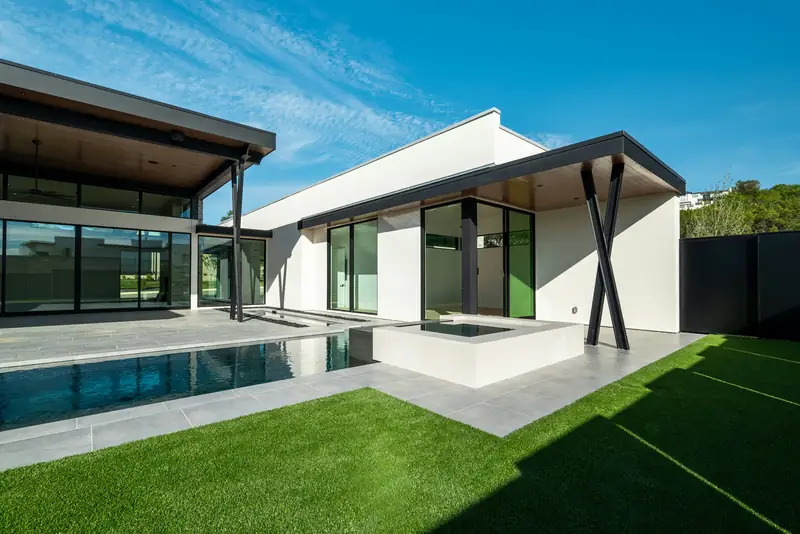
Grading the base around a pool deck so turf drains away from the coping
Turf set against a pool deck has one job the base has to support: moving splash-out and rain away from the coping instead of toward it. The compacted aggregate base around a Longwood pool gets graded with a gentle slope off the deck's edge, and the subgrade under it follows the same washed-rock, no-fines rule as every other part of the yard. Pool equipment pads, skimmer lines and deck drains all have to stay clear and functional once the turf is in, which means the base is built around them rather than over them, with the final grade checked at the coping before the turf is rolled out.
Turf drops off the irrigation calendar entirely
Longwood, like the rest of Seminole County inside the St. Johns River Water Management District, runs a year-round lawn-watering calendar split by address, odd numbers and no-number homes on one pair of days, even numbers on another, with no watering allowed between 10 a.m. and 4 p.m. (SJRWMD Watering Restrictions). A turf lawn has no irrigation zone left to schedule once it's installed, though if a homeowners' association's own documents don't already name turf, state law still limits what it can restrict to turf that's actually visible from the street or an adjoining lot (F.S. 720.3045).
Fitting turf panels into a paver pattern as an accent, not a patch
Turf set as a band inside a paver driveway or alongside a walkway gets its own edge restraint where it meets the pavers, tying into the paver's existing restraint rather than relying on the turf's perimeter nails alone. The panel is cut narrower than a full lawn roll and seamed along one or both long edges instead of four, which keeps the seam count down on a short run. Around Longwood, this kind of inset strip usually runs the width of a driveway or along one side of a front walk, with the turf sitting slightly proud of the paver surface so mowing or trimming never touches it.
Swapping a front lawn for turf on an older Longwood lot, worked out in square feet
Consider a Longwood yard built around the city's 1983 median home age, where 500 square feet of St. Augustine along the front has thinned out under live oak shade. At $10–$25 per sq ft installed, turf for that area runs roughly $5,000 to $12,500 depending on pile height and backing, and because the state rule requires a washed base rather than whatever sand sits under the existing lawn, the install includes removing and replacing that base rather than laying turf directly over the old grade.
What changes in the process for a pet area install
A dog run or pet area gets the same removal-grading-base sequence as the rest of a Longwood yard, with one extra step: the perforated or open-weave backing and drainage layer get checked for flow before infill goes in, usually by running water across the pad and watching how fast it clears. Infill is worked into the pile more conservatively than on a show lawn, since a pet area holds more liquid over its life and a lighter infill layer drains and dries faster between uses. The perimeter gets nailed down tight along any edge where digging is likely.
Installing turf under a live oak without checking the drip line first
A live oak's drip line can extend well past where the canopy visually seems to end, and DEP Rule 62-308.100 bars turf inside that line unless a certified arborist certifies the install won't harm the roots. Skipping that step on a Longwood property with a mature oak risks root damage during grading and base compaction, plus a rule violation that has nothing to do with how good the finished turf looks. Several Central Florida cities also protect large live oaks by ordinance, independent of the state turf rule, so a drip-line mistake near one of those trees can trigger a second problem on top of the first.
Checking seams and edges after storm season, not just once a year
A seam or edge that was anchored correctly at installation can still work loose over a season of heat cycling, wind and the occasional named storm moving through Longwood, so a walk around the full perimeter and every seam after a significant storm catches a lifted spot before it grows. Re-securing a loose edge early is a small fix; leaving it through another storm turns it into a bigger one, since each gust that gets under an open edge peels it back a little further. This check costs nothing but time and doesn't require pulling up any turf to do it.
Frequently asked questions
Does Longwood have its own artificial turf ordinance?
No city-specific rule was found; the construction standard that applies is the state's Rule 62-308.100, covering the base, infill and water-body setback the same way statewide.
Does turf in Longwood still need to follow the SJRWMD watering schedule?
No. The twice-a-week schedule governs irrigated sod and landscaping; a turf lawn has no sprinkler zone to schedule once it's in, though the lot's overall landscaping may still mix turf and irrigated beds under the same property.
Can a Longwood HOA refuse turf that meets the state standard?
Only to a point. Unless the association's own governing documents specifically address turf, state law limits what it can restrict to turf visible from the street frontage or an adjoining property.
Sources
- City of Longwood, Right-of-Way Permit
- City of Longwood, Manual of Standards for City Streets and Stormwater Systems
- City of Longwood, Impervious Surface Calculation Form
- City of Longwood, Historic District
- Wikipedia, Longwood Historic District
- Census Reporter, Longwood, FL
- Census Reporter API, Longwood median year structure built (B25035)
- SJRWMD Watering Restrictions
- Florida Administrative Code — Rule 62-308.100, Synthetic Turf (effective May 19, 2026)
- Florida Statutes §125.572 — synthetic turf on single-family lots
- F.S. 720.3045 (2026) Installation, display, and storage of items
- NRCS OSD Smyrna
Ready for a price on your project?
Request a free estimate
Tell us about the project and we'll call to set up a free site visit.