
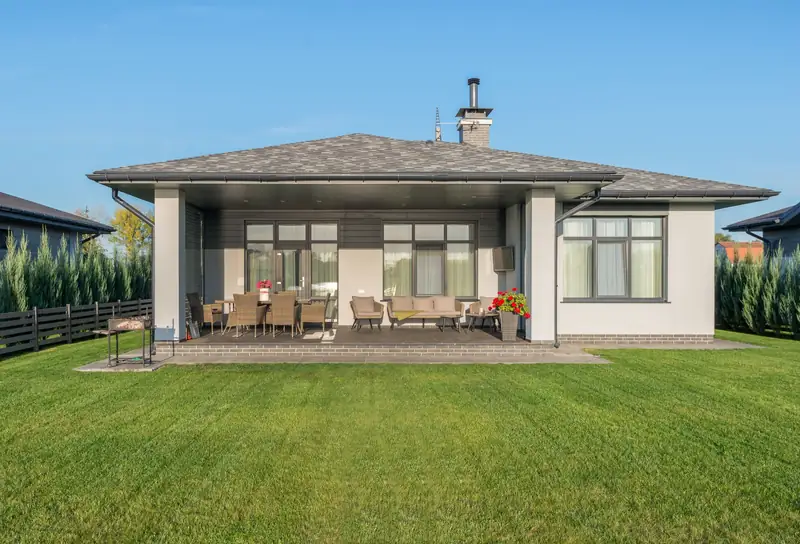
Artificial Turf · Casselberry, FL
Artificial Turf for Casselberry Yards
Artificial turf in Casselberry falls in the $10–$25 sq ft installed market range as of October 2026. The state's turf-construction rule sets a 10-foot setback from most water bodies, a detail that matters more here than in a landlocked town, given how many Casselberry lots touch a lake.
By the Opera Concrete & Pavers estimating team · Updated October 1, 2026
Get a free estimate
Tell us about the project and we'll call to set up a free site visit.
Turf going in near the edge of a Casselberry lake lot, worked out in square feet
Take a Casselberry backyard that slopes down toward one of the city's smaller lakes, where 450 square feet of lawn close to the shoreline keeps drowning out during the wet season. At $10–$25 per sq ft installed, that area runs roughly $4,500 to $8,100 to convert to turf, with the installer pulling the setback line 10 feet back from the water's edge before laying out the washed base, which on a narrow lakefront lot can trim the usable turf footprint more than the square-footage math alone would suggest.
Why the water-body setback carries extra weight in a city of lakes
Florida's Rule 62-308.100 keeps new turf at least 10 feet from a pond, lake or canal unless a seawall sits between the two, on top of requiring a washed base, natural infill and no buried irrigation line underneath (Florida Administrative Code, Rule 62-308.100). With more than two dozen named lakes inside roughly 8 square miles, that setback is a live measurement question on a meaningfully larger share of Casselberry yards than it would be in a town with one or two ponds (City of Casselberry, General Information).
How a backyard putting green is built differently from the surrounding lawn
A putting surface uses a shorter, denser nylon or polyethylene face than a lawn-style turf panel, run with little or no infill so the ball rolls true instead of catching on loose sand or rock. Where a fringe of taller turf surrounds the green, that section is built, seamed and sometimes infilled more like a standard lawn, so the two sections meet at a visible but clean line. Florida's rule allows green synthetic turf without restriction on color, which covers both the putting surface and the fringe around it. On a Casselberry green, the cup and flagstick positions get set after the base is finished, not before, so the surface isn't disturbed.
What state law does and doesn't let an HOA restrict
F.S. 125.572 limits how far a local government can go in regulating residential turf once it meets the state's construction rule, and separately, F.S. 720.3045 keeps most homeowners' associations from blocking turf that isn't actually visible from the street or a neighboring lot, unless the association's own documents say otherwise (F.S. 125.572; F.S. 720.3045). Turf itself also drops off the twice-weekly SJRWMD irrigation calendar that governs sod across the rest of a Casselberry property (SJRWMD Watering Restrictions).
Grading the base around a pool deck so turf drains away from the coping
Turf set against a pool deck has one job the base has to support: moving splash-out and rain away from the coping instead of toward it. The compacted aggregate base around a Casselberry pool gets graded with a gentle slope off the deck's edge, and the subgrade under it follows the same washed-rock, no-fines rule as every other part of the yard. Pool equipment pads, skimmer lines and deck drains all have to stay clear and functional once the turf is in, which means the base is built around them rather than over them, with the final grade checked at the coping before the turf is rolled out.
What happens when the base under turf isn't washed crushed rock
Limerock or road base with fines is cheaper and more common than washed crushed rock, which is exactly why it shows up under turf installs that skip the step DEP Rule 62-308.100 requires. Fines bind together once compacted and wet, sealing the subgrade instead of letting water pass through it, so a lawn that looked fine on a dry day in Casselberry starts holding standing water under the turf after the first real storm. The turf itself doesn't fail in that scenario, the base does, and by the time it shows up as a soft or soggy spot, the turf has to come up to fix what's underneath it.
Scheduling a turf install around Central Florida's rainy season
Base compaction needs dry, workable soil, which is harder to find in Casselberry between late May and mid-October, when afternoon storms are a near-daily pattern across both Central Florida and the Suncoast. A base compacted while saturated won't reach the density the job needs, and it can seal into a dense, impermeable layer that then fights the rule's percolation requirement instead of meeting it. Scheduling the grading and base lifts for a morning window, ahead of the typical afternoon buildup, keeps the material workable. Turf placement and seaming are far less weather-sensitive than the base work underneath them, so a stretch of wet afternoons affects the timeline more than it affects the finish.
Keeping septic access clear under a turf lawn
DEP Rule 62-308.100 requires septic tank access to stay reachable even with turf installed over or near the drain field, which in practice means the access lid location on a Casselberry property is marked and either left turf-free or fitted with a removable panel rather than nailed down like the rest of the lawn. Pump-out crews need to reach that lid without cutting turf to find it, so marking the location clearly at installation saves a repair later. A turf panel nailed solid over a septic lid turns a routine pump-out into an unplanned turf repair.
Frequently asked questions
Does Casselberry's lake density change the turf setback rule?
The 10-foot setback from a pond, lake or canal is set by state rule, not by the city, but because Casselberry has more than two dozen named lakes in a small area, the rule applies to a larger share of yards here than in most nearby towns.
Can turf go right up to a Casselberry lake's edge if there's a seawall?
The state rule's setback is waived specifically where a seawall separates the turf from the water, so a seawalled lot can generally run turf closer to the shoreline than an unwalled one.
Does artificial turf near a Casselberry lake still need the SJRWMD watering schedule?
No. Once a lawn is turf rather than irrigated sod, there's no sprinkler zone left for the district's twice-weekly schedule to apply to, regardless of how close the lot sits to the water.
Sources
- City of Casselberry, General Information
- City of Casselberry, Building Division
- Casselberry Zoning Ordinance Ch. II, Table 2-5.4 (via Municode)
- Seminole County Water Atlas, Lake Kathryn
- Seminole County Water Atlas, Lake Concord
- Census Reporter, Casselberry, FL
- Census Reporter API, Casselberry median year structure built (B25035)
- SJRWMD Watering Restrictions
- Florida Administrative Code — Rule 62-308.100, Synthetic Turf (effective May 19, 2026)
- Florida Statutes §125.572 — synthetic turf on single-family lots
- F.S. 720.3045 (2026) Installation, display, and storage of items
- NRCS OSD Myakka
Ready for a price on your project?
Request a free estimate
Tell us about the project and we'll call to set up a free site visit.