
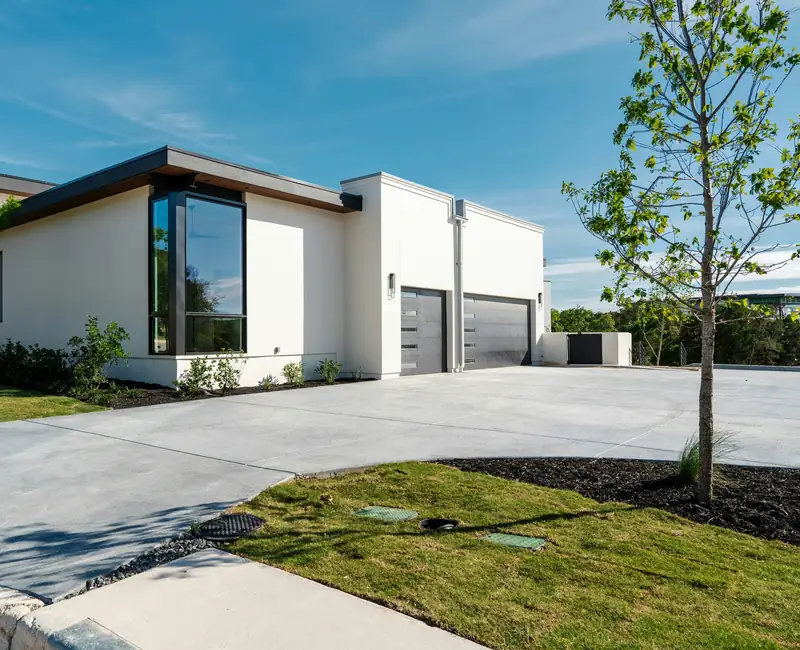
Concrete Driveways · Longwood, FL
Pouring a Concrete Driveway in Longwood
Pricing a concrete driveway in Longwood this October lands in the $6–$15 per sq ft installed market range. What changes from one Seminole County address to the next is the review process: inside Longwood's limits, the city's own right-of-way permit applies, and a driveway crossing a roadside ditch needs an actual culvert pipe, not a graded dip.
By the Opera Concrete & Pavers estimating team · Updated October 1, 2026
Get a free estimate
Tell us about the project and we'll call to set up a free site visit.
A city permit, not a county one, and a real culvert underneath
Longwood's right-of-way permit covers driveway reconstruction directly, for a $25 residential fee filed through the city's online portal, separate from the driveway application Seminole County runs for unincorporated addresses (City of Longwood, Right-of-Way Permit). Where the lot backs onto a roadside swale, the city's manual of standards requires a minimum 15-inch culvert pipe with mitered ends or a concrete headwall under the new slab; a swaled crossing with no pipe at all isn't an option the manual allows (City of Longwood, Manual of Standards).
Grading the Driveway Away From the Garage Slab
A driveway that slopes toward the garage instead of away from it sends every afternoon storm straight at the house. Florida code requires fill to be compacted for uniform support, and part of getting that right is shaping the subgrade so water sheets off the surface and away from the foundation rather than pooling at the threshold. On a flat Longwood lot, that sometimes means building the far edge of the driveway up slightly more than the garage end, even when the difference is not visible to the eye. It matters most on flatwoods soils that already hold water close to the surface for months at a time.
Fifty-five percent of the lot, driveway included
In Longwood's low-density residential district, the city's impervious-area worksheet treats a driveway as part of a single 55 percent ceiling that also covers the house, any patio and the pool deck (City of Longwood, Impervious Surface Calculation Form). A lot that already carries a full house footprint and a side patio can run into that number faster on a widened driveway than the driveway's own square footage would suggest on its own, which is worth checking against the worksheet before a width gets finalized.
Timing the Saw Cut Changes What the Joint Looks Like
A control joint cut too late can miss the crack it was meant to control, and one cut too early can tear the surface instead of slicing it cleanly. Early-entry saws go in about 1 to 4 hours after finishing, while a conventional wet saw waits 4 to 12 hours until the concrete has firmed up enough to cut without ravelling the edge. The right window shifts with temperature and humidity on a given Longwood pour day, which is why we watch the slab rather than work off a fixed clock. Getting this step wrong shows up later as a ragged joint edge or a crack that wandered off the cut line.
Replacing a 1980s driveway with a culvert crossing, worked out in square feet
Take a Longwood home built around the city's 1983 median construction year, where the original 10 by 22 foot driveway, 220 square feet, has cracked at the swale crossing. At $6–$15 per sq ft installed, a straight repour at that footprint runs roughly $1,320 to $3,300 before the permit fee, and because the lot backs onto a drainage ditch, the bid also has to cover a new 15-inch culvert pipe under the slab rather than reusing whatever shallow dip was there originally. Widening that same driveway to 24 feet for a second vehicle adds real square footage against the district's 55 percent ceiling, not just against the driveway's own budget.
Working Around Afternoon Storms Instead of Through Them
Central Florida's rainy season typically runs from late May into October, with afternoon storms that build fast on a summer day. Scheduling a Longwood pour during that stretch, we plan around the forecast rather than hoping the rain holds off, because fresh concrete caught in a downpour before it sets can wash out the surface finish or dilute the top layer. Morning pours give the slab more time to firm up before a typical afternoon storm arrives. Outside the rainy season, the schedule has more flexibility, but we watch the forecast the same way on every job regardless.
A Settling Driveway and a Sinkhole Aren't the Same Thing
Most cracked or uneven driveways are settlement, not sinkholes: a sign the base underneath was not compacted enough or that soil beneath the fill shifted over time. A true catastrophic ground cover collapse under Florida law involves a sudden, visible depression and structural damage, not a slowly widening crack at a control joint. Orange County sits on the state's broader list of counties with concentrated sinkhole claims; Sarasota and Manatee do not. Either way, a Longwood homeowner seeing gradual unevenness in a driveway is almost always looking at a compaction or drainage issue a contractor can diagnose, not a geological event that needs reporting to the state.
Watching for Root Heave Before It Becomes a Crack
A slab edge that starts to tent or lift slightly near a mature oak is an early sign of root growth underneath, worth noticing before it turns into a full crack. Orlando and Winter Park both regulate trees at 6 inches in diameter by ordinance, so the right first move in a Longwood yard with a protected tree nearby is checking the local rule, not reaching for a shovel or a saw. Catching heave early sometimes lets a contractor address the slab section without disturbing the root system at all, where waiting until the crack is severe narrows the options considerably.
Frequently asked questions
Is a Longwood driveway permit the same application as Seminole County's?
No. Inside Longwood's city limits, the driveway goes through the city's own right-of-way permit for $25. Just outside the city limits, the same work falls to Seminole County's separate driveway construction application.
What happens if a Longwood driveway crosses a roadside ditch?
The city's manual of standards requires a minimum 15-inch culvert pipe with mitered ends or a concrete headwall under that section of driveway. A graded swale dip with no pipe isn't an accepted substitute.
Does a driveway count toward Longwood's 55 percent coverage limit?
Yes, in the low-density residential district the driveway is part of the same impervious-area total as the house, patio and pool deck, capped at 55 percent of the lot under the city's worksheet.
Sources
- City of Longwood, Right-of-Way Permit
- City of Longwood, Manual of Standards for City Streets and Stormwater Systems
- City of Longwood, Impervious Surface Calculation Form
- City of Longwood, Historic District
- Wikipedia, Longwood Historic District
- Census Reporter, Longwood, FL
- Census Reporter API, Longwood median year structure built (B25035)
- SJRWMD Watering Restrictions
- Florida Administrative Code — Rule 62-308.100, Synthetic Turf (effective May 19, 2026)
- Florida Statutes §125.572 — synthetic turf on single-family lots
- F.S. 720.3045 (2026) Installation, display, and storage of items
- NRCS OSD Smyrna
Ready for a price on your project?
Request a free estimate
Tell us about the project and we'll call to set up a free site visit.