
Concrete Patios · Lakewood Ranch, FL
Building a Concrete Patio in Lakewood Ranch
A concrete patio in Lakewood Ranch runs $6–$13 per sq ft installed as of October 2026. On the Manatee side, a non-structural patio skips the county's building permit, though a slab poured with footers or one tied into a pool still needs one, and the community's own design review runs separately either way.
By the Opera Concrete & Pavers estimating team · Updated October 1, 2026
Get a free estimate
Tell us about the project and we'll call to set up a free site visit.
A lanai patio extension, worked out in square feet
Say a 14 by 16 foot lanai extension, 224 square feet, adds a sitting area off the back of a screened pool cage on a lot that backs onto one of the community's lakes. At $6–$13 per sq ft installed, that runs $1,344 to $2,912, or roughly $1,568 to $2,240 in the typical $7–$10 band for a broom-finished slab tied into the existing cage footing. Because the addition is non-structural and stays on grade, it's the kind of scope that clears Manatee's no-permit list; the design still goes to Community Association Services separately.
Why a non-structural patio skips the county permit, but a pool tie-in doesn't
Manatee County's current no-permit list puts a “non-structural concrete/paver patio” under work that doesn't need a building permit, while a “concrete slab with footers” or anything tied to a swimming pool still requires one (Manatee County, What Does Not Require a Permit). That exemption is about the county's building permit specifically, not about the community's own layer: a patio is still the kind of exterior change Community Association Services reviews on its own track, separate from whether the county needed paperwork first.
Weathering Class Changes the Psi a Covered Lanai Needs
Florida's residential code sets different minimum strengths for exterior flatwork depending on weathering exposure, 2,500 psi at the lightest category, climbing to 3,000 and 3,500 psi as exposure gets more severe, the same table that governs porches and carports. Which category a Lakewood Ranch patio falls into, open to the sky versus covered by a lanai roof, is not something we assume from the job site; it is a classification the local building official applies, and getting the psi right starts with confirming that classification rather than defaulting to whichever number sounds safest. A patio built to a higher strength than its exposure calls for is not a mistake, but it is money spent on margin nobody required.
Extending a lanai patio behind a home built after 2014
Because most Lakewood Ranch homes are recent, the screened pool cage and its original patio slab are usually part of the same build rather than a later addition. Extending that patio, toward a lake view or a fairway on the lots that back onto one, typically means tying a new edge into the existing slab rather than pouring under the screen frame itself, and matching the finish and slope of concrete that's rarely more than a decade old. A pool deck extension follows the same logic on a lot where the cage and the patio were poured together.
Why a Patio's Base Doesn't Need a Driveway's Depth
A patio never carries a car's rolling weight, which is why paver base guidance calls for at least 4 inches of compacted aggregate on well-drained soil under a patio or walkway, against 6 inches under a residential driveway. Florida's residential code still treats the ground under a Lakewood Ranch patio the same as any other slab on the ground: fill compacted for uniform support, topped with at least 4 inches of clean graded sand, gravel or crushed stone. On flatwoods soils like Myakka, Smyrna or EauGallie, which hold a water table within 18 inches of the surface part of the year, that lighter design load doesn't make the base work optional, only right-sized for what will actually sit on it.
A Fenced Backyard Changes How a Hot Pour Dries
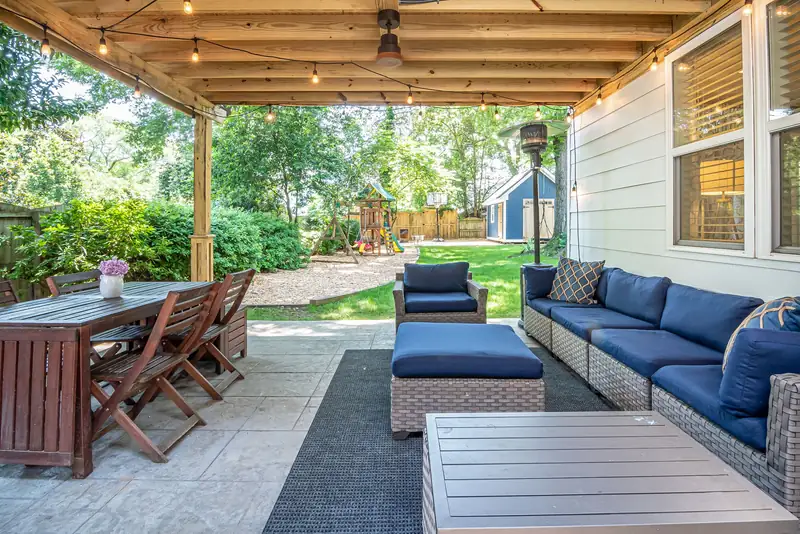
A fenced backyard or a patio boxed in by a pool cage and tall landscaping can trap heat and cut the wind that would normally help a hot pour evaporate at a predictable rate, which changes the plastic-shrinkage math a Lakewood Ranch crew plans around compared with an open, wind-exposed driveway. Less wind can lower the evaporation rate, which sounds like an advantage, but a boxed-in yard also traps radiant heat from fences and walls, so the net effect on a given lot is not automatic either way. Reading the actual microclimate of a specific backyard, rather than applying the same hot-weather plan used on every job, is what keeps a shaded or enclosed pour from surprising the crew.
When a Patio's Paperwork Crosses the Notice of Commencement Line
A direct contract over $2,500 requires a Notice of Commencement recorded and posted before work starts, and a modest Lakewood Ranch patio poured on open ground can sometimes land under that line on its own. Add a lanai's footers, a larger footprint or an outdoor kitchen's built-in features, though, and the same job can cross both the $2,500 lien-law threshold and the $5,000 mark where the permitting authority wants a copy of the notice filed before the first inspection. Scoping the paperwork alongside the design, rather than after a contract is signed, keeps a patio project from hitting a recording requirement nobody budgeted time for.
Algae Finds a Broom Finish Faster Than a Sealed One
A broom finish's texture holds surface moisture longer after rain than a sealed, stained or exposed-aggregate surface does, which is part of why a shaded section of a Lakewood Ranch patio, under a lanai roof or a stand of mature trees, tends to show algae or mildew discoloration before an open, sun-exposed section of the same pour does. Rinsing or lightly pressure washing a shaded patio on a tighter schedule than the sunny parts of the yard, rather than waiting for the whole patio to look dull, keeps that growth from working its way into the surface texture where it is harder to remove later.
Frequently asked questions
Does a concrete patio need a county permit in Lakewood Ranch?
On the Manatee side, a non-structural concrete or paver patio is on the county's own no-permit list. A slab poured with footers, or one tied into a pool, still needs a permit either way.
Does the community still review a patio that's exempt from the county permit?
Yes. The county's exemption only covers the building permit; exterior changes like a new patio still go through Community Association Services on a separate track.
Can I extend my patio toward the lake on my lot?
Usually, as long as the extension stays on grade and ties into the existing slab. The lake frontage itself doesn't add a separate rule beyond the standard county and community review, but a CDD-maintained easement near the water's edge is worth checking before finalizing the layout.
Sources
- Census Reporter, Lakewood Ranch CDP FL (ACS 2020-2024 5-yr, B01003/B25035)
- Census Reporter geography parents, Lakewood Ranch CDP
- Census 2024 Gazetteer, Florida places
- Lakewood Ranch / Schroeder-Manatee Ranch, About Us
- Lakewood Ranch Town Hall, CEVA Homeowners' Manual 2022
- Lakewood Ranch CEVA Modification Request Form
- Lakewood Ranch GBVA-SRVA Modification Request Form
- Manatee County LDC §1004.2 Access and Drainage Permit
- Manatee Driveway and Culvert Application (2022)
- Manatee — Request a Driveway or Culvert Permit
- Manatee — Inspections Required for Paver Driveways
- Manatee — What Does Not Require a Permit (6-16-26)
- Manatee County LDC §511.16 Swimming Pools, Spas, Screen Enclosures
- Sarasota County Code §124-48 Right-of-Way Use Permit
- Sarasota County Code §98-3 Driveway culvert / ROW use permit fees
- Sarasota County Code §124-255 Additional Provisions (culverts)
- Sarasota County Code §22-63 (retaining walls > 4 ft engineered)
- Sarasota County Building (search excerpt; 403 to direct fetch)
- SWFWMD District Water Restrictions
- Manatee County - Modified Phase III water shortage restrictions
- NRCS OSD Myakka
- NRCS OSD EauGallie
- NRCS OSD Immokalee
- Florida Administrative Code — Rule 62-308.100, Synthetic Turf (effective May 19, 2026)
- Florida Statutes §125.572 — synthetic turf on single-family lots
- F.S. 720.3045 (2026) Installation, display, and storage of items
Ready for a price on your project?
Request a free estimate
Tell us about the project and we'll call to set up a free site visit.