
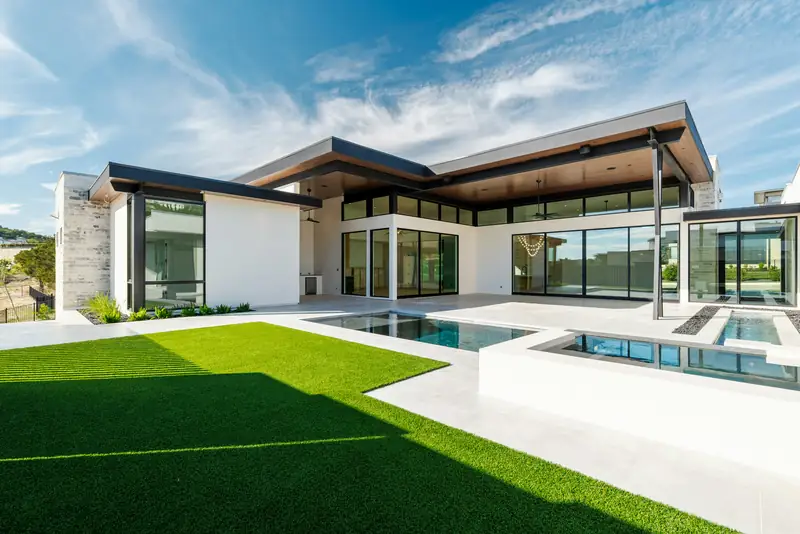
Concrete Pool Decks · Lakewood Ranch, FL
Concrete Pool Decks for New-Build Lakewood Ranch Homes
A concrete pool deck in Lakewood Ranch runs $5–$15 per sq ft installed as of October 2026. With a median home built in 2014, most pool decks here are a first install poured alongside the shell rather than a resurfacing job, and Manatee County sets a 5-foot setback from a lot line or shoreline for the deck itself.
By the Opera Concrete & Pavers estimating team · Updated October 1, 2026
Get a free estimate
Tell us about the project and we'll call to set up a free site visit.
Why so many Lakewood Ranch pool decks are a first install
The community's newer housing stock means a pool deck here is more often part of a new build or a recent add-on pool than a replacement of something original to a decades-old home, a pattern that shows up less in the Sarasota unit's older towns. The deck's slope to the drains and its expansion joints at the coping still matter the same way on a new pour as on an older one; what changes is that the site visit is checking a shell contractor's layout rather than an existing deck's wear.
Bullnose and Cantilever Coping: Two Ways to Finish the Pool Edge
A cantilevered concrete coping, poured as a thickened, rounded edge of the deck itself that overhangs the pool's bond beam by a couple of inches, is the standard detail on a poured concrete deck, finished smooth enough to be comfortable against bare skin. Some Lakewood Ranch homeowners instead set a separate precast bullnose coping unit at the pool's edge and pour the field deck up to it, which gives a sharper material contrast but adds another joint to detail correctly. Either approach still needs the same isolation gap between the coping and the bond beam underneath it; the coping style doesn't change that requirement.
A new pool deck on a lake lot, worked out in square feet
Say a new pool build on a lake-facing lot pours a 650 square foot deck around the shell. At $5–$15 per sq ft installed, that lands between $3,250 and $9,750, narrowing to roughly $4,550 to $7,800 in the typical $7–$12 band depending on the finish. Because the lot backs onto the water, the deck's edge gets held back at least 5 feet from the shoreline under the county's pool-code setback, which on a narrower lake lot can be the dimension that sets how large the deck can actually be before the pool contractor even finalizes the shell's position.
The county's 5-foot setback from a lot line or shoreline
Manatee County's pool-code section sets single-family pool decks on grade at least 5 feet from any lot line or shoreline in the side or rear yard, and the same section states that a pool, cage, deck or patio isn't treated as a yard encroachment (Manatee County LDC §511.16). On a lot that backs directly onto one of the community's lakes, that “shoreline” language is the number that decides how close the deck's edge can run to the water, not just the rear property line.
Plastic Shrinkage Cracking on a Deck With No Shade
An open pool deck with no tree cover and no screen cage yet is about as exposed as flatwork gets, which means the evaporation threshold that triggers plastic shrinkage cracking, roughly 0.2 pounds per square foot per hour, gets crossed more easily there than on a shaded driveway pour the same afternoon. The cracks that result are thin, usually a few feet apart, and show up within hours of finishing rather than developing over time. On a hot, breezy Lakewood Ranch pour day, windbreaks, a fog spray and a dampened subgrade all reduce that risk, but only if the crew is watching conditions rather than working off a fixed schedule.
Slope Has Two Jobs on a Pool Deck, Not Just One
A patio only needs to slope away from the house. A pool deck does that too, but it also has to carry water toward deck drains or a perimeter channel without letting it pool against the coping or run back into the pool itself. We set that two-direction grade into the subgrade before any base goes down, typically shaping a slight fall from the house side out to the drain line rather than one flat pitch across the whole deck. Skip that step on a Lakewood Ranch job and an afternoon storm leaves standing water right where people walk barefoot between the pool and the house, long after the rest of the yard has drained.
Applying the Kool Deck-Style Coating After the Base Cures
A spray texture coating doesn't go on the same day as the base slab pour, it waits until the concrete underneath has cured enough to take the topping without trapping moisture or causing bond problems. On a Lakewood Ranch job, that usually means a gap of at least several days between the structural pour and the coating step, timed around the same curing standard as the base slab rather than rushed to finish sooner. Skipping ahead on that timeline is one of the more common reasons a coating delaminates or blisters within the first season, since it never had a fully cured, dry surface to bond to.
Watching the Isolation Joint's Sealant Over Time
The flexible sealant in a pool deck's isolation joint takes the brunt of the deck and the pool shell moving independently, year after year, and it wears out well before the concrete on either side of it does. A Lakewood Ranch homeowner who checks that joint once or twice a year for cracking, gaps or sections where the sealant has pulled away from either surface catches a failing joint while a simple recaulk still fixes it. Letting a failed isolation joint go unaddressed defeats the whole purpose of having built it in the first place, since water and debris start working into exactly the gap the deck needed protected.
Frequently asked questions
Why are most pool decks in Lakewood Ranch new rather than resurfaced?
The community's median home was built in 2014, the newest in the Sarasota unit, so most pool decks are still close to their original pour rather than old enough to need resurfacing.
How close to the water can a pool deck be built on a lake lot?
Manatee County's pool-code section sets a 5-foot minimum from any lot line or shoreline in the side or rear yard for a pool deck on grade, which applies directly to lots backing onto one of the community's lakes.
Does a pool deck count as a yard encroachment in Manatee County?
No. The same county code section that sets the 5-foot setback also states that single-family pools, cages, decks and patios aren't considered a yard encroachment.
Sources
- Census Reporter, Lakewood Ranch CDP FL (ACS 2020-2024 5-yr, B01003/B25035)
- Census Reporter geography parents, Lakewood Ranch CDP
- Census 2024 Gazetteer, Florida places
- Lakewood Ranch / Schroeder-Manatee Ranch, About Us
- Lakewood Ranch Town Hall, CEVA Homeowners' Manual 2022
- Lakewood Ranch CEVA Modification Request Form
- Lakewood Ranch GBVA-SRVA Modification Request Form
- Manatee County LDC §1004.2 Access and Drainage Permit
- Manatee Driveway and Culvert Application (2022)
- Manatee — Request a Driveway or Culvert Permit
- Manatee — Inspections Required for Paver Driveways
- Manatee — What Does Not Require a Permit (6-16-26)
- Manatee County LDC §511.16 Swimming Pools, Spas, Screen Enclosures
- Sarasota County Code §124-48 Right-of-Way Use Permit
- Sarasota County Code §98-3 Driveway culvert / ROW use permit fees
- Sarasota County Code §124-255 Additional Provisions (culverts)
- Sarasota County Code §22-63 (retaining walls > 4 ft engineered)
- Sarasota County Building (search excerpt; 403 to direct fetch)
- SWFWMD District Water Restrictions
- Manatee County - Modified Phase III water shortage restrictions
- NRCS OSD Myakka
- NRCS OSD EauGallie
- NRCS OSD Immokalee
- Florida Administrative Code — Rule 62-308.100, Synthetic Turf (effective May 19, 2026)
- Florida Statutes §125.572 — synthetic turf on single-family lots
- F.S. 720.3045 (2026) Installation, display, and storage of items
Ready for a price on your project?
Request a free estimate
Tell us about the project and we'll call to set up a free site visit.