
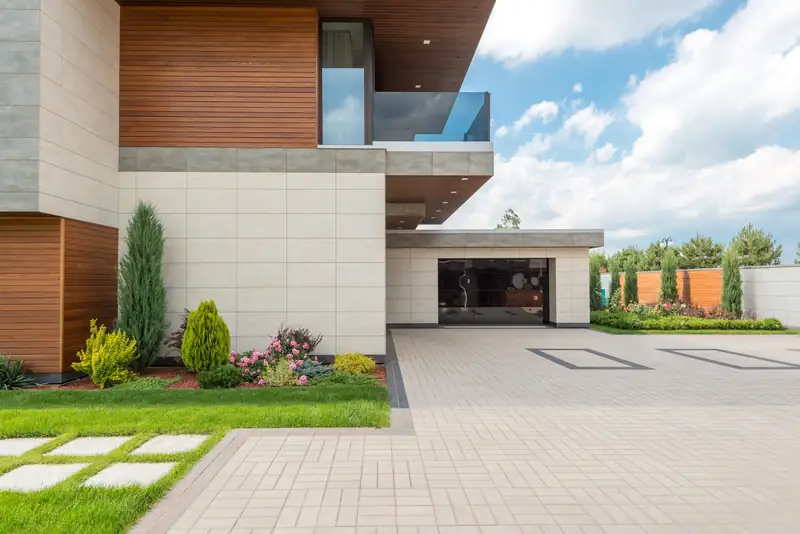
Paver Driveways · Lake Mary, FL
Paver Driveways and Lake Mary's Impervious Surface Rules
A paver driveway in Lake Mary runs $10–$30 per sq ft installed as of October 2026. Unlike a city that sets one flat impervious surface cap, Lake Mary ties its limit to each property's Future Land Use designation, which decides how much room is left for a driveway expansion before the lot maxes out.
By the Opera Concrete & Pavers estimating team · Updated October 1, 2026
Get a free estimate
Tell us about the project and we'll call to set up a free site visit.
Sizing a paver driveway against a lot's ISR room
Consider a Lake Mary home on a residential parcel where the house, existing driveway and a side patio already use a meaningful share of the lot's impervious allowance, and the owner wants to widen a 350 sq ft driveway into a 550 sq ft paver apron, adding 200 sq ft. Pricing the full 550 sq ft at $10–$30 per sq ft installed comes to somewhere between $5,500 and $16,500 depending on the paver chosen. Before ordering material, the city's own ISR figure for that specific land-use designation gets checked against the lot's existing coverage, since the ceiling differs by designation rather than following one flat rule.
The impervious cap moves with the land-use designation, not a single citywide number
Lake Mary's own zoning FAQ breaks the impervious surface ratio down by Future Land Use category: most designations, office, commercial, industrial and public or semi-public land among them, top out at 65 percent, the Downtown Development District and its related overlays allow up to 90 percent, and a High Intensity Planned Development is capped at 65 percent alongside a required 35 percent of open space (City of Lake Mary, FAQ: What is the impervious surface ratio (ISR)?). A homeowner widening a driveway into pavers checks the specific designation attached to the parcel rather than assuming a single citywide percentage applies the way it might in a neighboring city.
Edge restraint: the part of a paver driveway nobody sees
Every paver driveway needs edge restraint along its full perimeter and anywhere the paving material changes, because without it the field has nothing stopping it from spreading sideways under traffic. The spec allows plastic or aluminum restraint on a flexible base, with steel reserved for rigid bases, and it's specific about where the anchoring spikes go: into the compacted aggregate base, never into the surrounding soil. It also rules out one shortcut: the metal edging sold for planting beds isn't an acceptable substitute, even though it looks similar on a hardware store shelf. Once the pavers and joint sand are down, the restraint disappears from view on a Lake Mary driveway, which is exactly why it's worth getting right the first time.
The same Site Construction Permit and percentage fee apply either way
Whether the surface ends up poured concrete or pavers, the application still runs through the city's Site Construction Permit at 1.25 percent of the contract price, $250 minimum (City of Lake Mary, Application Fee Schedule). A plain concrete driveway and a paver one are reviewed on the same fee schedule, so the choice between materials comes down to budget and look rather than a difference in what the city charges to review the plan.
When the subgrade itself needs help before the base goes down
ICPI's spec admits its own 98 percent compaction standard may not be achievable in extremely saturated or very fine soils, and calls for stabilizing the subgrade instead of forcing the number on ground that won't take it. In practice that means dealing with the soil before a single scoop of aggregate base arrives, whether that's letting it dry out, adding a separation layer, or going with a different base depth altogether. A Lake Mary lot with sand over a denser layer behaves differently than one that's sand straight down, and the subgrade step is where that difference gets handled instead of ignored. Skipping it is a common reason a paver driveway starts to dip within a year or two.
What happens when joint sand washes out before it sets
Dry joint sand has to be swept in and compacted to actually lock a paver field together, and until that happens it's just loose material sitting in an eighth-inch gap. A heavy downpour that hits before the compaction pass, a real risk during a wet season that runs roughly late May through mid-October, can wash that sand partway out of a Lake Mary driveway before it ever gets the chance to set. The result isn't just cosmetic: without sand holding the joints, individual pavers can shift and rock under tire loads, which accelerates wear at the exact spots where the sand is thinnest. Re-sanding a washed-out joint is a straightforward fix, but it's one more trip that careful sequencing avoids.
What a crew checks before a single paver goes down
By the time the first paver is set, the base underneath has already been checked against two separate numbers: compaction density, tested to at least 98 percent of standard Proctor for a driveway, and surface tolerance, held to plus or minus three-eighths of an inch over a 10-foot span. Both checks happen before the bedding sand is even screeded, because fixing a low spot in the base is straightforward and fixing one after the pavers are set is not. On a Lake Mary job, that inspection step is the quiet middle of the process, sandwiched between the excavation everyone notices and the finished surface everyone sees, and it's the part that decides how the driveway looks in two years, not two days.
Pulling weeds and moss out of the joints
Joint sand that's thinned out from washing or wear leaves an opening for weed seeds and, in a shaded or damp section of a Lake Mary driveway, for moss or algae to take hold between the pavers. Pulling growth by hand or with a joint-safe tool and resweeping fresh sand into the gap afterward keeps the problem from spreading to neighboring joints, since one open seam tends to collect debris that the next one catches too. A driveway with a stabilized or polymeric joint resists this far better than one with plain dry sand, which is one of the trade-offs worth weighing against the lower upfront cost of the standard spec.
Frequently asked questions
Does Lake Mary use one impervious surface limit for every property?
No. The city ties the cap to each lot's Future Land Use designation, ranging from 65 percent in most categories up to 90 percent in the Downtown Development District and its overlays (City of Lake Mary, FAQ: What is the impervious surface ratio (ISR)?).
Does a paver driveway cost more to permit than a concrete one in Lake Mary?
No. Both go through the same Site Construction Permit at 1.25 percent of the contract price, so the fee tracks the job's dollar value rather than the surface material chosen.
What is a High Intensity Planned Development's impervious limit in Lake Mary?
65 percent, the same ceiling as most standard designations, but paired with a required minimum of 35 percent open space on the property (City of Lake Mary, FAQ: What is the impervious surface ratio (ISR)?).
Sources
- Census Bureau PEP, City and Town Population Totals, Vintage 2025 (July 1, 2025)
- Seminole County — Residential Driveway Construction Application
- Seminole County — New State Legislation Affecting Permits
- SJRWMD Watering Restrictions
- Florida Dept. of State - State Soil
- Florida Administrative Code — Rule 62-308.100, Synthetic Turf (effective May 19, 2026)
- Florida Statutes §125.572 — synthetic turf on single-family lots
- Census Reporter, Lake Mary FL (ACS 2020-2024 5-yr, B01003/B25035)
- Wikipedia, Lake Mary, Florida
- Wikipedia, Heathrow, Florida
- City of Lake Mary, Building Division
- City of Lake Mary, Permit Exemption (HB 803)
- City of Lake Mary, Application Fee Schedule
- City of Lake Mary, FAQ: What is the impervious surface ratio (ISR)?
- City of Lake Mary, Planning & Zoning FAQs
- City of Lake Mary Code of Ordinances §157.12, Arbor Permit Required
- Seminole County Water Atlas, Learn More: Soils
Ready for a price on your project?
Request a free estimate
Tell us about the project and we'll call to set up a free site visit.