
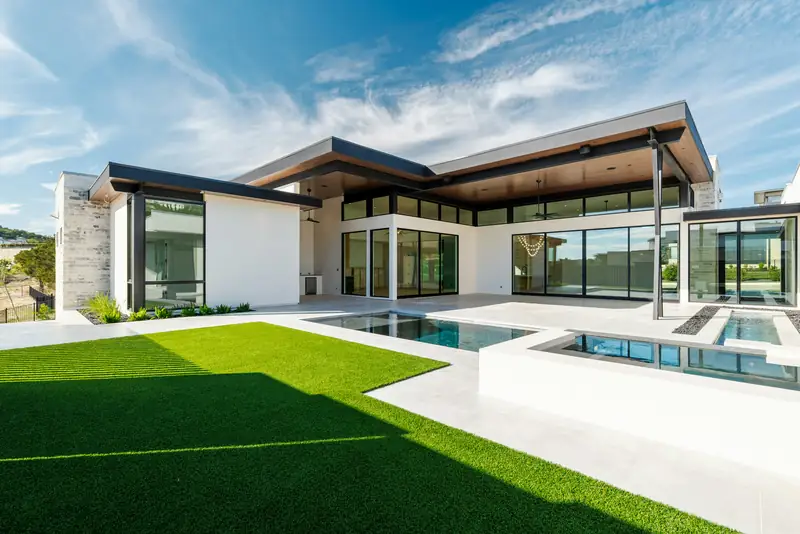
Concrete Pool Decks · Lake Mary, FL
Concrete Pool Decks for Lake Mary Homes
As of October 2026, a concrete pool deck in Lake Mary runs $5–$15 per sq ft installed in the Florida market. The city's own zoning rule sets how close a pool and its screen enclosure can sit to the rear lot line, a number that shapes the deck's footprint on a standard residential lot.
By the Opera Concrete & Pavers estimating team · Updated October 1, 2026
Get a free estimate
Tell us about the project and we'll call to set up a free site visit.
A 10-foot and 3-foot setback frame the deck before the pool shell goes in
Lake Mary's Planning & Zoning guidance allows a swimming pool to sit as close as 10 feet to the rear lot line in regular residential zoning districts, with the surrounding screen enclosure allowed to 3 feet from that same line (City of Lake Mary, Planning & Zoning FAQs). That gap between the two numbers is where most of a pool deck's usable footprint actually sits, since the enclosure can push closer to the property line than the water itself.
Flatwoods Soil Under a Pool Deck Behaves Differently Than Under a House
A lot of Lake Mary pool decks sit on flatwoods soils such as Myakka or Smyrna, where the seasonal high water table can sit within 18 inches of the surface for part of the year. Around a pool, that same wet ground often holds backfill from the pool excavation itself, placed around the shell before the deck base goes in. We test that backfill for compaction separately from the surrounding yard, since loosely dumped excavation spoil behaves nothing like native soil under a plate compactor. A deck poured over an uncompacted backfill ring settles in a shape that tracks the pool's outline, not the shape of a normal soft spot.
The deck's added surface still counts toward the lot's ISR figure
A new pool deck is new impervious surface, counted the same way a driveway or patio addition is against whatever Future Land Use designation governs that lot's impervious ceiling (City of Lake Mary, FAQ: What is the impervious surface ratio (ISR)?). A paver pool deck adds to that same total, so the setback and the ISR number both get checked before the deck's final dimensions are drawn.
Control Joint Spacing Around a Curved Pool Shape
NRMCA's joint spacing guidance, about 8 to 12 feet apart on a 4-inch slab and never past roughly 15 feet, still applies around a free-form pool, but laying it out takes more judgment than on a rectangular driveway. We run joints radially from the pool's curve where the shape allows it, keeping each panel close to square rather than letting a long, narrow sliver form along a tight bend. On a Lake Mary deck with a kidney-shaped or free-form pool, grid lines laid in straight rows regardless of the pool's outline leave slivers that end up cracking off the cut line entirely.
Laying out a deck against the rear setback
Take a standard Lake Mary lot adding a new pool with a screen cage set 3 feet off the rear line and the water itself held to the 10-foot pool setback, leaving a 620 sq ft deck between the house and the cage. Figuring $5–$15 per sq ft installed puts that job between roughly $3,100 for a plain broom finish and $9,300 for a decorative cool-touch surface. Running the enclosure to the 3-foot line rather than further back is what lets the deck and pool fit the lot without pushing into the required rear yard space.
Why We Start Early on a Hot, Open Pour
A pool deck usually sits wide open to direct sun with no roof or tree cover until the screen cage goes up, which pushes evaporation rates higher than a shaded driveway pour sees on the same morning. Hot-weather guidance calls for avoiding the hottest part of the day and getting curing started as soon as finishing wraps up, and that matters more on a deck than almost anywhere else on a Lake Mary property, since there's so little shade working in the crew's favor. Starting before sunrise on a summer pour buys real working time before the surface starts drying faster than the slab underneath can gain strength.
Plastic Shrinkage Cracking on a Deck With No Shade
An open pool deck with no tree cover and no screen cage yet is about as exposed as flatwork gets, which means the evaporation threshold that triggers plastic shrinkage cracking, roughly 0.2 pounds per square foot per hour, gets crossed more easily there than on a shaded driveway pour the same afternoon. The cracks that result are thin, usually a few feet apart, and show up within hours of finishing rather than developing over time. On a hot, breezy Lake Mary pour day, windbreaks, a fog spray and a dampened subgrade all reduce that risk, but only if the crew is watching conditions rather than working off a fixed schedule.
Keeping Deck Drains Clear Before the Rainy Season
A deck drain clogged with leaves, pine straw or pool debris stops doing its job exactly when an open, sun-exposed deck needs it most, during a hard afternoon storm typical of the rainy season running roughly from late May into October. Clearing drain inlets and the low points leading to them a few times a year, and especially right before that season starts, keeps water moving the way the two-direction slope was built to send it. On a Lake Mary deck, a clogged drain usually shows up first as standing water pooling right at the inlet rather than anywhere else, an easy spot to check during a routine walk-through.
Frequently asked questions
How close to the rear lot line can a Lake Mary pool sit?
As close as 10 feet in regular residential zoning districts, with the screen enclosure around it allowed to 3 feet from that same line (City of Lake Mary, Planning & Zoning FAQs).
Does a Lake Mary pool deck count toward the lot's impervious surface limit?
Yes, the same as any other new paved surface, counted against whatever ISR ceiling applies under the lot's Future Land Use designation.
Can pavers go over an existing Lake Mary pool deck instead of a full tear-out?
Often, as an overlay, following the same Site Construction Permit process as new construction; how far the original slab has cracked or settled decides whether an overlay holds up long-term.
Sources
- Census Bureau PEP, City and Town Population Totals, Vintage 2025 (July 1, 2025)
- Seminole County — Residential Driveway Construction Application
- Seminole County — New State Legislation Affecting Permits
- SJRWMD Watering Restrictions
- Florida Dept. of State - State Soil
- Florida Administrative Code — Rule 62-308.100, Synthetic Turf (effective May 19, 2026)
- Florida Statutes §125.572 — synthetic turf on single-family lots
- Census Reporter, Lake Mary FL (ACS 2020-2024 5-yr, B01003/B25035)
- Wikipedia, Lake Mary, Florida
- Wikipedia, Heathrow, Florida
- City of Lake Mary, Building Division
- City of Lake Mary, Permit Exemption (HB 803)
- City of Lake Mary, Application Fee Schedule
- City of Lake Mary, FAQ: What is the impervious surface ratio (ISR)?
- City of Lake Mary, Planning & Zoning FAQs
- City of Lake Mary Code of Ordinances §157.12, Arbor Permit Required
- Seminole County Water Atlas, Learn More: Soils
Ready for a price on your project?
Request a free estimate
Tell us about the project and we'll call to set up a free site visit.