
Paver Driveways · Horizon West, FL
Paver Driveways in Horizon West
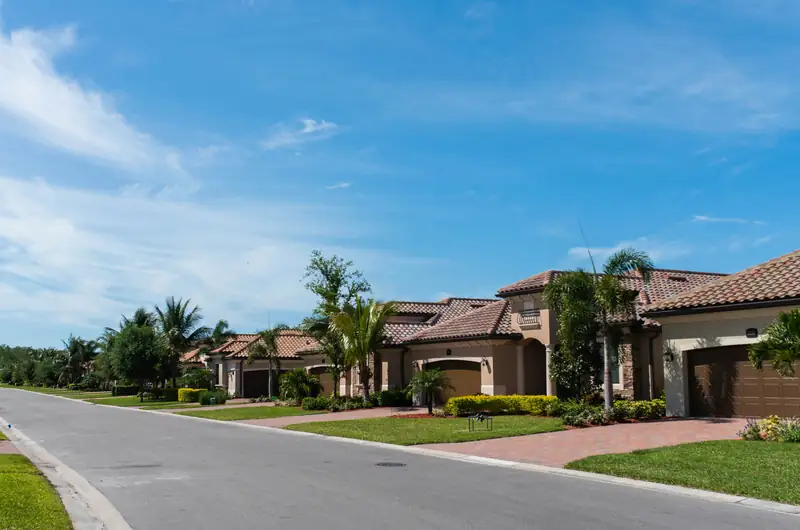
A paver driveway in Horizon West runs $10–$30 per sq ft installed as of October 2026. On the wider, front-loaded lots where a paver driveway is even an option, the county's own design code asks builders to stagger where that driveway sits relative to the house next door, so two identical paver layouts rarely sit side by side.
By the Opera Concrete & Pavers estimating team · Updated October 1, 2026
Get a free estimate
Tell us about the project and we'll call to set up a free site visit.
A randomization rule most homeowners never hear about until they ask
Orange County's design standards for Horizon West direct that front-loaded garages “should randomly alternate the location of driveways in relation to front façade,” a streetscape rule meant to keep a block from reading as a repeating row of identical driveway cuts (Orange County Planning Division, Horizon West Architectural Design Standards Guidebook). A paver driveway replacement on an existing lot doesn't have to meet that standard again since the layout is already built, but it explains why neighboring driveways in the same village rarely line up the way they would in an older, more uniform subdivision.
The permit itself is the same lighter review used countywide
Pavers go through Orange County's residential paver permit rather than the fuller review a poured driveway needs, with a $38 permit fee, a matching $38 Development Engineering review fee, and about 4 business days to turn around once a dimensioned site plan is submitted (Orange County, Residential Pavers). That same zoning code holds residential lots to a 40 percent minimum of private open space, a figure a wide paver driveway on a freshly built Horizon West lot has to leave room for.
When the subgrade itself needs help before the base goes down
ICPI's spec admits its own 98 percent compaction standard may not be achievable in extremely saturated or very fine soils, and calls for stabilizing the subgrade instead of forcing the number on ground that won't take it. In practice that means dealing with the soil before a single scoop of aggregate base arrives, whether that's letting it dry out, adding a separation layer, or going with a different base depth altogether. A Horizon West lot with sand over a denser layer behaves differently than one that's sand straight down, and the subgrade step is where that difference gets handled instead of ignored. Skipping it is a common reason a paver driveway starts to dip within a year or two.
Cutting pavers at the edges takes longer than laying the field
Laying full pavers across the open middle of a driveway moves fast once the bedding sand is screeded flat, course after course set tight against the last one. The borders are a different job: every paver that meets an edge restraint, a garage apron, or an angled property line has to be measured and cut to fit, and a Horizon West driveway with a curved edge or an angled approach can have more border cuts than field pavers in some sections. That work happens with a wet saw, one piece at a time, which is why a crew's pace visibly slows near the edges of a job even though the material and the base underneath haven't changed at all.
A front-loaded paver driveway sized against the open-space minimum, worked out in square feet
Say a 70-foot-wide lot in Lakeside Village, wide enough for a front-loaded garage, lays a 520 square foot paver driveway. At $10–$30 per sq ft installed, that runs roughly $6,240 to $15,600, and because the county's zoning code holds the lot to a 40 percent open-space floor, that 520 square feet gets checked against the porch, walkway and any rear patio before the final width is confirmed.
A driveway built to carry more than a sedan
A standard residential paver driveway is built around the loads a car puts on it, but a boat trailer, an RV, or a loaded work truck asks more of the same surface. ICPI's spec response is layered: a thicker 80 mm paver instead of the usual 60 mm, a base compacted to the stricter modified Proctor standard used for vehicular areas rather than the pedestrian number, and edge restraint that can actually hold the field together under a turning tire. None of those changes are visible once the job is finished, part of why they're easy to skip on a Horizon West quote that never asks what the driveway will actually carry. Specifying the load up front is cheaper than rebuilding a surface that wasn't built for it.
What an HOA can and can't require before you start
An HOA's authority to approve a driveway's look exists only to the extent its declaration or published guidelines actually say so, and Florida law requires that authority to be used reasonably, with a written denial that cites the specific rule being enforced. As of the 2026 statutes, an HOA also can't require a government-issued building permit as a prerequisite just to review a project, which separates the association's own approval step from the city or county's separate permitting process. A Horizon West homeowner inside an HOA is dealing with two different approvals that don't have to happen in a fixed order, and confusing the two is a common way a paver driveway project stalls before it starts.
Resweeping joint sand after a pressure wash
A pressure washer aimed straight down into the joints of a paver driveway does what rain does in miniature: it can blast loose joint sand out from between the units, especially where the sand was never stabilized with a sealer or a polymeric additive. ICPI's spec treats that stabilizer as optional, which means plenty of Horizon West driveways run on plain dry sand that needs resweeping after a thorough cleaning, not just an occasional touch-up. Washing at an angle rather than straight down, and keeping the pressure moderate near the joints specifically, slows how often that resweep is needed, but it doesn't eliminate the job on a surface built with the standard, unstabilized joint.
Frequently asked questions
Does Horizon West's design code control where a paver driveway sits on the lot?
For new construction on front-loaded lots, yes; the county's design standards ask builders to vary driveway placement relative to the house next door rather than repeating the same layout down the block. A driveway replacement on an already-built lot isn't required to meet that rule again.
What does Orange County charge for a paver driveway permit in Horizon West?
The same countywide residential paver permit: a $38 permit fee plus a $38 Development Engineering review fee, typically reviewed within about 4 business days.
Does a wide paver driveway in Horizon West have to leave room elsewhere on the lot?
Generally yes. The county's zoning code sets residential private open space at a 40 percent minimum, so a wide driveway is weighed against the porch, walkway and any patio already using up that allowance.
Sources
- Orange County Division of Building Safety
- Orange County — Do I Need a Permit
- Orange County — Residential Pavers
- Orange County — ROW Utilization Permit directory
- Orange County — Municode Ch. 21 Art. VI ROW Utilization
- Orange County — Residential Lot Grading Policy 2023
- Orange County — A Guide for Residential Plan Approval
- Orange County, Tree Removal Permit
- Orange County, Horizon West
- SJRWMD Watering Restrictions
- Florida Administrative Code — Rule 62-308.100, Synthetic Turf (effective May 19, 2026)
- Florida Statutes §125.572 — synthetic turf on single-family lots
- F.S. 720.3045 (2026) Installation, display, and storage of items
- Orange County Planning Division, Horizon West Architectural Design Standards Guidebook (Dec. 2015)
- Wikipedia, Horizon West, Florida
- Census Reporter, Horizon West, FL
- Orange Observer, forecast on Horizon West's newest elementary school
- Horizon West Happenings, school year overcrowding report
Ready for a price on your project?
Request a free estimate
Tell us about the project and we'll call to set up a free site visit.