
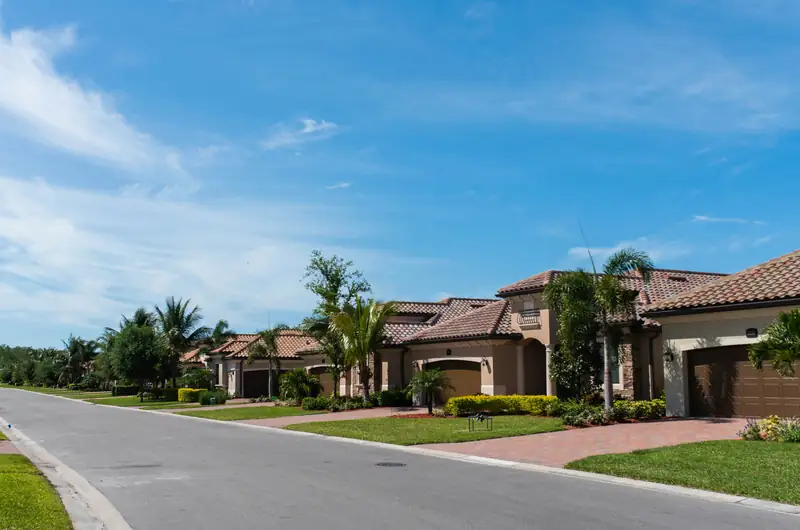
Paver Driveways · Celebration, FL
Paver Driveways and Alley Aprons in Celebration
As of October 2026, a paver driveway in Celebration runs $10–$30 per sq ft installed on the Florida market. On many of the community's original blocks, the paved vehicle access isn't a front driveway at all; it's a short apron off a rear alley, since the New Urbanism layout put garages behind the house rather than facing the street.
By the Opera Concrete & Pavers estimating team · Updated October 1, 2026
Get a free estimate
Tell us about the project and we'll call to set up a free site visit.
Rear-alley garages turn a 'driveway' job into a different shape of project
A number of Celebration's original neighborhoods were designed with front porches close to the sidewalk and garages reached from alleys running behind the row of houses (Max Life Realty, Celebration, FL Community Guide). On a block built that way, a paver driveway project is really a short alley apron and parking pad rather than the long front-yard run a conventional subdivision lot would need, and the materials list shrinks accordingly even though the per-square-foot price stays the same.
60 mm or 80 mm: picking paver thickness for a driveway
Pavers come in two standard thicknesses for the jobs a homeowner deals with. A 2⅜-inch (60 mm) unit is the standard spec for pedestrian areas and residential driveways under normal car traffic, while a 3⅛-inch (80 mm) unit is reserved for heavier loads, like streets, industrial pavement, or a driveway that regularly carries something bigger than a sedan. The two aren't interchangeable just because they look similar from the sidewalk: the thicker unit spreads load over a larger area and resists point loading better, which matters every time a tire turns in the same spot. For a typical Celebration two-car driveway, 60 mm pavers on a properly compacted base is the standard choice; the 80 mm jump is a conversation for anyone with heavier equipment.
A rear-alley paver apron, worked out in square feet
Say a home on an original Celebration block repaves a 10 by 22 foot alley apron and parking pad, 220 square feet, behind the house. That footage at $10–$30 per sq ft installed comes to roughly $2,640 to $4,400, well under what a full front-yard paver driveway on a conventional subdivision lot of the same width would run. Because the work touches the alley's right-of-way, the 48-hour regrading rule still applies even though the job itself is smaller than a typical driveway.
Right-of-way work in unincorporated Osceola County has its own clock
An alley apron counts as right-of-way work the same as a frontage project would, and the county's guidance puts a tight two-day window on getting any disturbed ground back under grade, plus narrow weekday hours for closing a lane (county right-of-way guidance). Unlike the driveway ordinance, that right-of-way rule carries no published price tag, so pin the number down with the Building Office at 407-742-0200 before counting on a figure.
Oil and fluid stains on an unsealed paver surface
Concrete pavers aren't sealed by default under ICPI's spec, which treats sealing as optional rather than a required step, and an unsealed surface takes on an oil or transmission-fluid stain the way any unsealed masonry does: by absorbing it rather than letting it sit on top. A stain that's blotted quickly, before it has time to soak deeper into the paver and the bedding sand underneath, cleans up far more easily than one left to set for days on a Celebration driveway. It's one of the practical reasons some owners choose to seal a new driveway sooner than the spec requires, even though there's no fixed interval written into it, rather than waiting until a stain forces the decision.
When the subgrade itself needs help before the base goes down
ICPI's spec admits its own 98 percent compaction standard may not be achievable in extremely saturated or very fine soils, and calls for stabilizing the subgrade instead of forcing the number on ground that won't take it. In practice that means dealing with the soil before a single scoop of aggregate base arrives, whether that's letting it dry out, adding a separation layer, or going with a different base depth altogether. A Celebration lot with sand over a denser layer behaves differently than one that's sand straight down, and the subgrade step is where that difference gets handled instead of ignored. Skipping it is a common reason a paver driveway starts to dip within a year or two.
Inspections on a driveway, if the job needs one
Florida law keeps a local government from requiring a license just to install a driveway, but that doesn't remove the permit itself, and a permit usually comes with an inspection tied to it. Projects with a direct contract price over $2,500 also fall under Florida's lien law, which requires a recorded Notice of Commencement before work starts, separate from any building-permit inspection. Whether a specific Celebration driveway needs a permit at all depends on the scope, the jurisdiction, and whether the work touches a right-of-way apron, which is worth asking the local building department directly rather than assuming the answer from a different town's rule.
Sealing a paver driveway: no fixed clock, but a real one
ICPI's own spec doesn't give a number of years between sealer applications, noting only that it depends on use, climate and the sealer's own quality, with acrylic sealers typically holding up for what the spec calls a few years before recoating is worth it. Climate does real work in that sentence for a Celebration driveway: both service areas sit close to the 50-inch mark for annual rainfall, concentrated heavily in a rainy season, and that much water and sun exposure wears a sealer faster than a drier region would. Watching the surface for fading sheen or water that stops beading is a better guide than a calendar, since the spec itself won't give a firm date.
Frequently asked questions
Why don't some Celebration homes have a front driveway?
Many of the community's original blocks were built with garages on rear alleys and front porches facing the street, so the paved vehicle access sits behind the house instead of in front of it.
Is an alley apron cheaper than a full front driveway?
Usually, simply because it covers less square footage. The market price per square foot is the same either way; the alley layout just means less area to pave.
Does alley work in Celebration need a right-of-way permit?
If it disturbs the county right-of-way behind the house, yes, with ground required to be regraded within 48 hours. Confirming the exact fee is a call to the county's Building Office.
Sources
- Celebration, Architectural Review Committee
- Osceola County — Parking Ordinance, Ch. 22 Art. II (Sec. 22-50.6)
- Osceola County — Right-of-Way Permit Information
- Osceola County — Permit Information
- Osceola County — Homeowners
- NRCS OSD Smyrna
- NRCS OSD Myakka
- NRCS OSD Basinger
- Florida Administrative Code — Rule 62-308.100, Synthetic Turf (effective May 19, 2026)
- Florida Statutes §125.572 — synthetic turf on single-family lots
- Florida Statutes §720.3045 — items not visible from the frontage or an adjacent parcel
- Census Reporter, Celebration, FL (ACS 2020-2024 5-yr)
- Celebration Community Development District, About the CDD
- Wikipedia, Celebration, Florida
- Max Life Realty, Celebration, FL Community Guide
Ready for a price on your project?
Request a free estimate
Tell us about the project and we'll call to set up a free site visit.