
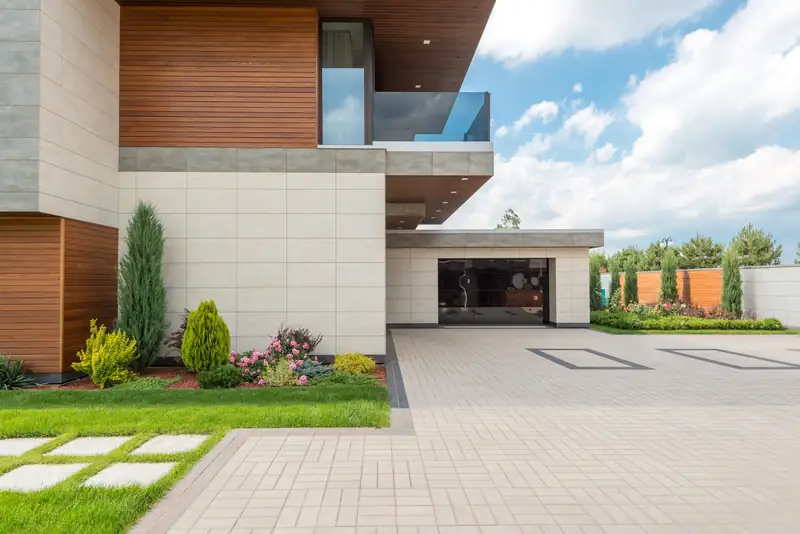
Paver Driveways · Kissimmee, FL
Paver Driveways in Kissimmee: Permits and Fees
A paver driveway in Kissimmee runs $10–$30 per sq ft installed as of October 2026, roughly double the plain-concrete range because of material and base labor. The city's own permit-types list has no separate line item for pavers, and any part of the job that reaches into the right-of-way needs its own permit with fees that start at a $25 minimum.
By the Opera Concrete & Pavers estimating team · Updated October 1, 2026
Get a free estimate
Tell us about the project and we'll call to set up a free site visit.
No separate paver line item means confirming the scope before ordering material
The city's permit-types page spells out “Slab With/Without Footer,” a stand-alone pool and spa category, and “Fences & Walls” for masonry, but pavers have no entry of their own (City of Kissimmee, Types of Permits). That's not the same as being exempt; it means the permitting desk, at 407-518-2379 or [email protected], is the one to call to confirm which category a given paver driveway actually falls under before the pallets show up on site.
The right-of-way permit for the apron has its own fee schedule
Where a paver driveway's apron crosses into the right-of-way, it needs a separate right-of-way permit, covering any work “in a street, under a sidewalk, or in the grassy area next to a street,” routed through Aaron Mendez at 407-518-2536 or [email protected] (City of Kissimmee, Apply for Right-of-Way Permits). Fees start at a $25 minimum; an open cut on a paved street runs $150, an open cut on an unpaved surface runs $25, and a bore-and-jack crossing runs $50. Outside the right-of-way, the rest of the driveway on private property doesn't carry that particular fee.
Why 6 inches of base isn't automatic under a driveway near Kissimmee
ICPI's own spec sets a residential driveway base at a minimum of 6 inches of compacted aggregate over well-drained soil, while a patio or walkway only needs about 4 inches. That minimum isn't the end of the math: on wet or poorly drained ground, the same spec calls for 2 to 4 inches more before the base is considered done. Around Kissimmee, which number applies depends on what's actually under the topsoil, not on habit. A crew that quotes 6 inches for every lot skipped the step where someone checks the soil, and that's the step that keeps a driveway from settling at the edges a year later.
What a crew checks before a single paver goes down
By the time the first paver is set, the base underneath has already been checked against two separate numbers: compaction density, tested to at least 98 percent of standard Proctor for a driveway, and surface tolerance, held to plus or minus three-eighths of an inch over a 10-foot span. Both checks happen before the bedding sand is even screeded, because fixing a low spot in the base is straightforward and fixing one after the pavers are set is not. On a Kissimmee job, that inspection step is the quiet middle of the process, sandwiched between the excavation everyone notices and the finished surface everyone sees, and it's the part that decides how the driveway looks in two years, not two days.
A paver driveway apron tying into the right-of-way, worked out in square feet
Say a 480 square foot two-car paver driveway ties into the street with an 8-foot-wide, 6-foot-deep apron section, 48 square feet, that technically sits in the right-of-way. At $10–$30 per sq ft installed, the full driveway lands between roughly $4,800 and $14,400 before the apron's open-cut fee, $150 if the street is paved, is added on top. The rest of the driveway, the 432 square feet back from the street, doesn't carry that particular line item, though it still needs the city's or county's standard driveway review depending on the lot's jurisdiction.
Why the bedding sand layer is exactly one inch, not an estimate
Between the compacted aggregate base and the pavers themselves sits a layer of bedding sand, screeded to a nominal 1 inch before it's ever compacted. That number isn't a rough guide: too little and the pavers rock on the base; too much and the layer compacts unevenly once traffic starts rolling over it. The joints between individual units are set at no more than one-eighth of an inch, tight enough that the field locks together once dry joint sand is swept in. On a Kissimmee driveway laid course by course, keeping that bedding layer consistent across the whole field is one of the steps that separates a flat surface from one with visible waves within a year.
Tire-turning wear at the same spot, every day
A driveway sees a narrower range of tire motion than a street does: the same vehicle turning into the same garage bay, day after day, concentrates scrubbing force on a small area instead of spreading it across the whole surface. On a standard 60 mm paver sized for normal car traffic, that repeated turning and braking at one spot, especially near a garage apron, can scuff the surface finish and work joint sand loose faster than it does across the rest of a Kissimmee driveway. It's one reason heavier vehicles, or driveways with a tight turning radius, are candidates for the thicker 80 mm paver and the stricter vehicular compaction standard rather than the standard driveway spec.
What to do about an oil stain, fast
Because concrete pavers aren't sealed by default, an oil or fluid stain soaks in rather than sitting on the surface, so the fastest response, blotting the spill right away rather than wiping it or letting it sit, matters more on an unsealed Kissimmee driveway than it would on a sealed one. A stain that's already set can sometimes be lifted with a degreaser made for masonry, applied and worked in rather than pressure-washed aggressively, since high pressure aimed straight at the joints risks the same sand loss a routine cleaning causes. Sealing the driveway ahead of time, even without a fixed resealing schedule required, is the more direct way to keep future spills from reaching the paver at all.
Frequently asked questions
Does a paver driveway need a different permit than concrete in Kissimmee?
The city's permit-types list doesn't name pavers separately the way it names slabs or pool decks, so confirming the correct category with the permitting desk before ordering material is worth the call. The scope of review isn't necessarily lighter just because pavers aren't listed by name.
What does a right-of-way permit cost for a Kissimmee driveway apron?
Fees start at a $25 minimum, with an open cut on a paved street running $150, an open cut on an unpaved surface running $25, and a bore-and-jack crossing running $50. That's separate from whatever the driveway permit itself costs for the rest of the lot.
Who approves paver work that crosses into the Kissimmee right-of-way?
Right-of-way permits route through Aaron Mendez in the Engineering Division, reachable at 407-518-2536 or [email protected], covering any paver work that extends into the street, under a sidewalk, or in the grassy strip next to the road.
Sources
- Census Bureau PEP, City and Town Population Totals, Vintage 2025 (July 1, 2025)
- Census Reporter, Kissimmee FL (ACS 2020-2024 5-yr, B25035)
- City of Kissimmee, Parks
- City of Kissimmee — Apply for Driveway/Sidewalk Construction
- City of Kissimmee — Apply for Right-of-Way Permits
- City of Kissimmee — Types of Permits
- Osceola County — Right-of-Way Permit Information
- Osceola County — Parking Ordinance, Ch. 22 Art. II (Sec. 22-50.6)
- Osceola County — Permit Information
- Osceola County — Homeowners
- NRCS OSD Smyrna
- NRCS OSD Myakka
- Celebration, Architectural Review Committee
- Florida Administrative Code — Rule 62-308.100, Synthetic Turf (effective May 19, 2026)
- Florida Statutes §125.572 — synthetic turf on single-family lots
- Toho Water Authority, Watering Days and Times
- Osceola County, STRPD District
Ready for a price on your project?
Request a free estimate
Tell us about the project and we'll call to set up a free site visit.