
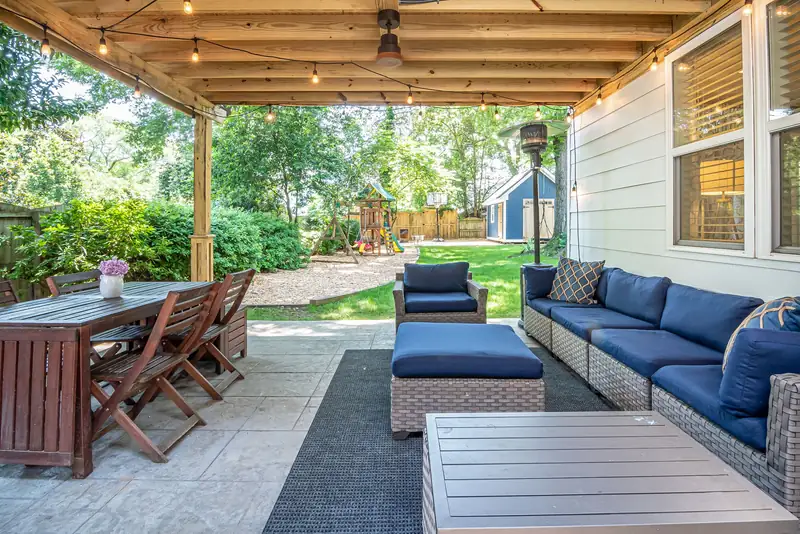
Concrete Patios · Kissimmee, FL
Building a Concrete Patio in Kissimmee
A concrete patio in Kissimmee costs $6–$13 per sq ft installed, a Florida market range as of October 2026. Kissimmee files a patio slab under its “Slab With/Without Footer” permit type, the same category covering a shed pad or an AC pad, and on the lots that back up to Lake Tohopekaliga or one of its canals, the slope away from the water matters as much as the mix design.
By the Opera Concrete & Pavers estimating team · Updated October 1, 2026
Get a free estimate
Tell us about the project and we'll call to set up a free site visit.
A patio goes through the same slab permit type as a shed or AC pad
Kissimmee's permitting office lists “Slab With/Without Footer” as one of its building permit types, a category that covers a patio the same way it covers a utility pad, separate from the pool-and-spa category or the “Fences & Walls” category for masonry (City of Kissimmee, Types of Permits). Call Permitting at 407-518-2379 or [email protected] to confirm scope before pouring. A patio that stays inside the existing footprint of an older slab is typically a smaller submission than one that extends the paved area outward.
Thickening the Slab Under a Built-In Grill Island
A built-in grill island, counter or pizza oven sitting in one spot for the life of the patio calls for more than the standard 4-inch section under it, the same logic that pushes a driveway from 4 to 5 or 6 inches wherever it has to carry a boat trailer's wheels. On a Kissimmee patio, we thicken or reinforce that section locally rather than building the whole slab to the heavier spec, since the rest of the pad only ever sees foot traffic and movable furniture. Deciding where that heavier section goes has to happen at layout time, because adding a grill island to a finished patio means cutting into concrete that was not built for it.
A lakefront patio addition, worked out in square feet
Say a home backing onto Lake Tohopekaliga adds a 14 by 16 foot patio off the back of the house, 224 square feet, between the existing lanai and the yard that slopes toward the water. Pricing that at $6–$13 per sq ft installed puts the job somewhere around $1,344 to $2,912 before a broom or stamped finish changes the number. Before the forms go in, the crew checks where the existing yard already sheds water, since a patio poured flat against a lot that already drains slowly toward the lake can pond against the house rather than carry water away from it.
Grading toward Lake Tohopekaliga or a canal comes before the pour
The city's own parks page describes Big Toho Marina on Lake Tohopekaliga as home to “one of the nation's best bass fishing lakes,” and a meaningful share of Kissimmee's backyards sit along that lake, a connected canal, or a community pond (City of Kissimmee, Parks). On a lot like that, a patio's slope has to carry rainwater away from the house without dumping it straight toward the shoreline, since the yard is already working with less fall than an inland lot has to spare. A paver patio on the same lot faces the identical grading question before the base goes down.
Two Truckloads of Colored Concrete Can Show a Seam
Integral color has to be batched consistently, and a Kissimmee patio large enough to need two truckloads runs the real risk of a visible color shift where the second load meets the first, even when both loads were ordered to the same mix design. Weather, mixing time and even how long a load sits in the truck before it is placed can all nudge the shade slightly, which shows up as a faint seam across an otherwise uniform patio once it cures. Planning the pour sequence and truck timing around where that seam will fall, tucking it under a planned joint or a less visible edge, is cheaper than living with a stripe down the middle of a colored patio.
Why a Patio's Base Doesn't Need a Driveway's Depth
A patio never carries a car's rolling weight, which is why paver base guidance calls for at least 4 inches of compacted aggregate on well-drained soil under a patio or walkway, against 6 inches under a residential driveway. Florida's residential code still treats the ground under a Kissimmee patio the same as any other slab on the ground: fill compacted for uniform support, topped with at least 4 inches of clean graded sand, gravel or crushed stone. On flatwoods soils like Myakka, Smyrna or EauGallie, which hold a water table within 18 inches of the surface part of the year, that lighter design load doesn't make the base work optional, only right-sized for what will actually sit on it.
Starting Early When the House Itself Blocks the Morning Shade
A patio built close to the back of a Kissimmee house often sits in the house's own shadow through mid-morning, which shifts the riskiest window for a hot pour later in the day than it would be on an open driveway facing the street. Hot-weather guidance still calls for avoiding the hottest stretch of the day and starting early enough that finishing and the first hours of curing happen before heat and evaporation peak, but starting early on a shaded patio sometimes means watching the sun angle as much as the clock. Reading the site's actual shade pattern, not just a generic start time, is part of planning the pour day.
A Hairline Crack Near a Footer Isn't Automatically a Problem
A hairline crack running along or near a control joint close to a lanai's footer is typically ordinary shrinkage, not a sign the footer itself has a problem, especially on a Kissimmee patio with a few years on it. What is worth a call is a sudden, visible depression near the footer paired with cracking that reaches toward the structure rather than staying in the patio surface, since that combination looks more like a foundation issue than routine settlement. For most homeowners, the practical rule is the same one that applies to any slab: gradual change over months is normal monitoring, and anything abrupt near a structural element is worth a quicker look.
Frequently asked questions
What permit covers a concrete patio in Kissimmee?
The “Slab With/Without Footer” permit type, the same category the city uses for a shed pad or an AC pad, reviewed by Permitting at 407-518-2379. A patio that stays within an existing footprint is usually a smaller submission than one that extends the paved area.
Does a lakefront lot need special grading for a new patio?
Not a separate permit, but the slope matters more. A yard near Lake Tohopekaliga or a connected canal already has less natural fall to carry rainwater away from the house, so the patio's pitch gets checked against the existing drainage pattern before forming begins rather than left to chance.
Can I add a patio without extending the existing slab's footprint?
Often, yes, and staying within the existing paved footprint keeps the permit submission smaller. Extending outward into new ground, closer to the lake or into a side yard, brings in the same slab review but with a larger survey and drainage check attached.
Sources
- Census Bureau PEP, City and Town Population Totals, Vintage 2025 (July 1, 2025)
- Census Reporter, Kissimmee FL (ACS 2020-2024 5-yr, B25035)
- City of Kissimmee, Parks
- City of Kissimmee — Apply for Driveway/Sidewalk Construction
- City of Kissimmee — Apply for Right-of-Way Permits
- City of Kissimmee — Types of Permits
- Osceola County — Right-of-Way Permit Information
- Osceola County — Parking Ordinance, Ch. 22 Art. II (Sec. 22-50.6)
- Osceola County — Permit Information
- Osceola County — Homeowners
- NRCS OSD Smyrna
- NRCS OSD Myakka
- Celebration, Architectural Review Committee
- Florida Administrative Code — Rule 62-308.100, Synthetic Turf (effective May 19, 2026)
- Florida Statutes §125.572 — synthetic turf on single-family lots
- Toho Water Authority, Watering Days and Times
- Osceola County, STRPD District
Ready for a price on your project?
Request a free estimate
Tell us about the project and we'll call to set up a free site visit.