
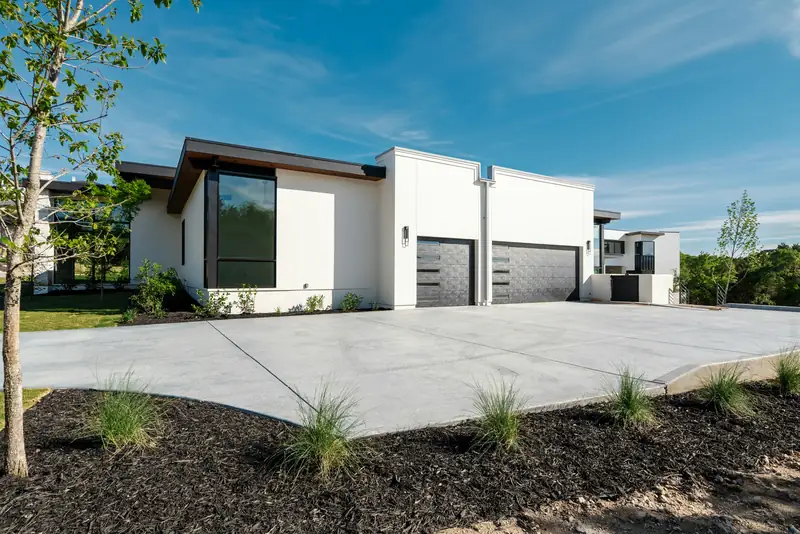
Concrete Driveways · Kissimmee, FL
Pouring or Replacing a Concrete Driveway in Kissimmee
A new or replacement concrete driveway in Kissimmee runs $6–$15 per sq ft installed as of October 2026. Which office reviews the job, the city's Engineering Division or Osceola County's Building Office, depends on whether the lot sits inside the Kissimmee city limits or in the surrounding unincorporated county, and the two offices don't apply the same width rule.
By the Opera Concrete & Pavers estimating team · Updated October 1, 2026
Get a free estimate
Tell us about the project and we'll call to set up a free site visit.
A two-car driveway on each side of the city line, worked out in square feet
Say a two-car driveway measures 20 by 24 feet, 480 square feet, replacing a cracked original pour. At $6–$15 per sq ft installed, that job lands between roughly $2,880 and $7,200 before demolition of the old slab is added. Inside the city limits, that width clears Engineering's review without a special finding. On an otherwise identical lot in unincorporated Osceola County, a 24-foot-wide driveway sits right at the code's cap, so a homeowner planning anything wider, a third bay or a boat-trailer apron, needs a conditional use approval from the county before the extra footage gets poured.
Inside the city, EnerGov routes the job in at least two business days
The Engineering Division, at 101 Church St., 3rd Floor, takes driveway and sidewalk applications through the city's EnerGov portal under “Driveway / Sidewalk Construction,” and staff there confirm which documents a specific lot needs before the job moves forward (City of Kissimmee, Apply for Driveway/Sidewalk Construction). Call 407-518-2278 or email [email protected] to start the file. The city flags that some right-of-way along a given street belongs to FDOT or the county rather than the city, so a driveway on a state road or a county-maintained street can route through a second reviewer before the city's own sign-off is final.
Why a 4-Inch Slab Isn't Enough for a Boat Trailer
A standard 4-inch driveway is built for cars and light trucks, not for an RV, a boat trailer or anything that concentrates weight on a narrow set of wheels. For that kind of load, we take the slab to 5 or 6 inches thick, which spreads the weight over more concrete and resists the point-load cracking a thinner slab would show first. Anyone in Kissimmee planning to park something heavier than a daily driver should say so before the forms go in, since thickening a finished driveway later means tearing it out. Mix strength matters too, but added thickness does more for a point load than extra psi alone.
Outside the limits, a driveway can't legally exceed 24 feet without a conditional use
Osceola County's own driveway ordinance, Code §22-50.6, sets a hard ceiling of 24 feet for an ordinary residential driveway out in the unincorporated county, and getting past that number takes a conditional use approval before construction or widening can start (Osceola County, Parking Ordinance Ch. 22 Art. II). That review runs through the county's Building Office at 1 Courthouse Square, Suite 1400, 407-742-0200 (Osceola County, Right-of-Way Permit Information). The city hasn't published an equivalent limit for driveways inside its own limits, so a three-car layout that would trip the county's conditional-use review may clear the city's counter without it; confirming which jurisdiction actually governs the lot is the first call to make, before a paver driveway or a wide concrete apron gets designed around the wrong rule.
What a Flatwoods Lot Means for the Subgrade
Much of Greater Orlando and the Suncoast sits on flatwoods soil series like Myakka, Smyrna, Immokalee, EauGallie and Pomona, which hold a water table within 18 inches of the surface for one to four months most years. That is workable ground for a driveway, but only if we test it before pouring instead of assuming it behaves like the lot next door. Wet, weak native soil will not compact to a stable subgrade no matter how long a plate compactor runs over it. On a Kissimmee property with this kind of soil, we remove the saturated layer and build up with compacted fill rather than forming directly on soggy ground, which is what keeps the slab from settling unevenly within a few years.
A Settling Driveway and a Sinkhole Aren't the Same Thing
Most cracked or uneven driveways are settlement, not sinkholes: a sign the base underneath was not compacted enough or that soil beneath the fill shifted over time. A true catastrophic ground cover collapse under Florida law involves a sudden, visible depression and structural damage, not a slowly widening crack at a control joint. Orange County sits on the state's broader list of counties with concentrated sinkhole claims; Sarasota and Manatee do not. Either way, a Kissimmee homeowner seeing gradual unevenness in a driveway is almost always looking at a compaction or drainage issue a contractor can diagnose, not a geological event that needs reporting to the state.
Curing Starts the Moment the Finish Work Ends
The pour is the visible part of the job, but curing is where the slab actually gains its strength. Once finishing is done, the surface needs to stay moist, whether through a curing compound or wet curing, for at least 3 days, and a white-pigmented compound helps by reflecting heat rather than absorbing it. A Kissimmee driveway poured in summer loses moisture faster than one poured in a mild week, so we adjust the curing method to the weather instead of using the same approach year-round. Rushing this step does not save any real time and is the fastest way to weaken a slab that looked fine on pour day.
Telling Normal Cracking From Something Worth a Call
A hairline crack along or near a control joint, especially in a driveway with large panels or a few years on it, is typically ordinary shrinkage and settlement, not a structural problem. What is worth a call is a sudden, visible depression, especially paired with cracking that reaches a structure rather than just the driveway surface, since that combination is closer to what Florida law treats as a catastrophic ground cover collapse. For a Kissimmee homeowner, the practical rule of thumb is that gradual change over months is normal monitoring, while anything abrupt is worth a quick look rather than waiting for the next routine check.
Frequently asked questions
Does Kissimmee require a permit for a concrete driveway?
Inside the city limits, yes: the Engineering Division reviews it through EnerGov, with routing taking at least two business days once the application and required documents are in. Outside the city, the same lot goes through Osceola County's Building Office instead.
How wide can a driveway be in unincorporated Osceola County?
County Code §22-50.6 caps a residential driveway at 24 feet wide unless the county approves a conditional use for something wider. That figure applies outside the Kissimmee city limits; the city itself hasn't published a comparable stand-alone width cap.
Who do I call if I'm not sure whether my lot is inside Kissimmee city limits?
Either office can usually tell you from the address: the city's Engineering Division at 407-518-2278, or Osceola County's Building Office at 407-742-0200. Confirming jurisdiction before a design is finalized avoids submitting a driveway plan to the office that doesn't actually review that parcel.
Sources
- Census Bureau PEP, City and Town Population Totals, Vintage 2025 (July 1, 2025)
- Census Reporter, Kissimmee FL (ACS 2020-2024 5-yr, B25035)
- City of Kissimmee, Parks
- City of Kissimmee — Apply for Driveway/Sidewalk Construction
- City of Kissimmee — Apply for Right-of-Way Permits
- City of Kissimmee — Types of Permits
- Osceola County — Right-of-Way Permit Information
- Osceola County — Parking Ordinance, Ch. 22 Art. II (Sec. 22-50.6)
- Osceola County — Permit Information
- Osceola County — Homeowners
- NRCS OSD Smyrna
- NRCS OSD Myakka
- Celebration, Architectural Review Committee
- Florida Administrative Code — Rule 62-308.100, Synthetic Turf (effective May 19, 2026)
- Florida Statutes §125.572 — synthetic turf on single-family lots
- Toho Water Authority, Watering Days and Times
- Osceola County, STRPD District
Ready for a price on your project?
Request a free estimate
Tell us about the project and we'll call to set up a free site visit.