
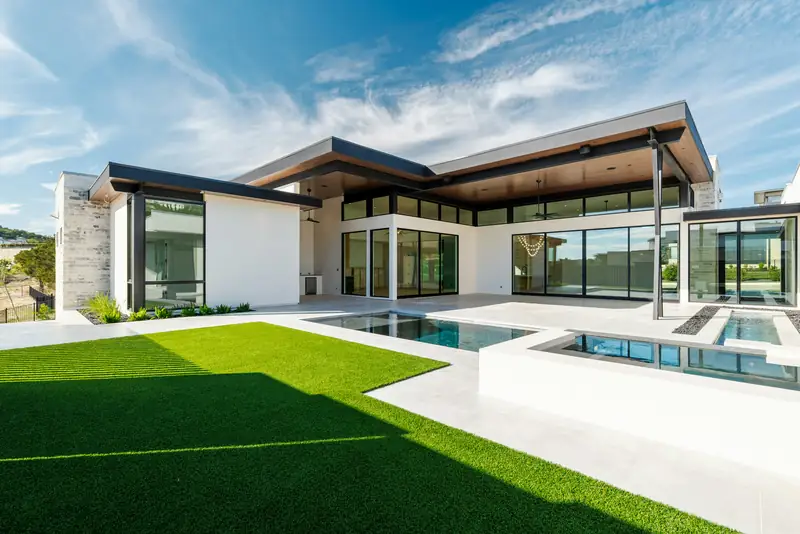
Concrete Pool Decks · Winter Park, FL
Concrete Pool Decks for Winter Park Homes
A concrete pool deck in Winter Park runs $5–$15 per sq ft installed as of October 2026. Section 58-65 names decks directly alongside driveways and patios in the city's 50 percent lot-coverage math, and on a home built around the city's 1976 median, the existing deck is often as old as the pool itself.
By the Opera Concrete & Pavers estimating team · Updated October 1, 2026
Get a free estimate
Tell us about the project and we'll call to set up a free site visit.
A pool deck counts the same as a driveway in the coverage math
The ordinance's own list, “buildings, accessory structures, patios, decks, drives and other impervious surfaces,” puts a pool deck in the identical 50 percent citywide bucket as everything else hard on the lot (City of Winter Park, Sec. 58-65 R-1A districts). On a property that already carries a full driveway and a side patio, enlarging an existing pool deck is sometimes the addition that pushes the lot closest to that ceiling, which is worth checking on the worksheet before a design gets finalized rather than after.
Control Joint Spacing Around a Curved Pool Shape
NRMCA's joint spacing guidance, about 8 to 12 feet apart on a 4-inch slab and never past roughly 15 feet, still applies around a free-form pool, but laying it out takes more judgment than on a rectangular driveway. We run joints radially from the pool's curve where the shape allows it, keeping each panel close to square rather than letting a long, narrow sliver form along a tight bend. On a Winter Park deck with a kidney-shaped or free-form pool, grid lines laid in straight rows regardless of the pool's outline leave slivers that end up cracking off the cut line entirely.
Resurfacing a 1970s-era Winter Park pool deck, worked out in square feet
Say a pool built not long after the home's 1976 construction date carries an original 500 square foot broom-finish deck now showing surface cracking. At $5–$15 per sq ft installed, a resurfacing at the low end of that range lands around $2,500, while a full decorative refinish runs toward $7,500. Staying inside the existing 500 square foot footprint means the job doesn't add to the lot's impervious total, which matters more on an older Winter Park lot than on a newer one with more coverage headroom to spare.
Original decks on 1970s-era Winter Park pools
With the city's median home dating to 1976 (Census Reporter API, B25035), a large share of its in-ground pools are old enough that the original deck has gone through at least one resurfacing already, and some are due for a second. A straight resurface or a decorative overlay still has to clear the same building-permit review as a new deck (City of Winter Park, Do I Need a Permit), and on a lot already close to the coverage ceiling, a resurfacing over the existing footprint avoids adding new square footage the way a widened deck would.
Screen Cage Footers Cracking the Deck Around Them
When a screen enclosure's footer wasn't isolated from the surrounding deck during construction, ordinary settling of either one eventually telegraphs as a crack radiating out from the footer location, not a random crack elsewhere on the slab. That's harder to diagnose after the fact than it is to prevent during the pour, since the footer is usually hidden under the aluminum track by the time anyone notices the cracking. On a Winter Park deck with an older screen cage, a crack pattern that consistently starts at each post location is a strong sign the isolation detail was skipped originally, and the fix usually means cutting a joint in after the fact.
Base Work Where a Screen Cage Footer Lands on the Deck
Most pool decks in this market get enclosed by a screen cage before the job is finished, and the cage's aluminum posts land on isolated concrete footers, not on the deck slab itself. We pour those footers first and set an isolation strip between the footer and the surrounding deck so the two can move independently. On a Winter Park job, skipping that isolation strip lets the deck slab crack outward from the footer the first time the ground beneath either one shifts even slightly. Coordinating footer layout with the screen company before the deck forms go up keeps that joint in the right place the first time.
The Last Step: Checking Every Drain and Joint Before Cleanup
Once the deck is finished and cured, we walk every deck drain and the full length of the isolation joint before calling the job done, checking that water actually moves toward the drains rather than pooling against the coping anywhere around the pool. On a Winter Park job, this walk-through happens with a hose running water across sections that don't get an obvious test from rain alone, since a dry-season completion can hide a slope problem the first wet season would otherwise reveal. Catching a low spot at this stage means a quick patch, not a callback after the homeowner has already furnished the deck.
Telling Ordinary Cracking From Something Worth a Call
A hairline crack along a control joint on the open part of a pool deck, away from the coping, is typically normal shrinkage and settlement, the same as it would be on a driveway or patio. What's worth a closer look is a crack that specifically tracks the coping line or radiates from a screen cage footer, since both point to an isolation detail that may have failed rather than ordinary flatwork cracking. For a Winter Park homeowner, the practical rule is that cracking away from the pool and its footers is routine monitoring, while cracking that follows the pool's own shape deserves a professional look sooner rather than later.
Frequently asked questions
Does a pool deck count toward Winter Park's impervious coverage cap?
Yes, decks are named directly in section 58-65's list of impervious surfaces, capped at 50 percent of the whole lot along with the driveway, patio and any accessory structures.
Is resurfacing an old pool deck cheaper than adding new square footage?
Usually, and it also avoids adding to the lot's coverage total the way widening the deck would. A resurfacing or decorative overlay still goes through the same building-permit review as new construction.
How old are most pool decks in Winter Park?
With the city's median home built in 1976, a substantial share of its pools and original decks are now approaching or past 50 years old, old enough that a second resurfacing is common rather than unusual.
Sources
- City of Winter Park — Do I Need a Permit
- City of Winter Park — Sec. 58-65 R-1A districts
- City of Winter Park — Driveway Permit Requirements
- City of Winter Park — Setback/Coverage Worksheet
- City of Winter Park — Right of Way FAQ
- City of Winter Park Ordinance 3320-24 (tree preservation)
- City of Winter Park, Tree Removal Permit Application
- SJRWMD Watering Restrictions
- F.S. 720.3045 (2026) Installation, display, and storage of items
- Florida Statutes §125.572 — synthetic turf on single-family lots
- Florida Administrative Code — Rule 62-308.100, Synthetic Turf (effective May 19, 2026)
- Census Reporter, Winter Park, FL (ACS 2024 5-yr)
- Census Reporter API, Winter Park median year structure built (B25035)
- City of Winter Park, Street Brick Policy
Ready for a price on your project?
Request a free estimate
Tell us about the project and we'll call to set up a free site visit.