
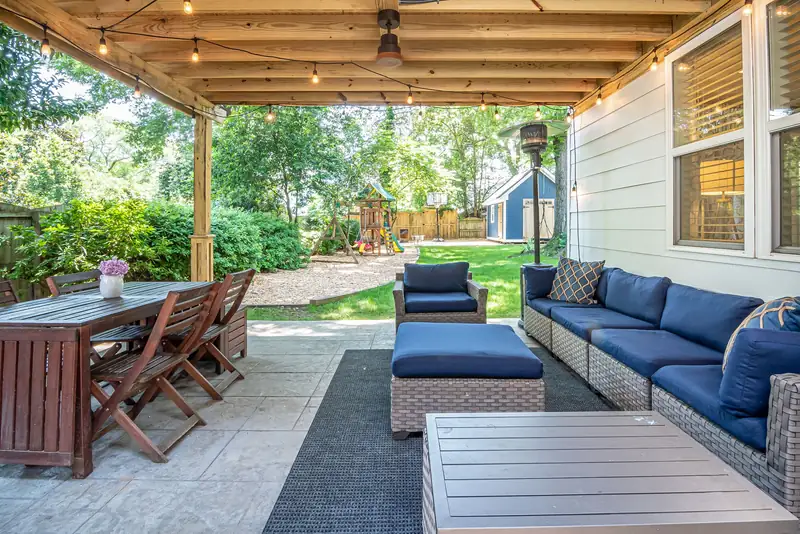
Concrete Patios · Winter Garden, FL
Building a Concrete Patio in Winter Garden
Expect $6–$13 per sq ft installed for a concrete patio in Winter Garden, the Florida range current for this October. Because a patio is almost always added onto a lot where the house, driveway and walkways are already built, the city's worksheet has less room left to work with than it would on a brand-new build, which is the main thing that decides how big the slab can go.
By the Opera Concrete & Pavers estimating team · Updated October 1, 2026
Get a free estimate
Tell us about the project and we'll call to set up a free site visit.
Porches and lanais are named on the same worksheet as the patio itself
Winter Garden's impervious-area worksheet lists porches and lanais as their own line item alongside driveways, walkways and pool decks, and a new concrete patio off the back of the house has to be added to whatever those existing surfaces already total (impervious worksheet). On a lot built out close to that limit already, a patio addition sometimes has to shrink from the size a homeowner first pictures, which is worth finding out from a worksheet calculation before a design is drawn.
A backyard that slopes toward Lake Apopka changes which way the pour sheds water
Winter Garden grew up along the south shore of Lake Apopka, and the water management district is now working with the city on a project to improve boat access near the shoreline, part of a restoration that has brought native vegetation back to about 95 percent of the lake's edge as of a 2024 survey (SJRWMD lake project page). A lakefront patio's pitch gets set to carry rain away from the house and toward the yard's natural low point rather than straight at the shoreline, a grading question that doesn't come up on a lot a mile or two from the water.
Why a Patio's Base Doesn't Need a Driveway's Depth
A patio never carries a car's rolling weight, which is why paver base guidance calls for at least 4 inches of compacted aggregate on well-drained soil under a patio or walkway, against 6 inches under a residential driveway. Florida's residential code still treats the ground under a Winter Garden patio the same as any other slab on the ground: fill compacted for uniform support, topped with at least 4 inches of clean graded sand, gravel or crushed stone. On flatwoods soils like Myakka, Smyrna or EauGallie, which hold a water table within 18 inches of the surface part of the year, that lighter design load doesn't make the base work optional, only right-sized for what will actually sit on it.
Scheduling a Cure Around a Screen Enclosure Crew
When a screen enclosure contractor is scheduled to anchor posts into a new Winter Garden patio soon after the pour, the curing timeline has to work backward from that install date rather than following a fixed default. Hot-weather curing calls for keeping the surface moist, by compound or wet curing, for at least 3 days before anyone treats the slab as finished work, and anchoring posts into concrete that has not had that time can disturb a cure that is still gaining strength. Coordinating the pour date with the enclosure crew's schedule, instead of booking both independently, avoids a scramble where one trade is waiting on concrete that genuinely is not ready yet.
A patio addition checked against the existing worksheet total, in square feet
A 14-by-18-foot patio off the back door comes to 252 square feet, and at the $6–$13 per sq ft installed range, that pour lands between roughly $1,500 and $3,275 before a decorative finish changes the number. On a lot where the driveway, walkway and an existing lanai already use a chunk of the worksheet's limit, that 252 square feet gets added to the running total first, which sometimes trims the patio's footprint before the forms ever go up.
Why a Tie-In Seam Gets an Isolation Joint, Not a Bond
Where a new patio section ties into an existing slab, we use an isolation joint between the two rather than bonding fresh concrete directly to old, since the new pour will shrink as it cures while the existing slab already finished shrinking years ago. On a Winter Garden tie-in, that joint, typically a strip of compressible material between the two edges, lets each section expand, contract and settle on its own schedule instead of fighting the other one at a single hard seam. Skipping the isolation joint and pouring tight against the old edge is how a tie-in develops a crack right at the seam within the first year or two.
A Shaded Patio Can Discolor Before the First Year Is Out
A patio that sits in shade most of the day, whether from a lanai roof, the house itself or mature trees, stays damp longer after each rainy-season storm than an open, sun-exposed slab, and algae or mildew can take hold on a shaded Winter Garden patio within the first year if the finish choice did not account for that exposure. A plain broom finish holds more surface moisture in its texture than a sealed, stained or exposed-aggregate surface does, which makes the finish decision made before the pour part of how the patio ages, not just how it looks on day one. That tradeoff is worth raising at the planning stage, before concrete that cannot easily change finish is already down.
What Salt Air Adds to a Coastal Patio's Checklist
A patio within reach of salt air, more of a factor on the coastal side of Sarasota and Manatee than on the Orlando side of the service area, benefits from an occasional check of any exposed rebar or wire mesh near a chip or a crack, since airborne salt speeds up corrosion once metal is exposed to it. Outdoor furniture hardware, a screen enclosure's fasteners and any metal edging near a Winter Garden patio age faster in that same salt air, so a yearly look at the whole setup, not just the concrete, catches small problems before they spread. Coastal exposure does not change how the patio was built, only how closely it is worth watching afterward.
Frequently asked questions
Does adding a concrete patio in Winter Garden require a new impervious calculation?
Yes. The worksheet treats porches, lanais and patios as their own line item, and a new patio has to be added to whatever the driveway, walkway and any existing lanai already total before the city signs off.
Does a Winter Garden patio near Lake Apopka need different grading?
A lot that slopes toward the lake gets its patio pitched to carry water toward the yard's own low point instead of straight at the shoreline, a grading check that doesn't apply the same way a mile or two inland.
Can a Winter Garden patio be denied for exceeding the impervious limit?
A design that would push the lot's total past its worksheet limit doesn't clear review as drawn. Checking the running total against the worksheet before the forms are ordered avoids a redesign later.
Sources
- City of Winter Garden — Building FAQs
- City of Winter Garden — Impervious Area Calculation Worksheet
- City of Winter Garden — Municode R-1A
- City of Winter Garden — Right-of-Way Permit Application
- City of Winter Garden — When is a permit required?
- Census Bureau PEP, City and Town Population Totals, Vintage 2025 (July 1, 2025)
- Census Reporter, Winter Garden FL (ACS 2020-2024 5-yr, B25035)
- Orange County, Horizon West
- SJRWMD Watering Restrictions
- Florida Senate Interim Report 2011-104 (sinkhole insurance)
- Orange County — A Guide for Residential Plan Approval
- NRCS OSD Candler
- NRCS OSD Tavares
- NRCS OSD Astatula
- NRCS OSD Myakka
- NRCS OSD Smyrna
- Florida Administrative Code — Rule 62-308.100, Synthetic Turf (effective May 19, 2026)
- Florida Statutes §125.572 — synthetic turf on single-family lots
- the city history page
- the trail Wikipedia entry
- St. Johns River Water Management District, Lake Apopka Project
Ready for a price on your project?
Request a free estimate
Tell us about the project and we'll call to set up a free site visit.