
Sidewalks & Walkways · Windermere, FL
Concrete Sidewalks and Walkways in Windermere
A concrete walkway or sidewalk section in Windermere runs $7–$17 per sq ft installed as of October 2026. Most of the town's residential streets are sand or brick rather than paved, so a walkway's edge treatment and drainage depend on which kind of street the lot actually fronts.
By the Opera Concrete & Pavers estimating team · Updated October 1, 2026
Get a free estimate
Tell us about the project and we'll call to set up a free site visit.
A walkway along a sand street answers to a different drainage picture
Outside the paved Main Street and Sixth Avenue corridors, most of Windermere's residential grid stayed unpaved by the town's own choice Wikipedia, Windermere, Florida, and a current pilot on Bessie and Butler streets is adding swales and a rain garden so stormwater sheets to the sides of the road instead of washing out the crown ClickOrlando, Windermere's dirt-road pilot. A front walkway tying into one of those improved sections has to clear the new swale rather than the flat, worn edge an older sand street would have had, while a walkway along an untouched sand street still faces the kind of edge washout the town's own maintenance program is trying to fix.
A Narrow Walkway Is Mostly Edge, and the Base Has to Hold It
A driveway's base has a wide, continuous interior that holds its shape once compacted, but a 3- or 4-foot-wide walkway is mostly edge for its entire length, which means more of the compacted aggregate under a Windermere walkway sits within a few inches of an unsupported side than it would under a wider slab. Loose material along that edge migrates or settles more easily than material in the middle of a wide pad, especially on sandy soils that do not hold a compacted edge well without some kind of restraint. We pay closer attention to edge compaction on a narrow walkway for that reason, not because the base spec itself is different from a wider slab's.
Only the piece that touches the street needs the town's sign-off
Most of a front walk, the stretch from the porch to the driveway, is private work that PDCS reviews separately from anything happening at the curb. The short run at the far end, wherever it actually meets the road, answers to the same Right-of-Way Use Application the town built for driveway aprons Windermere ROW Use Application. A driveway apron goes through that identical review for its own road-facing edge, whether the street it meets is Main Street's pavement or one of the town's sand lanes.
A Curved Walkway Needs More Joints, Not Fewer
Joint-layout guidance calls for panels that stay close to square, with length no more than about one and a half times the width, a rule that is easy to follow on a straight run and harder to follow on a walkway that curves around a tree, a bed or a corner of the house. On a curved section of a Windermere walkway, that usually means cutting joints more frequently than the standard 8-to-12-foot spacing used on a straight 4-inch slab, so each panel along the curve stays close to that near-square shape instead of tapering into a long wedge. Planning the joint layout around the curve at design time avoids an awkward sliver panel that cracks wherever it wants to.
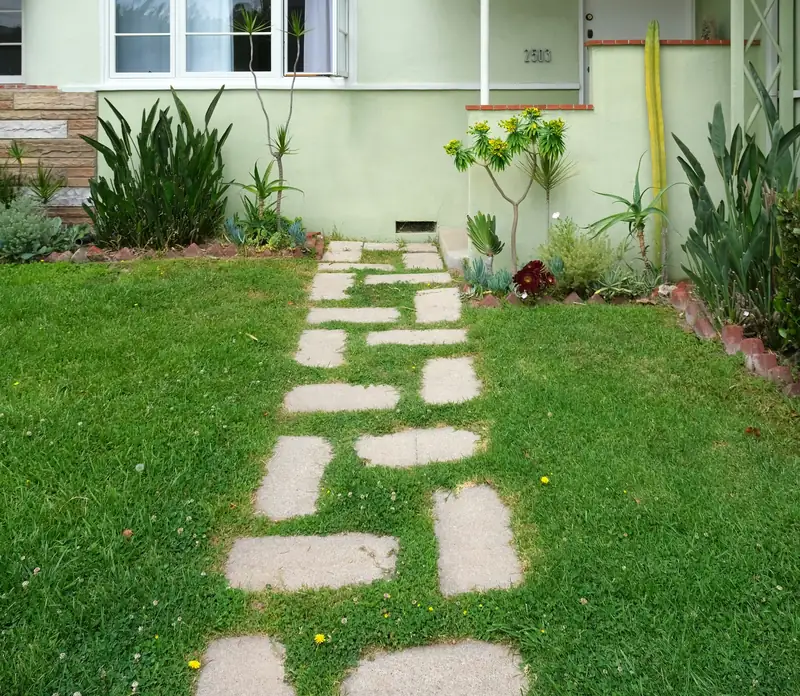
A front walkway replacement along a sand street, worked out in square feet
Say a 5 by 30 foot front walkway, 150 square feet, connects the driveway to the entry on a lot fronting one of Windermere's unpaved residential streets, crossing the sidewalk strip near the road. At $7–$17 per sq ft installed, that runs $1,050 to $2,550, or about $1,200 to $1,800 in the typical $8–$12 band for a broom-finished walk. Where the walkway meets the sand street's edge, the crew checks whether that block has already been regraded to the town's newer crown-and-swale design or still carries the older flat profile before setting the final grade.
A Long, Narrow Pour Dries From Both Edges at Once
A walkway's shape works against it on a hot Windermere pour day in a way a wider driveway slab does not: with almost the whole surface close to an edge, evaporation can pull moisture from both sides of a narrow section at the same time, raising the effective drying rate even when the air temperature and wind match conditions on a wider pour nearby. Starting early and watching the evaporation rate rather than just the clock matters as much here as on any other flatwork, but a narrow walkway gives a crew less margin for error before plastic shrinkage cracking shows up along both edges of the same panel.
Steps That Don't Account for Water Get Slippery Fast
A set of outdoor steps built without attention to drainage can pond a thin film of water on a tread after almost any rain, and that film turns a broom-finished step slippery in a way a flat section of the same walkway never is, since water on a slope behaves differently than water on level ground. On a shaded Windermere lot, where a step sits under a tree canopy or close to the house, that tread can also stay damp long enough after a storm for algae to start building a film of its own. Grading each tread to shed water and choosing a texture that still grips when wet are both decisions made before the pour, not after someone slips.
Telling a Normal Crack From a Panel That Needs Releveling
A hairline crack along a joint on a Windermere walkway, especially one with a few years on it, is typically ordinary shrinkage, the same kind of cracking a driveway or patio develops over time. What is worth addressing is a panel that is visibly higher or lower than its neighbor at the joint, since that is a trip hazard rather than a cosmetic issue, and raising or releveling a sunken section is usually a smaller, more targeted repair than replacing the whole panel. Mudjacking-style releveling for a sidewalk-sized section tends to run as a modest line item compared with tearing out and repouring, worth knowing before assuming a lifted panel means a full replacement.
Frequently asked questions
Do Windermere's sand streets change how a front walkway is built?
They can change the grading at the street edge. A block already rebuilt under the town's swale-and-crown drainage pilot sheds water differently than an older, flat sand street, so the walkway's edge is set against whichever profile that block actually has.
Does a walkway crossing a Windermere sidewalk strip need a permit?
Yes, the portion crossing into the public right-of-way goes through the same Right-of-Way Use Application the town requires for a driveway apron.
Why is Windermere investing in drainage on Bessie and Butler streets?
A roughly $1.4 million pilot project there is adding swales and a rain garden so stormwater runs to the sides of the road rather than down the crown, which has been causing washout on those unpaved streets.
Sources
- PDCS — Windermere
- Town of Windermere/PDCS — Right-of-Way Use Application 2.2024
- Town of Windermere — Municode LDC Art. VI §6.01
- Census Bureau PEP, City and Town Population Totals, Vintage 2025 (July 1, 2025)
- Census Reporter, Windermere FL (ACS 2020-2024 5-yr, B25035)
- Orange County Division of Building Safety
- Orange County — Do I Need a Permit
- Orange County — Residential Pavers
- Orange County — A Guide for Residential Plan Approval
- Orange County — Residential Lot Grading Policy 2023
- Orange County, Horizon West
- SJRWMD Watering Restrictions
- Florida Administrative Code — Rule 62-308.100, Synthetic Turf (effective May 19, 2026)
- Florida Statutes §125.572 — synthetic turf on single-family lots
- Florida Senate Interim Report 2011-104 (sinkhole insurance)
- FDEP / Florida Geological Survey Sinkhole FAQ
- Wikipedia, Windermere, Florida
- Wikipedia, Isleworth, Florida
- Wikipedia, Lake Down
- Wikipedia, List of Outstanding Florida Waters
- FDEP, Outstanding Florida Waters fact sheet
- ClickOrlando, a Windermere dirt-road stormwater pilot
- Orange Observer, the cost of keeping Windermere's roads dirty
Ready for a price on your project?
Request a free estimate
Tell us about the project and we'll call to set up a free site visit.