
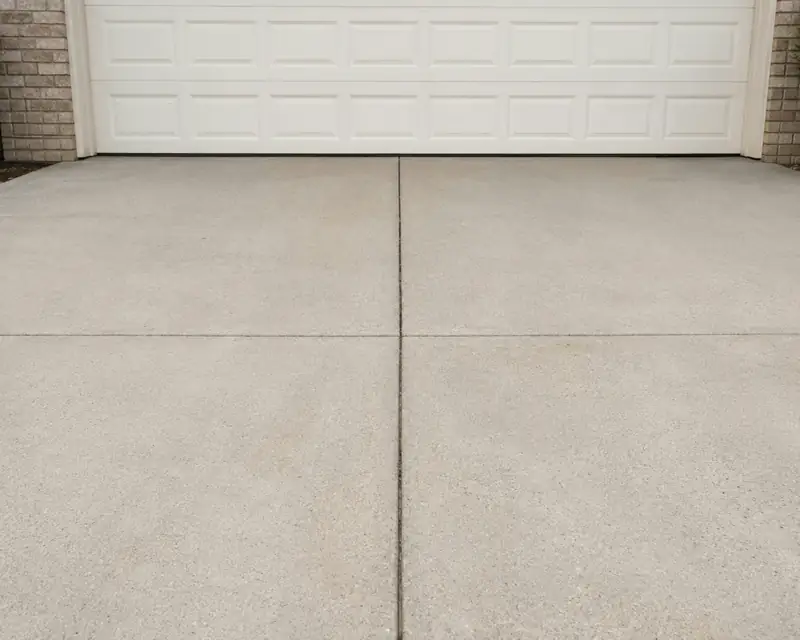
Concrete Driveways · Windermere, FL
Pouring or Replacing a Concrete Driveway in Windermere
A new or replacement concrete driveway in Windermere runs $6–$15 per sq ft installed as of October 2026. Before the apron is formed, the town's own Right-of-Way Use Application sets the fee, the inspection schedule and the exact spec the apron has to meet, a separate process from the private slab review PDCS also handles.
By the Opera Concrete & Pavers estimating team · Updated October 1, 2026
Get a free estimate
Tell us about the project and we'll call to set up a free site visit.
A driveway rebuild with flares, worked out in square feet
Say a Windermere driveway measures 24 by 40 feet, 960 square feet, and the apron where it meets the road adds two 5-foot flares at roughly 25 square feet each for 1,010 square feet total. At $6–$15 per sq ft installed, that full scope runs $6,060 to $15,150, narrowing to about $8,080 to $12,120 in the typical $8–$12 band. The private portion and the right-of-way apron are priced together here, but only the apron crossing into the public strip needs the $75 Right-of-Way Use Application and its follow-up inspection.
The $75 application and $50 inspection cover only the right-of-way piece
Windermere's Right-of-Way Use Application, run by the town's contracted building office, PDCS LLC, charges $75 to apply, $50 for the first inspection and another $50 if a reinspection is needed, and Public Works asks for a day's notice before the pour so an inspector can be on site for both the pre-pour and the final look Windermere ROW Use Application. That fee covers the portion of the driveway sitting in the public strip; the rest of the slab, on private ground, is reviewed separately. A homeowner swapping a cracked apron for a new one still files the application even when nothing about the private driveway itself is changing.
The Plastic Sheet Most People Never See Under a Slab
Code calls for a 6-mil polyethylene vapor retarder under most slabs on the ground, lapped at least 6 inches at the seams, before the concrete goes down. It is one of the few parts of a driveway build nobody sees again once the pour is finished, but it keeps ground moisture from migrating up through the slab over time. Garages and unheated accessory structures get some exceptions to this rule, so what is required under a Windermere driveway next to an attached garage can differ from what is required under a detached slab a few feet away. It is a small material cost for a step that is hard to add back in later.
The apron spec is specific about thickness, flares and setbacks
The same application fixes the apron at 6 inches of 3,000 psi concrete with fiber mesh, saw-cut cleanly at the edge of the road, with 5-foot flares on each side Town of Windermere/PDCS — Right-of-Way Use Application 2.2024. No new driveway can sit within 5 feet of a side property line or within 40 feet of an intersection, and where a culvert is called for, it has to run at least 15 inches across with mitered ends Town of Windermere/PDCS — Right-of-Way Use Application 2.2024. On a lot where the existing apron predates that spec, matching it exactly, rather than copying the old dimensions, is what gets the reinspection fee avoided the first time around.
What a Flatwoods Lot Means for the Subgrade
Much of Greater Orlando and the Suncoast sits on flatwoods soil series like Myakka, Smyrna, Immokalee, EauGallie and Pomona, which hold a water table within 18 inches of the surface for one to four months most years. That is workable ground for a driveway, but only if we test it before pouring instead of assuming it behaves like the lot next door. Wet, weak native soil will not compact to a stable subgrade no matter how long a plate compactor runs over it. On a Windermere property with this kind of soil, we remove the saturated layer and build up with compacted fill rather than forming directly on soggy ground, which is what keeps the slab from settling unevenly within a few years.
What Salt Air Does to a Driveway Near the Coast
A driveway close enough to the Gulf for salt air to reach it ages differently than one further inland: airborne salt speeds up corrosion of any exposed rebar or wire mesh at a crack or an edge, which can widen that crack faster than plain weathering would on its own. Coastal stretches of Sarasota and Manatee also carry FEMA AE and VE flood zone designations in places, which affects more than the driveway but is worth knowing before planning concrete work there. If Windermere sits in one of those coastal pockets, it is worth asking how that factors into the reinforcement and finish choices for the job.
Why We Start Early on a Summer Pour
On a hot Windermere morning, waiting until midday to pour concrete works against a crew instead of for it. Guidance for hot-weather concreting calls for avoiding the hottest part of the day, because high heat speeds up how fast the surface dries relative to how fast the slab underneath is gaining strength. We start early so there is more working time before evaporation becomes a problem, and so finishing and the start of curing both happen before the afternoon heat peaks. Starting late is one of the easiest mistakes to avoid and still one of the most common.
Why the Groove in a Control Joint Needs to Stay Clear
The groove cut into a driveway's control joints has to reach at least a quarter of the slab's thickness to do its job of controlling where the concrete cracks, and that same depth is what lets sand, dirt and organic debris pack into the joint over time if nobody checks it. On a Windermere driveway, keeping those grooves swept out, especially heading into the rainy season, keeps them working the way they were cut to work instead of silting in and trapping water against the edges of each panel. It is a five-minute task with a broom, not a specialty job, and it is easy to let slide for years at a time.
Frequently asked questions
What does Windermere charge for a driveway permit?
$75 to apply for the Right-of-Way Use Application, plus $50 for the first inspection and another $50 if a reinspection is needed. That covers the portion of the driveway in the public right-of-way.
How close to the property line can a Windermere driveway sit?
At least 5 feet from a side property line and at least 40 feet from an intersection, under the town's own Right-of-Way Use Application standard.
Does a straight apron replacement in Windermere need the same review as a new driveway?
Yes. Replacing an existing apron still goes through the Right-of-Way Use Application and its pre-pour and final inspections, even when the private portion of the driveway isn't being touched.
Sources
- PDCS — Windermere
- Town of Windermere/PDCS — Right-of-Way Use Application 2.2024
- Town of Windermere — Municode LDC Art. VI §6.01
- Census Bureau PEP, City and Town Population Totals, Vintage 2025 (July 1, 2025)
- Census Reporter, Windermere FL (ACS 2020-2024 5-yr, B25035)
- Orange County Division of Building Safety
- Orange County — Do I Need a Permit
- Orange County — Residential Pavers
- Orange County — A Guide for Residential Plan Approval
- Orange County — Residential Lot Grading Policy 2023
- Orange County, Horizon West
- SJRWMD Watering Restrictions
- Florida Administrative Code — Rule 62-308.100, Synthetic Turf (effective May 19, 2026)
- Florida Statutes §125.572 — synthetic turf on single-family lots
- Florida Senate Interim Report 2011-104 (sinkhole insurance)
- FDEP / Florida Geological Survey Sinkhole FAQ
- Wikipedia, Windermere, Florida
- Wikipedia, Isleworth, Florida
- Wikipedia, Lake Down
- Wikipedia, List of Outstanding Florida Waters
- FDEP, Outstanding Florida Waters fact sheet
- ClickOrlando, a Windermere dirt-road stormwater pilot
- Orange Observer, the cost of keeping Windermere's roads dirty
Ready for a price on your project?
Request a free estimate
Tell us about the project and we'll call to set up a free site visit.