
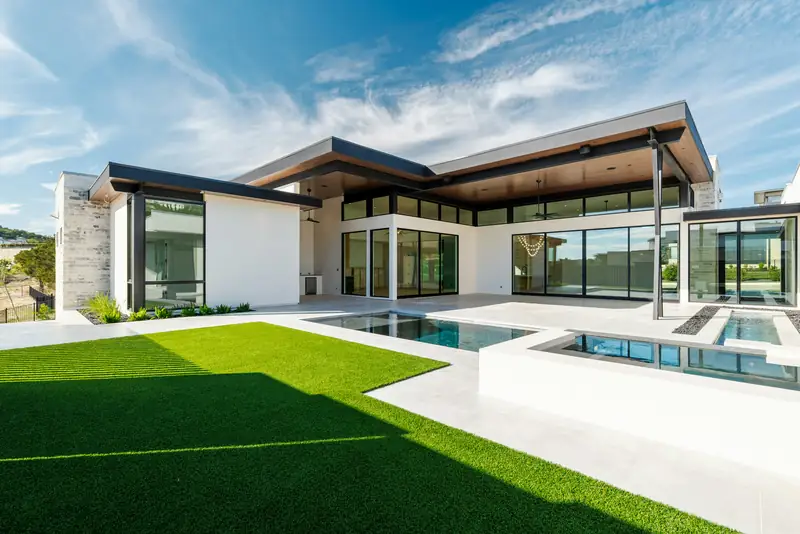
Concrete Pool Decks · Venice, FL
Concrete Pool Deck Installation in Venice
A concrete pool deck in Venice runs $5–$15 per sq ft installed as of October 2026. Lots near the Intracoastal Waterway or the Gulf side of Venice Island often sit in a FEMA flood zone, and the deck itself doesn't count toward the city's lot-coverage limit the way the house footprint does.
By the Opera Concrete & Pavers estimating team · Updated October 1, 2026
Get a free estimate
Tell us about the project and we'll call to set up a free site visit.
A pool deck pour near the Intracoastal, worked out in square feet
Say a canal-front home on Venice Island pours a 600 square foot deck around a screened cage, close enough to Roberts Bay to land inside FEMA's Zone AE on the current flood map. Pricing that at $5–$15 per sq ft installed puts the job between $3,000 and $9,000, or about $4,200 to $7,200 in the typical $7–$12 range, for a textured, slip-resistant surface pitched toward the yard drain rather than a plain trowel finish. Sitting inside a mapped flood zone means the deck's edge height and the fill beneath it get set against that base-flood number instead of an inland assumption, and the deck's own footprint still leaves the lot's coverage total untouched, unlike an addition to the house itself.
Checking a lot's flood category before the forms go up
Lots along Venice Island's Gulf frontage or facing the Intracoastal fall into one of two FEMA categories: Zone AE, carrying roughly a one-percent annual flood chance with lighter wave action, or the Coastal High Hazard Zone VE, the same odds paired with surf capable of punching through a low deck edge in a major storm FEMA's coastal flood-map guidance. Roberts Bay marks where the Intracoastal meets the island's north end, and parcels along that stretch are the ones most worth checking on FEMA's map viewer before a deck's finished height is set. A pour that reaches toward the beach side of the control line adds Florida's own DEP review on top of whatever the city otherwise requires FDEP's CCCL program.
Deck Thickness and the Load It Actually Carries
A pool deck only carries foot traffic, lounge chairs and the occasional grill, not a parked car, so we build it to a standard 4-inch slab at 3,000 to 4,000 psi rather than the thicker spec a driveway needs. Florida's residential code sets 3 1/2 inches as the bare minimum for a slab on the ground, and the extra half inch gives the deck room for the isolation joint, drain inlets and the coping transition without thinning out at any one point. A Venice homeowner planning a heavy built-in grill station or a raised fire feature on the deck should flag it before the pour, since that load changes the thickness call in that one section.
Why the deck doesn't change Venice's lot-coverage math
A pool deck, like a roof, is not exempt from review, but Venice's own rule only ties coverage to the structure's footprint, listing pools specifically among the paved features it leaves out of the count Venice LDR §3.1. That matters on an older 1986-era lot where the original pool cage and deck are smaller than a current family wants: expanding the deck's footprint doesn't push the parcel toward a separate coverage ceiling, though the slope and drainage at the slab's edge still have to carry water away from the house rather than toward a neighbor's yard or the canal behind it.
Base Work Where a Screen Cage Footer Lands on the Deck
Most pool decks in this market get enclosed by a screen cage before the job is finished, and the cage's aluminum posts land on isolated concrete footers, not on the deck slab itself. We pour those footers first and set an isolation strip between the footer and the surrounding deck so the two can move independently. On a Venice job, skipping that isolation strip lets the deck slab crack outward from the footer the first time the ground beneath either one shifts even slightly. Coordinating footer layout with the screen company before the deck forms go up keeps that joint in the right place the first time.
Plastic Shrinkage Cracking on a Deck With No Shade
An open pool deck with no tree cover and no screen cage yet is about as exposed as flatwork gets, which means the evaporation threshold that triggers plastic shrinkage cracking, roughly 0.2 pounds per square foot per hour, gets crossed more easily there than on a shaded driveway pour the same afternoon. The cracks that result are thin, usually a few feet apart, and show up within hours of finishing rather than developing over time. On a hot, breezy Venice pour day, windbreaks, a fog spray and a dampened subgrade all reduce that risk, but only if the crew is watching conditions rather than working off a fixed schedule.
Curing a Deck Nobody's Supposed to Walk On Yet
Keeping people off a freshly poured pool deck is harder than keeping them off a driveway, since the whole point of the deck is standing between the house and the water everyone wants to use. We rope off the fresh pour and talk through an access plan with the homeowner before the truck arrives, since curing needs to run its course, kept moist for at least 3 days, without early foot traffic compacting footprints into the surface. On a Venice job during a hot stretch, that curing window is also when the coating or Kool Deck topping, if the deck is getting one, has to wait for the base slab to cure first.
Keeping the Equipment Pad Clear and Draining
The small slab under the pump, filter and heater needs the same basic upkeep as the rest of the deck, mainly keeping its control joint clear and confirming water still drains away from the equipment rather than pooling at its base after a storm. A Venice homeowner doing routine pool maintenance is usually standing right at that pad anyway, so a quick look at the slab under the equipment costs nothing extra and catches a drainage problem before it reaches anything electrical. Landscaping or mulch added near the pad over the years can quietly redirect water back toward it even when the original grading was correct.
Frequently asked questions
Is my Venice pool deck lot in a flood zone?
Possibly, especially near the Intracoastal Waterway or the Gulf side of Venice Island. FEMA's map viewer shows Zone AE or the higher-hazard Zone VE by address, and the line can split a single street.
Does a Venice pool deck need a state permit as well as a city one?
If it's seaward of Florida's Coastal Construction Control Line, a DEP permit is required first. Most mainland and canal-front lots away from the beach itself don't cross that line.
Does a bigger pool deck push my Venice lot over a coverage limit?
No. The city's lot-coverage definition excludes pools and paved areas from the count, measuring coverage by building footprint only, unlike a percentage-based cap some other cities use.
Sources
- Venice LDR §9.1 Defined Terms (Right-of-Way Use Permit)
- Venice LDR §3.1 General Development Standards
- Venice LDR §3.8 Fences, Walls, Berms, and Retaining Walls
- Venice Engineering — Permits, Forms and Applications (search excerpt)
- Venice Building Division FAQ (search excerpt)
- Venice Building Permit Guidelines (3rd-party copy, FBC 2014 era)
- Census Bureau PEP, City and Town Population Totals, Vintage 2025 (July 1, 2025)
- Census Reporter, Venice FL (ACS 2020-2024 5-yr, B25035)
- Wikipedia, John Nolen Plan of Venice Historic District
- SWFWMD District Water Restrictions
- FDOT Structures Design Guidelines Vol. 1, §1.3.2 environmental classification
- FEMA - Features of Flood Insurance Rate Maps in Coastal Areas
- FDEP Coastal Construction Control Line Program
- FDEP — Apply for a CCCL permit
- Florida Senate Interim Report 2011-104 (sinkhole insurance)
- Sarasota County Code §124-255 Additional Provisions (culverts)
- Sarasota County Code §124-76 District Development Standards
- Sarasota County Code §22-63 (retaining walls > 4 ft engineered)
- Sarasota County Online Permitting
- Florida Administrative Code — Rule 62-308.100, Synthetic Turf (effective May 19, 2026)
- Florida Statutes §125.572 — synthetic turf on single-family lots
- Venetian Golf & River Club POA, ACC Application
- Sarasota County / USF Water Atlas, Intracoastal Waterway (Venice)
- Sarasota County / USF Water Atlas, Roberts Bay (Venice)
Ready for a price on your project?
Request a free estimate
Tell us about the project and we'll call to set up a free site visit.