
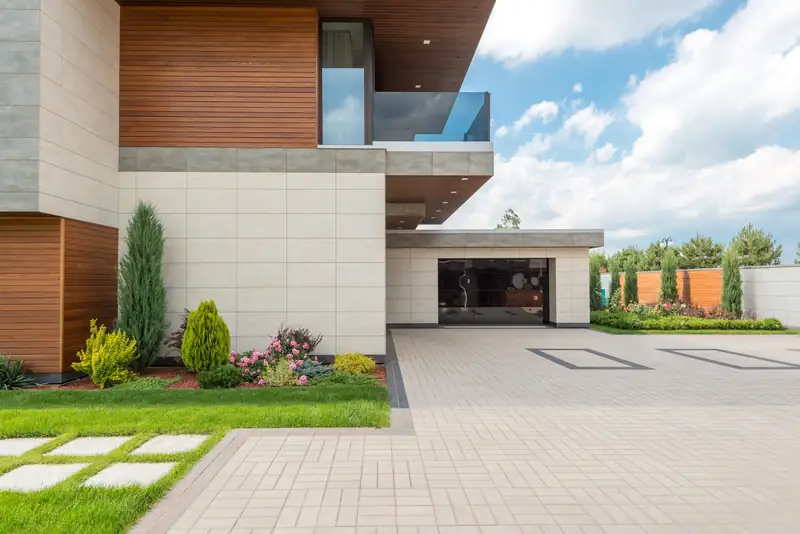
Paver Driveways · Ocoee, FL
Paver Driveways for Ocoee Homes
Figure $10–$30 per sq ft installed for a paver driveway in Ocoee heading into the final quarter of 2026. With the city's typical home dating to 2000, paver work splits fairly evenly between first installs on newer construction near the SR 50 corridor and replacements on older driveways closer to downtown.
By the Opera Concrete & Pavers estimating team · Updated October 1, 2026
Get a free estimate
Tell us about the project and we'll call to set up a free site visit.
Material doesn't change the paperwork
Ocoee's building review doesn't treat pavers differently from poured concrete; the same site-plan-and-description requirement applies to "concrete slab, patio, driveway, or pavers" as one category (City of Ocoee, Building FAQ). A paver driveway that widens toward the street still routes the apron section through the separate right-of-way application, the same as a poured one would (City of Ocoee, Right-of-Way Permitting).
Joint sand or polymeric sand: what the spec leaves open
ICPI's own spec treats joint sand plainly: dry sand swept into the eighth-inch joints and compacted in place, with sealers or joint sand stabilizers listed as optional rather than required. Polymeric sand is the common stabilizer choice, meant to bind in the joint and resist the ordinary washout that plain sand can see over time, but the spec doesn't mandate it for a standard residential driveway. That leaves it as a real decision for a Ocoee homeowner rather than a box every crew checks the same way: plain sand costs less and can be swept back in after a pressure wash, while a stabilized joint holds up longer between resweeps but costs more up front. Either way the joint itself keeps the same eighth-inch tolerance.
A paver driveway on newer fill near the business corridor, worked out in square feet
A 24 by 22 ft paver driveway on a recently built lot comes to 528 sq ft, and at $10–$30 per sq ft installed, that job runs roughly $5,280 to $15,840 depending on the paver style and base depth. On ground graded within the last few years, a base crew typically spends extra time confirming compaction before setting bedding sand, since fill that hasn't been through a full rainy season yet can still settle unevenly under a vehicle load.
New rooftops near the SR 50 corridor mean more first installs
The city's own figures point to West Oaks Mall and Orlando Health Central Hospital anchoring the "Fifty West Business Corridor," the commercial spine that newer residential growth has followed over the past two decades (City of Ocoee, Facts & Figures). Subdivisions built up around that corridor skew newer than the city's 2000 median, which is why a paver crew working that side of Ocoee sees more fresh-fill lots than it does closer to the older blocks ringing Starke Lake.
Tire-turning wear at the same spot, every day
A driveway sees a narrower range of tire motion than a street does: the same vehicle turning into the same garage bay, day after day, concentrates scrubbing force on a small area instead of spreading it across the whole surface. On a standard 60 mm paver sized for normal car traffic, that repeated turning and braking at one spot, especially near a garage apron, can scuff the surface finish and work joint sand loose faster than it does across the rest of a Ocoee driveway. It's one reason heavier vehicles, or driveways with a tight turning radius, are candidates for the thicker 80 mm paver and the stricter vehicular compaction standard rather than the standard driveway spec.
When the subgrade itself needs help before the base goes down
ICPI's spec admits its own 98 percent compaction standard may not be achievable in extremely saturated or very fine soils, and calls for stabilizing the subgrade instead of forcing the number on ground that won't take it. In practice that means dealing with the soil before a single scoop of aggregate base arrives, whether that's letting it dry out, adding a separation layer, or going with a different base depth altogether. A Ocoee lot with sand over a denser layer behaves differently than one that's sand straight down, and the subgrade step is where that difference gets handled instead of ignored. Skipping it is a common reason a paver driveway starts to dip within a year or two.
What rain does to a paver job mid-install
A paver driveway under construction is vulnerable to rain at a few specific points: an open excavation can fill and soften the exposed subgrade, a freshly screeded bedding sand layer can wash or rut before pavers cover it, and loose joint sand swept in but not yet compacted can migrate or wash out in a hard downpour. Orlando and Sarasota-Bradenton both average close to 50 inches of rain a year, much of it landing in a rainy season that runs roughly late May through mid-October, so a Ocoee schedule built during those months has to plan around afternoon storms rather than hope around them. Covering exposed sand and timing the joint-sand step for a dry stretch isn't optional scheduling, it's part of the process.
What efflorescence needs from you: nothing
The whitish bloom that can show up on new concrete pavers within the first couple of months doesn't call for a cleaner, a sealer, or a change in routine, because ICPI's spec is clear that it doesn't affect the structural performance of the pavers at all. It tends to fade on its own with normal weather and traffic, and scrubbing at it or sealing over it early can trap it rather than help it clear, so the honest advice for a Ocoee driveway showing this in its first season is to keep up the normal sweeping and let it wear off. Treating it as a maintenance problem instead of a normal early-life process is the only real mistake available here.
Frequently asked questions
Does a paver driveway in Ocoee need a different permit than a concrete one?
No. The city's building FAQ groups slabs, patios, driveways and pavers together under the same site-plan-and-description requirement, so a paver driveway goes through the identical review.
Is most new paver driveway work in Ocoee near the SR 50 corridor?
A meaningful share is, since residential growth has followed the commercial development along State Road 50 over the past two decades, putting more new-construction lots in that part of the city than near the older downtown core.
Does fresh fill on a new Ocoee lot change how a paver base is built?
It can. A crew typically checks compaction more carefully on recently graded ground than on an older, already-settled lot, since fill that hasn't gone through a full wet season can still shift.
Sources
- Census Bureau PEP, City and Town Population Totals, Vintage 2025 (July 1, 2025)
- SJRWMD Watering Restrictions
- Florida Senate Interim Report 2011-104 (sinkhole insurance)
- Florida Administrative Code — Rule 62-308.100, Synthetic Turf (effective May 19, 2026)
- Florida Statutes §125.572 — synthetic turf on single-family lots
- Orange County — A Guide for Residential Plan Approval
- NRCS OSD Candler
- NRCS OSD Tavares
- NRCS OSD Astatula
- NRCS OSD Myakka
- NRCS OSD Smyrna
- City of Ocoee, Building FAQ: concrete slab, patio, driveway and paver permits
- City of Ocoee, Building Division
- City of Ocoee, Right-of-Way Permitting
- City of Ocoee, Downtown
- City of Ocoee, Facts & Figures
- Census Reporter, Ocoee FL (ACS 2020-2024 5-yr, B25035/B01003)
- Wikipedia, Ocoee Street Historic District
- Wikipedia, Withers-Maguire House
Ready for a price on your project?
Request a free estimate
Tell us about the project and we'll call to set up a free site visit.