
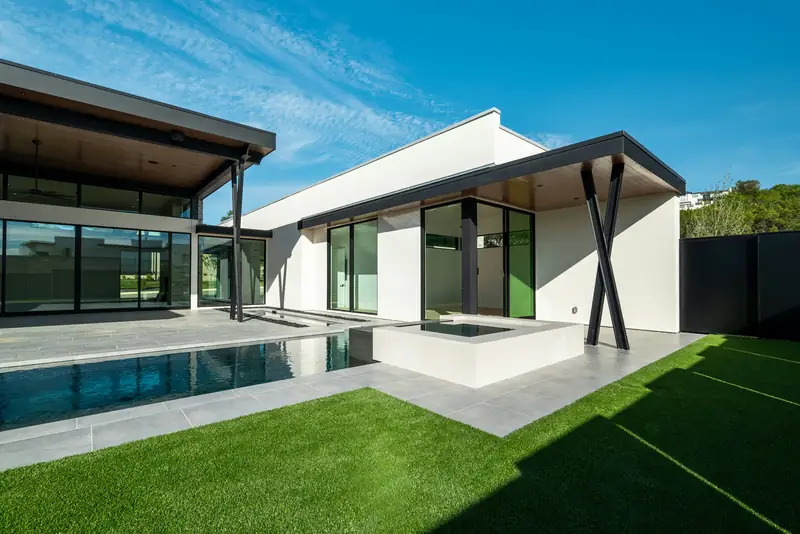
Artificial Turf · Ocoee, FL
Artificial Turf for Ocoee Yards
Turf installers are pricing Ocoee jobs at $10–$25 per sq ft installed this fall. The statewide 2026 turf rule sets the same base, infill and water-edge buffer here as anywhere else in Florida, and Orange County's inclusion on the state's own sinkhole-claims list is one more reason that base gets built to spec rather than skipped.
By the Opera Concrete & Pavers estimating team · Updated October 1, 2026
Get a free estimate
Tell us about the project and we'll call to set up a free site visit.
The 2026 turf rule applies the same way across Ocoee as anywhere else in the state
Florida's synthetic turf rule, in effect since May 19, 2026, calls for a washed, permeable subgrade, bars any buried irrigation line under the turf, and requires the panel to stay at least 10 feet from the edge of a pond, lake or canal unless a seawall already separates the two (Florida Administrative Code, Rule 62-308.100). A 2025 law limits how much further a city or county can tighten that standard (Florida Statutes §125.572). On a lot backing up to one of Ocoee's retention ponds or drainage canals, that buffer gets measured from the water's real edge, not from a fence line set back from it, before a turf layout is finalized.
A sound base matters on ground that sits inside the state's sinkhole-claims counties
A 2010 Florida Senate interim report, drawing on state insurance-regulator data, places Orange among the counties responsible for the bulk of Florida's sinkhole insurance claims filed between 2006 and 2009 (Florida Senate Interim Report 2011-104). That history doesn't mean a soft patch of yard is a sinkhole, but it is a reason the compacted, washed-stone base the state turf rule already requires gets built carefully rather than rushed, since a weak base under turf can pond the same water it was supposed to shed.
Why a side-yard turf strip needs its own drainage path
A narrow run of turf between the house and the fence collects more water than a wide-open lawn panel does, because roof runoff, AC condensate and the neighbor's grade all drain toward the same few feet. The base in a side yard at a Ocoee home has to be built with a slight fall away from the foundation, not flat, so water keeps moving instead of sitting under the turf backing. Washed crushed rock is compacted in the same thin lifts used anywhere else on the property, but the finished grade gets checked with a level across the whole run before turf goes down, since there's no second chance to fix a low spot once it's covered.
Working turf installation around a functioning pool
A pool deck install has to protect the coping and the water itself through every stage, so base material and turf offcuts get kept off the pool surface and out of the skimmer, and equipment pads stay covered while grading happens nearby. On a Ocoee pool deck, the final seam at the coping is usually placed last, once the rest of the panel is set and trimmed, so the most exposed joint in the whole job gets the most attention and the least foot traffic during cure. Pool chemicals and standing water near the work area also push drying and seaming steps later in the day than they'd run elsewhere in the yard.
Laying out turf against a drainage canal setback
Consider a 380 sq ft stretch of side yard that backs up to a drainage canal on an Ocoee lot: pulling the layout back the required 10 feet from the canal's edge trims off roughly 45 sq ft, leaving about 335 sq ft to actually turf. At $10–$25 per sq ft installed, that comes to somewhere between $3,350 and $8,375 depending on pile height and backing. Measuring from the canal's actual waterline, rather than guessing from where the grass currently stops, is what sets the real number before material gets ordered.
Choosing and setting turf around a pool deck
Turf around a pool gets fastened tight to the deck's edge restraint or coping bead, since that joint takes more foot traffic and more splash than any other seam in the yard. Chlorinated water and sunscreen residue don't break down most turf backings, but a seam placed right at the coping wears faster than a seam set back from the water, so the layout is planned to keep joints away from the busiest edge wherever it's practical. Infill still has to meet the state's natural-material rule even in a pool surround. On a Ocoee deck, drain lines and skimmer equipment get built around, with turf cut to the equipment rather than equipment moved to fit the turf.
Installing turf under a live oak without checking the drip line first
A live oak's drip line can extend well past where the canopy visually seems to end, and DEP Rule 62-308.100 bars turf inside that line unless a certified arborist certifies the install won't harm the roots. Skipping that step on a Ocoee property with a mature oak risks root damage during grading and base compaction, plus a rule violation that has nothing to do with how good the finished turf looks. Several Central Florida cities also protect large live oaks by ordinance, independent of the state turf rule, so a drip-line mistake near one of those trees can trigger a second problem on top of the first.
Keeping septic access clear under a turf lawn
DEP Rule 62-308.100 requires septic tank access to stay reachable even with turf installed over or near the drain field, which in practice means the access lid location on a Ocoee property is marked and either left turf-free or fitted with a removable panel rather than nailed down like the rest of the lawn. Pump-out crews need to reach that lid without cutting turf to find it, so marking the location clearly at installation saves a repair later. A turf panel nailed solid over a septic lid turns a routine pump-out into an unplanned turf repair.
Frequently asked questions
How close to a drainage canal can artificial turf go in Ocoee?
No closer than 10 feet from the water's actual edge under the statewide turf rule, unless a seawall or similar barrier already separates the lawn from the water.
Does Orange County's sinkhole-claims history affect turf installation in Ocoee?
Not as a direct rule, but it's a reason the washed, compacted base the state turf standard already requires gets built properly, since poorly draining ground is more likely to show problems on geology like this.
Can an HOA in Ocoee still restrict artificial turf beyond the state rule?
An HOA's own architectural guidelines sit outside the state law limiting city and county turf restrictions, so checking a specific community's rules is still worth doing before ordering material.
Sources
- Census Bureau PEP, City and Town Population Totals, Vintage 2025 (July 1, 2025)
- SJRWMD Watering Restrictions
- Florida Senate Interim Report 2011-104 (sinkhole insurance)
- Florida Administrative Code — Rule 62-308.100, Synthetic Turf (effective May 19, 2026)
- Florida Statutes §125.572 — synthetic turf on single-family lots
- Orange County — A Guide for Residential Plan Approval
- NRCS OSD Candler
- NRCS OSD Tavares
- NRCS OSD Astatula
- NRCS OSD Myakka
- NRCS OSD Smyrna
- City of Ocoee, Building FAQ: concrete slab, patio, driveway and paver permits
- City of Ocoee, Building Division
- City of Ocoee, Right-of-Way Permitting
- City of Ocoee, Downtown
- City of Ocoee, Facts & Figures
- Census Reporter, Ocoee FL (ACS 2020-2024 5-yr, B25035/B01003)
- Wikipedia, Ocoee Street Historic District
- Wikipedia, Withers-Maguire House
Ready for a price on your project?
Request a free estimate
Tell us about the project and we'll call to set up a free site visit.