
Artificial Turf · Montverde, FL
Artificial Turf for Montverde's Sloped Yards
Turf installation in Montverde runs $10–$25 per sq ft installed, current Florida figures for this fall. Lake County's current order allows only one watering day a week, and on a hillside lot where water already runs off faster than it would on flat ground, that single soak leaves new sod with even less to work with.
By the Opera Concrete & Pavers estimating team · Updated October 1, 2026
Get a free estimate
Tell us about the project and we'll call to set up a free site visit.
Slope plus one watering day makes for a hard combination
Under SJRWMD's Phase III Extreme Water Shortage order, Montverde addresses water once a week, odd-numbered on Saturday and even-numbered on Sunday, with nothing allowed between 8 a.m. and 6 p.m. (SJRWMD, Watering Restrictions). On a lot that drops toward Lake Apopka or one of the hills near Bella Collina, rainfall and irrigation alike run downhill before much of it soaks in, which is why new sod on a graded Montverde lot can struggle to establish even by the standard of a single-watering-day schedule, and why artificial turf gets asked about for the steepest section of a yard specifically.
Why a backyard putting green needs a flatter, finer base than a lawn panel
A lawn panel can tolerate a little waviness; a putting surface can't. The aggregate base under a backyard green in Montverde gets screeded and compacted in thinner lifts than a standard lawn area, so the finished plane reads true across slopes and breaks instead of showing every ripple in the subgrade. DEP Rule 62-308.100 still governs the material: washed crushed rock or crushed concrete, not limerock with fines, and the state rule caps how tight the subgrade can be compacted so water still percolates through it. A green that's compacted hard enough to putt true but still drains is a balance the base work has to get right the first time.
The 10-foot lake buffer matters more here than in a landlocked town
Florida's statewide synthetic-turf rule sets a minimum 10-foot gap between installed turf and the edge of a pond, lake or canal, dropped only where a seawall takes the place of open shoreline, and it calls for a washed base with natural infill rather than buried irrigation underneath (Florida Administrative Code, Rule 62-308.100). With Lake Apopka forming Montverde's northern edge, more properties here sit within reach of that buffer than in towns without a comparable shoreline, and a 2025 statute limits how far local government can tighten residential turf rules beyond the state standard (Florida Statutes §125.572).
Choosing and setting turf around a pool deck
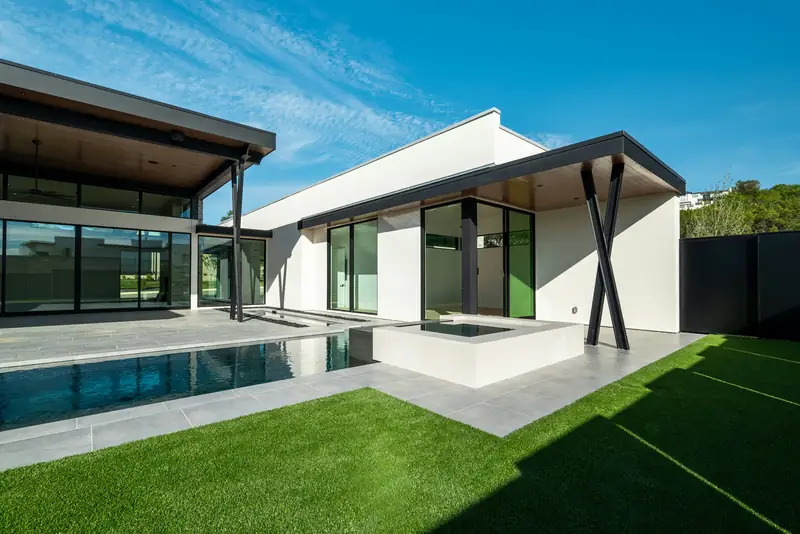
Turf around a pool gets fastened tight to the deck's edge restraint or coping bead, since that joint takes more foot traffic and more splash than any other seam in the yard. Chlorinated water and sunscreen residue don't break down most turf backings, but a seam placed right at the coping wears faster than a seam set back from the water, so the layout is planned to keep joints away from the busiest edge wherever it's practical. Infill still has to meet the state's natural-material rule even in a pool surround. On a Montverde deck, drain lines and skimmer equipment get built around, with turf cut to the equipment rather than equipment moved to fit the turf.
Turf on a graded slope above Lake Apopka, worked out in square feet
A side yard on a Montverde lot that slopes toward the lake, measuring 18 by 30 feet, covers 540 square feet once the required shoreline buffer is subtracted from the original footprint. At the $10–$25 per sq ft installed range, that comes to roughly $5,400 to $13,500 depending on the pile height and backing. Because the slope sheds water fast, the base underneath gets extra attention to drainage during installation so runoff doesn't undercut the turf's edge after a heavy storm.
Fitting a turf accent into an existing paver layout
Where turf goes in alongside pavers already set in Montverde, the process starts with removing a strip of pavers and bedding sand rather than grading an open yard. The exposed subgrade is excavated a little deeper to fit the washed aggregate base for the turf, then compacted against the paver's existing edge restraint so the two systems tie together instead of shifting independently. The turf panel is cut to the exact width of the removed strip and seamed along its paver-side edge before the field edge is finished. Removed pavers are either reused elsewhere on the property or set aside for the homeowner.
The problem with leaving an old sprinkler head under new turf
DEP Rule 62-308.100 bars using in-ground irrigation to water a synthetic turf area, which means every head that used to cover that zone has to be dealt with, not just switched off at the controller. A head left live and buried under turf in Montverde eventually pressurizes against the turf backing, finds a low spot or a seam, and pushes water up through it on a schedule nobody controls. What looks like a drainage problem months later is often an irrigation problem that was never actually fixed, just hidden under a new surface that made it harder to find.
Keeping turf clear of the drainage paths it sits next to
DEP Rule 62-308.100 bars turf from a swale, ditch, stormwater pond or a pond's littoral zone, and the same logic applies to ongoing care: infill, trimmed edges and loose debris from a Montverde yard shouldn't wash into those drainage features even when the turf itself is set back from them correctly. Keeping the turf's edge clean and the infill topped up where it borders a swale keeps material from migrating downhill during heavy rain. A drainage path that's been narrowed by stray infill or buildup over a season or two is worth clearing before it becomes a bigger problem for the whole street.
Frequently asked questions
Does Montverde's hilly terrain make artificial turf a better fit than sod?
On the steepest sections of a yard, often yes, since runoff on a slope leaves less time for a single weekly watering to soak in than it would on flat ground, making new sod harder to establish there.
How close to Lake Apopka can artificial turf be installed in Montverde?
At least 10 feet back from the shoreline under the state's synthetic-turf rule, unless the edge is a seawall. No irrigation can be buried under the turf itself either way.
Does Montverde's own code add turf rules on top of the state standard?
The published Section 4-84 language covers driveways and aprons specifically; for turf, the 2025 state statute and the DEP rule are the primary framework, and confirming any town-specific add-on is worth a call to the Building Department.
Sources
- Town of Montverde, Ordinance 2022-18, Land Development Code §4-84
- Town of Montverde, Building & Permitting Department
- Wikipedia, Montverde, Florida
- Census Reporter, Montverde, FL
- Bella Collina Golf Club, Course Overview
- Point2Homes, Montverde, FL Demographics
- NRCS OSD Candler
- NRCS OSD Tavares
- SJRWMD Watering Restrictions
- Florida Administrative Code — Rule 62-308.100, Synthetic Turf (effective May 19, 2026)
- Florida Statutes §125.572 — synthetic turf on single-family lots
Ready for a price on your project?
Request a free estimate
Tell us about the project and we'll call to set up a free site visit.