
Concrete Driveways · Lakewood Ranch, FL
Pouring or Widening a Concrete Driveway in Lakewood Ranch
A concrete driveway in Lakewood Ranch runs $6–$15 per sq ft installed as of October 2026. Most homes here were built around 2014, so driveway work tends to mean widening or replacing a builder-spec pour rather than resurfacing decades of wear, and which county reviews the permit depends on which side of the community line the lot sits on.
By the Opera Concrete & Pavers estimating team · Updated October 1, 2026
Get a free estimate
Tell us about the project and we'll call to set up a free site visit.
Why the permit office depends on which side of the line you're on
On the Manatee County side, about three-quarters of the community by area (Census Reporter, Lakewood Ranch CDP geography), any driveway reaching from the property line to the edge of the roadway pavement needs an access and drainage permit under LDC §1004.2, filed through the Public Works Infrastructure Engineering Division (Manatee County LDC §1004.2). On the Sarasota County side, the same scope of work falls under the county's Right-of-Way Use Permit, required for all work inside the county right-of-way (Sarasota County Code §124-48). Neither permit is the community's own review; the Modification Request Form that Community Association Services processes runs on a separate track afterward.
Why an L-Shaped Driveway Panel Is a Problem Before It's Poured
Joint layout is not just about spacing, it is also about shape. Guidance on control joints calls for panels that come out close to square, with the length no more than about one and a half times the width, and specifically warns against L-shaped panels. A driveway in Lakewood Ranch that wraps around a porch step or a utility pad often tempts a layout with exactly that shape, and an L-shaped section concentrates stress at the inside corner no matter how well the rest of the slab is built. We plan extra joints into that corner at layout time instead of hoping the shape holds on its own.
A two-car driveway on the Manatee side, worked out in square feet
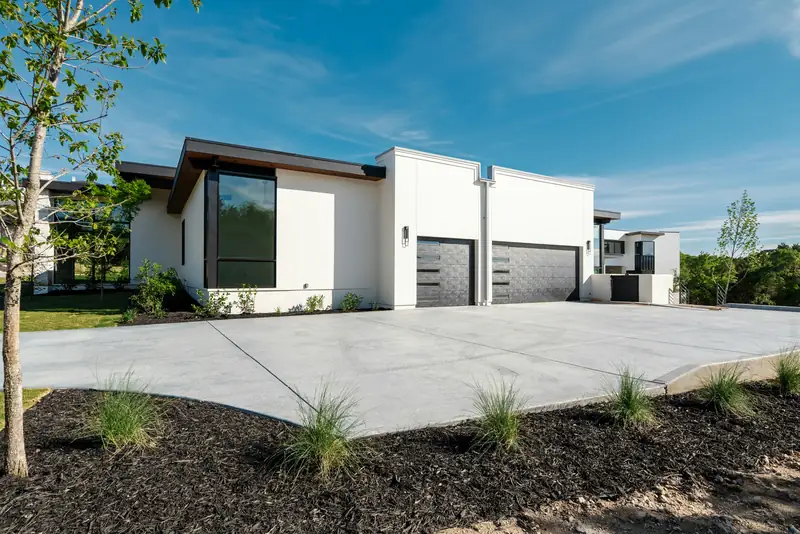
Say a two-car driveway on the Manatee County side of Lakewood Ranch measures 20 by 24 feet, 480 square feet, and the household wants it widened to fit a third vehicle alongside the county's access and drainage permit review. At $6–$15 per sq ft installed, a straight repour of that footprint lands between $2,880 and $7,200, narrowing to roughly $3,840 to $5,760 in the typical $8–$12 band. Because the home dates to the community's 2014 median year, the existing slab is usually sound enough that the job is a widening rather than a full tear-out, and widening past the original footprint means a fresh look at the 12-to-24-foot width cap before the county signs off.
Manatee's own width and thickness spec, where it applies
On the Manatee side, the county's Driveway and Culvert Application sets a 12-foot minimum and 24-foot maximum width for a residential driveway, widening to 30 feet for a street-facing three-car garage, with the slab itself 6 inches thick from the edge of the roadway pavement to the right-of-way line and an expansion joint set between the curb and the new concrete (Manatee Driveway and Culvert Application). The application also rules out a shell driveway apron next to a paved road. Applications go in through the county's Accela portal under Building > Public Works > Driveway/Culvert (Manatee County, Request a Driveway or Culvert Permit).
A Driveway Can Lift Years After the Tree Was Already There
Live oak roots keep growing long after a driveway is poured, and a root that was not a problem at install can lift a slab edge five or ten years later. Orlando, Winter Park and Sarasota all protect larger trees by ordinance, and cutting into a protected root system without a permit can be a code violation even if the tree itself looks like it is just dropping leaves on the driveway. A Lakewood Ranch homeowner who notices a slab edge starting to tent near a mature tree is better off checking the local tree ordinance before calling anyone with a saw, since the fix has to account for the tree's status, not just the concrete.
What a Flatwoods Lot Means for the Subgrade
Much of Greater Orlando and the Suncoast sits on flatwoods soil series like Myakka, Smyrna, Immokalee, EauGallie and Pomona, which hold a water table within 18 inches of the surface for one to four months most years. That is workable ground for a driveway, but only if we test it before pouring instead of assuming it behaves like the lot next door. Wet, weak native soil will not compact to a stable subgrade no matter how long a plate compactor runs over it. On a Lakewood Ranch property with this kind of soil, we remove the saturated layer and build up with compacted fill rather than forming directly on soggy ground, which is what keeps the slab from settling unevenly within a few years.
Demolition Day Looks Nothing Like Pour Day
Replacing an existing driveway starts with tearing out what is there, breaking up and hauling off the old slab before any new base work begins. That is a separate phase from forming, grading and pouring, and on a Lakewood Ranch job it usually happens on its own day or two rather than the same day as the new pour. Once the old concrete is gone, we can finally see and test the subgrade underneath it, which sometimes changes the plan if the soil under a decades-old slab turns out wetter or weaker than expected. Skipping ahead to forming before demolition is fully cleared is how schedules slip.
Checking Irrigation Timing Against a New Driveway
On the Orlando side of the service area, the year-round rule caps each irrigation zone at about an hour, with up to three-quarters of an inch of water, run on specific days by address, while the Sarasota and Manatee side is currently under a stricter once-a-week schedule tied to the last digit of the address. Either way, it is worth confirming a Lakewood Ranch driveway's edge sits outside a zone's spray pattern once the new restrictions and the new concrete are both in place, since a head that barely clears an old garden bed may land differently relative to a driveway that was not there before. A quick adjustment after the schedule changes costs nothing and saves the slab years of overspray.
Frequently asked questions
Which office issues a driveway permit in Lakewood Ranch?
It depends on the lot's location: Manatee County's Public Works Infrastructure Engineering Division on the Manatee side, under an access and drainage permit, or Sarasota County's Right-of-Way Use Permit on the Sarasota side. Confirming which side a given address falls on is the first step.
How wide can a driveway be on the Manatee County side?
12 feet minimum and 24 feet maximum for most residential driveways, with an exception up to 30 feet for a street-facing three-car garage, under the county's own Driveway and Culvert Application.
Do I still need the community's approval if the county issues a permit?
Yes. The county permit and Community Association Services' Modification Request Form are two separate reviews. Our Lakewood Ranch ARC guide covers which form applies to which village.
Sources
- Census Reporter, Lakewood Ranch CDP FL (ACS 2020-2024 5-yr, B01003/B25035)
- Census Reporter geography parents, Lakewood Ranch CDP
- Census 2024 Gazetteer, Florida places
- Lakewood Ranch / Schroeder-Manatee Ranch, About Us
- Lakewood Ranch Town Hall, CEVA Homeowners' Manual 2022
- Lakewood Ranch CEVA Modification Request Form
- Lakewood Ranch GBVA-SRVA Modification Request Form
- Manatee County LDC §1004.2 Access and Drainage Permit
- Manatee Driveway and Culvert Application (2022)
- Manatee — Request a Driveway or Culvert Permit
- Manatee — Inspections Required for Paver Driveways
- Manatee — What Does Not Require a Permit (6-16-26)
- Manatee County LDC §511.16 Swimming Pools, Spas, Screen Enclosures
- Sarasota County Code §124-48 Right-of-Way Use Permit
- Sarasota County Code §98-3 Driveway culvert / ROW use permit fees
- Sarasota County Code §124-255 Additional Provisions (culverts)
- Sarasota County Code §22-63 (retaining walls > 4 ft engineered)
- Sarasota County Building (search excerpt; 403 to direct fetch)
- SWFWMD District Water Restrictions
- Manatee County - Modified Phase III water shortage restrictions
- NRCS OSD Myakka
- NRCS OSD EauGallie
- NRCS OSD Immokalee
- Florida Administrative Code — Rule 62-308.100, Synthetic Turf (effective May 19, 2026)
- Florida Statutes §125.572 — synthetic turf on single-family lots
- F.S. 720.3045 (2026) Installation, display, and storage of items
Ready for a price on your project?
Request a free estimate
Tell us about the project and we'll call to set up a free site visit.