
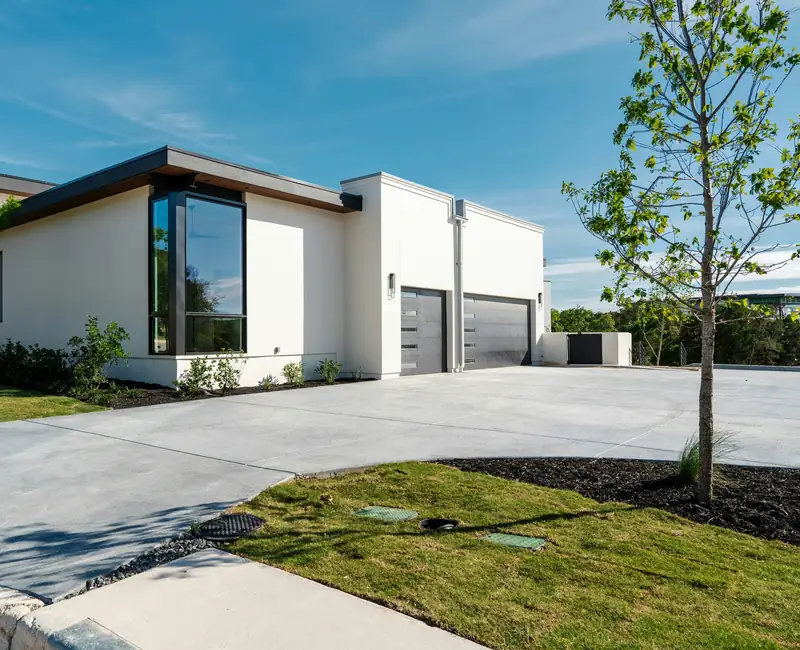
Concrete Driveways · Groveland, FL
Pouring a Concrete Driveway in Groveland
A new or replacement concrete driveway in Groveland is pricing at $6–$15 per sq ft installed heading into late 2026, by current Florida contractor figures. City Hall treats the job as a zoning permit rather than a building permit, built around an impervious-surface worksheet, and concrete is only one of several surfaces the Florida Vernacular code names as approved.
By the Opera Concrete & Pavers estimating team · Updated October 1, 2026
Get a free estimate
Tell us about the project and we'll call to set up a free site visit.
A zoning application and an impervious-surface worksheet replace a flat permit fee
Groveland's checklist for a new driveway asks for a zoning application, a property record card and a dimensioned site plan, plus the lot's impervious-surface math worked out on the city's own form; where the lot sits inside a subdivision with an HOA, an approval letter from that association goes in the same packet (City of Groveland, Pavers or Concrete Slab Checklist). No set fee is printed on the form, so a call to the Building Division, 352-429-2141 option 2, or an email to [email protected], pins down the current one for a specific address before a crew is scheduled.
Florida's Minimum Isn't What We Build a Driveway To
Florida's residential code sets 3 1/2 inches as the minimum thickness for a slab on the ground, but that number is written for ordinary floors, not a surface that takes a car's full weight every day. For daily passenger traffic, we build a Groveland driveway a full 4 inches thick, poured at a strength in the 3,000 to 4,000 psi range. The extra half inch over the code minimum is not padding: it gives the slab room to carry point loads, like a jack stand or a trailer tongue, without stressing the edge of what code treats as acceptable. Garage floors and carports fall under the same code section but carry their own strength requirement by weathering exposure.
A driveway widening on a recently platted lot, worked out in square feet
A Groveland homeowner adding a 10-foot-wide, 22-foot-long extension alongside an existing one-car driveway picks up 220 square feet to park a second vehicle off the street. Figured against the $6–$15 per sq ft installed range, that addition lands somewhere around $1,320 to $3,300, not counting any saw-cut tie-in to the existing slab. Because the city's impervious-surface worksheet totals the driveway against the house, porch and any patio already on the lot, running that math on a current survey before the extension is designed is what keeps the project inside whatever ratio Planning confirms for that subdivision.
Concrete is one approved surface among several, not the only option on the list
Article 6 of the city's Community Development Code names brick pavers, compacted clay, gravel, crushed oyster shell and concrete as approved driveway materials, with staff approval required for anything outside that list, and it rules out recycled concrete and phosphogypsum outright (City of Groveland, Article 6 (Florida Vernacular Requirements)). A straight concrete pour clears that list without extra review, which is part of why it stays the most common choice for a new Groveland driveway even though the code leaves room for gravel or clay instead.
No License Required Doesn't Mean No Rules Apply
Florida law bars local governments from requiring a license specifically for driveway installation, but that exemption does not do away with permits, and a Groveland jurisdiction can still require one for the work. It is narrower than it sounds at first. Separately, as of the 2026 statutes, an HOA cannot require a building permit to already be issued before it will even review a project, which changes the order some homeowners assume these steps happen in. Treating a license exemption as blanket permission is how a driveway project runs into a stop-work order or an HOA dispute that proper sequencing would have avoided.
Grading the Driveway Away From the Garage Slab
A driveway that slopes toward the garage instead of away from it sends every afternoon storm straight at the house. Florida code requires fill to be compacted for uniform support, and part of getting that right is shaping the subgrade so water sheets off the surface and away from the foundation rather than pooling at the threshold. On a flat Groveland lot, that sometimes means building the far edge of the driveway up slightly more than the garage end, even when the difference is not visible to the eye. It matters most on flatwoods soils that already hold water close to the surface for months at a time.
Demolition Day Looks Nothing Like Pour Day
Replacing an existing driveway starts with tearing out what is there, breaking up and hauling off the old slab before any new base work begins. That is a separate phase from forming, grading and pouring, and on a Groveland job it usually happens on its own day or two rather than the same day as the new pour. Once the old concrete is gone, we can finally see and test the subgrade underneath it, which sometimes changes the plan if the soil under a decades-old slab turns out wetter or weaker than expected. Skipping ahead to forming before demolition is fully cleared is how schedules slip.
Telling Normal Cracking From Something Worth a Call
A hairline crack along or near a control joint, especially in a driveway with large panels or a few years on it, is typically ordinary shrinkage and settlement, not a structural problem. What is worth a call is a sudden, visible depression, especially paired with cracking that reaches a structure rather than just the driveway surface, since that combination is closer to what Florida law treats as a catastrophic ground cover collapse. For a Groveland homeowner, the practical rule of thumb is that gradual change over months is normal monitoring, while anything abrupt is worth a quick look rather than waiting for the next routine check.
Frequently asked questions
Does a new driveway in Groveland need a building permit?
It's reviewed as a zoning permit instead, with a site plan, an impervious-surface calculation and an HOA approval letter where the subdivision has one. The city's own form doesn't list a flat fee, so Building Division confirms the current one by phone or email.
Can a Groveland driveway be built in gravel instead of concrete?
Yes. The city's Florida Vernacular code approves gravel, compacted clay, crushed oyster shell and brick pavers alongside concrete; anything outside that list needs Community Development staff approval before it's installed.
Is recycled concrete allowed for a Groveland driveway base or surface?
No. Article 6 of the city's Community Development Code specifically prohibits recycled concrete as a driveway material, along with phosphogypsum.
Sources
- City of Groveland, Building Division — Pavers or Concrete Slab Checklist
- City of Groveland, Community Development Code — Article 6, Florida Vernacular Requirements
- City of Groveland — Our History
- Wikipedia — Groveland, Florida
- Wikipedia — South Lake Trail
- Census Reporter — Groveland, FL
- NRCS OSD Candler
- NRCS OSD Astatula
- SJRWMD Watering Restrictions
- Florida Administrative Code — Rule 62-308.100, Synthetic Turf (effective May 19, 2026)
- Florida Statutes §125.572 — synthetic turf on single-family lots
Ready for a price on your project?
Request a free estimate
Tell us about the project and we'll call to set up a free site visit.