
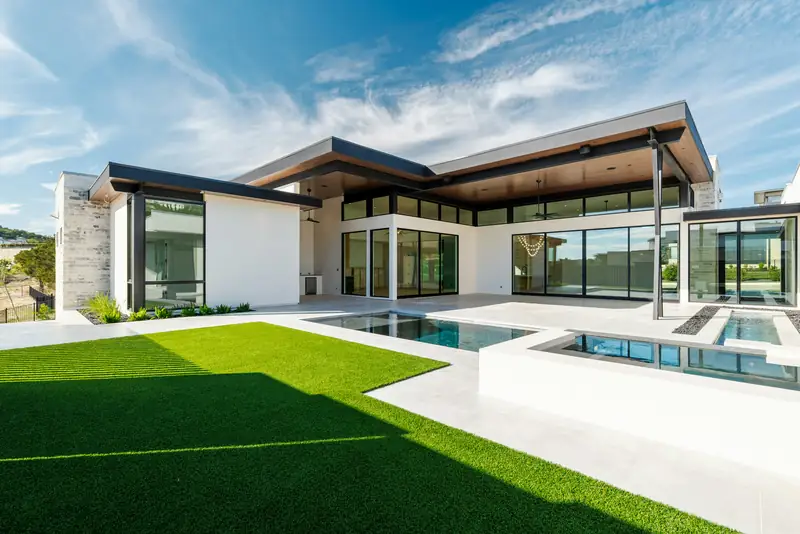
Concrete Pool Decks · Dr. Phillips, FL
Concrete Pool Decks for Dr. Phillips Homes
A concrete pool deck in Dr. Phillips runs $5–$15 per sq ft installed as of October 2026. Orange County sits on a state list of counties with the heaviest run of sinkhole insurance claims, which makes an honest look at a settling deck worth doing, even though ordinary fill settlement explains most of what actually shows up.
By the Opera Concrete & Pavers estimating team · Updated October 1, 2026
Get a free estimate
Tell us about the project and we'll call to set up a free site visit.
Replacing a dipped pool deck section, worked out in square feet
Picture a 1990s-era pool on a Clubhouse Estates lot where a 200 square foot section of deck near one corner has settled about half an inch below the rest. Repouring that section after confirming it's ordinary fill settlement, not a void underneath, runs roughly $1,000 to $3,000 at the $5–$15 per sq ft installed range, with a plain broom finish at the lower end and a decorative cool-touch texture pushing it higher.
A state claims list, read carefully
A 2010 Florida Senate interim report, citing state Office of Insurance Regulation data, found that just eleven Florida counties accounted for more than 88 percent of sinkhole insurance claims paid between 2006 and 2009, and Orange is on that list (state sinkhole-claims report). That figure describes insurance claims countywide, not a Dr. Phillips-specific rate, and a dipped corner on an older pool deck is still far more often ordinary settlement over compacted fill than a sinkhole, but it's a fact worth knowing before assuming either explanation without a look at the pattern of the cracking.
What a Kool Deck-Style Coating Actually Is
A spray texture or Kool Deck-style coating is not a structural pour, it's a thin acrylic cement topping troweled or sprayed over a cured concrete base slab to add texture, color and some heat reflectance. Market ranges put that coating at roughly $3 to $6 per square foot in Central Florida, well under the $5 to $15 per square foot a full new concrete pour runs. A Dr. Phillips homeowner resurfacing instead of replacing is paying for surface texture and color, not a new slab underneath, so a coating only makes sense when the base concrete is still structurally sound, without the cracking or settling that signals a deeper problem.
The ground under the deck shifts character across the community
West Orange County's soil runs from excessively drained Candler and Tavares sand on the ridge side to poorly drained Myakka and Smyrna flatwoods soil holding a shallow water table for months at a stretch (Candler soil survey; Smyrna soil survey), and Dr. Phillips sits in the transition band between the two. Laying out a deck's compacted base starts from whichever side of that line a given lot falls on, since a pour over the flatwoods soil generally wants a deeper base than the same deck would need over fast-draining sand a few streets away.
Base Work Where a Screen Cage Footer Lands on the Deck
Most pool decks in this market get enclosed by a screen cage before the job is finished, and the cage's aluminum posts land on isolated concrete footers, not on the deck slab itself. We pour those footers first and set an isolation strip between the footer and the surrounding deck so the two can move independently. On a Dr. Phillips job, skipping that isolation strip lets the deck slab crack outward from the footer the first time the ground beneath either one shifts even slightly. Coordinating footer layout with the screen company before the deck forms go up keeps that joint in the right place the first time.
Slip Risk Where the Deck Stays Wet Longest
The section of deck closest to the pool, and any shaded strip under a lanai roof or a stand of trees, stays damp longer after each swim session or rain than the open sun-facing side, and that combination of standing moisture and algae film is where most slip incidents on a pool deck actually happen. A smooth or heavily sealed finish makes that worse, since sealing can fill in the texture a broom finish or acrylic coating was supposed to provide. On a Dr. Phillips deck, the shaded or splash-zone sections are worth checking for a slick film more often than the rest of the surface, since they develop the problem faster and show it less obviously.
Demolition Around a Pool That Still Has Water In It
Replacing an old deck around a pool that's staying in place means cutting and removing concrete within inches of the water without cracking the bond beam or dropping debris into the pool. We saw-cut a clean line a few inches off the coping before breaking out the field concrete, leaving a narrow buffer to hand-remove rather than running heavy equipment right at the water's edge. On a Dr. Phillips job, covering the pool before demolition starts is a cheap step that saves a full pool cleaning and chemical rebalance afterward, since concrete dust and chips are far more work to filter out of pool water than to keep out in the first place.
Resealing or Recoating a Deck on Its Own Schedule
There's no fixed resealing interval for a concrete sealer or an acrylic coating like Kool Deck, the same way ICPI gives no set number of years for paver sealers, so the better signal on a Dr. Phillips deck is watching the surface rather than counting calendar years. Water that used to bead now soaks in, color that's gone chalky or faded, or a texture worn smoother than it used to feel underfoot all point to a coating or sealer that's due. A deck that sees heavy pool traffic and constant chlorine or salt exposure typically needs that attention sooner than a shaded patio ever would.
Frequently asked questions
Does Orange County's place on the sinkhole-claims list mean a Dr. Phillips pool deck is at risk?
Not specifically. The county's position on the state's 2006-2009 claims list describes insurance activity across all of Orange County, not a Dr. Phillips rate, and most dipped deck sections trace to ordinary fill settlement rather than a sinkhole.
Is the soil the same under every Dr. Phillips pool deck?
No. The community sits where excessively drained ridge sand on one side gives way to wetter flatwoods soil on the other, so the base depth that works for one deck doesn't necessarily carry over to a lot a few streets away.
What should be checked before repouring a settled section of pool deck?
Confirming whether the dip traces to compacted fill settling normally or to a void underneath changes the fix. A site visit before the forms go up is what settles that question rather than guessing from the surface crack alone.
Sources
- Orange County Division of Building Safety
- Orange County — Do I Need a Permit
- Orange County — Residential Pavers
- Orange County — ROW Utilization Permit directory
- Orange County — Municode Ch. 21 Art. VI ROW Utilization
- Orange County — Residential Lot Grading Policy 2023
- Orange County — A Guide for Residential Plan Approval
- Orange County, Tree Removal Permit
- SJRWMD Watering Restrictions
- Florida Administrative Code — Rule 62-308.100, Synthetic Turf (effective May 19, 2026)
- Florida Statutes §125.572 — synthetic turf on single-family lots
- F.S. 720.3045 (2026) Installation, display, and storage of items
- Florida Senate Interim Report 2011-104 (sinkhole insurance)
- NRCS OSD Candler
- NRCS OSD Tavares
- NRCS OSD Myakka
- NRCS OSD Smyrna
- Wikipedia, Dr. Phillips, Florida
- Census Reporter, Doctor Phillips, FL (ACS 2024 5-yr)
- Florida Neighborhood Realty, Restaurant Row in Dr. Phillips
- MarketConnect Realty, Phillips Landing homes
- FDEP, Outstanding Florida Waters fact sheet
- Point2Homes, Doctor Phillips demographics
Ready for a price on your project?
Request a free estimate
Tell us about the project and we'll call to set up a free site visit.