
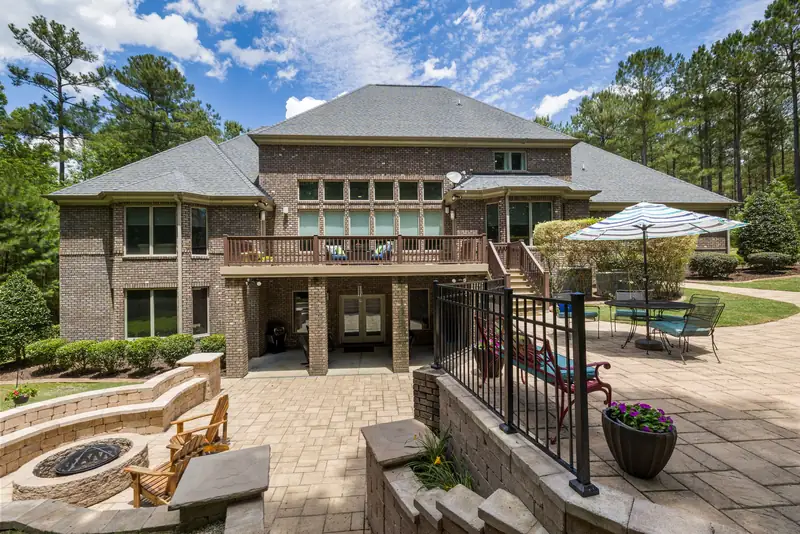
Paver Patios & Walkways · Clermont, FL
Paver Patios and Walkways for Clermont Homes
$10–$17 per sq ft installed is the going Florida range this October 2026 for a paver patio in Clermont. In Kings Ridge, a 55-and-over community in Clermont, no exterior change clears without sign-off from two separate committees, and with the city's median home dating to 2006, a lot of paver-patio work here is an extension of a still-fairly-new builder slab rather than a full tear-out.
By the Opera Concrete & Pavers estimating team · Updated October 1, 2026
Get a free estimate
Tell us about the project and we'll call to set up a free site visit.
A Kings Ridge patio extension, worked out in square feet
A Kings Ridge lanai patio extended with 260 square feet of pavers has to clear both the Neighborhood Architectural Review Committee and the community-wide Architectural Control Committee before the first paver is set. Applying the $10–$17 per sq ft installed range to that footprint prices the job between about $2,600 and $4,420, depending on the paver and base depth. Submitting to only one of the two committees doesn't clear the project; the community's own guidance is explicit that both have to sign off before pavers go down.
Kings Ridge requires two committees to sign off before work starts
Kings Ridge's own community FAQ spells out a two-step review: a Neighborhood Architectural Review Committee looks at the application first and helps a resident match the guidelines, then the community-wide Architectural Control Committee gives the final approval or denial, and the page states plainly, “please do not make any change without having first received the approval of both the NARC and ACC” (Kings Ridge Community, Frequently Asked Questions). Some individual neighborhoods inside the community can layer on stricter rules of their own, so confirming which guideline applies to a specific address comes before a paver patio design is finalized.
Why edge restraint isn't optional on a patio
Every paver field needs a continuous edge restraint around the perimeter and anywhere the paving material changes, whether that's plastic, aluminum or steel. The spikes that hold it down drive into the compacted aggregate base, not into the native soil beneath it, since soil alone won't hold a spike against the outward push of thousands of interlocking pavers. A strip of plastic landscape edging meant for a flower bed is not a substitute; it isn't rated for that job. On a Clermont patio bordered by turf or mulch, a proper restraint is what keeps the outer courses from creeping outward season after season until the edge joints open up.
A 2006 median build year means a lot of extensions, not tear-outs
Clermont's population climbed from 42,992 in 2020 to about 52,812 by mid-2025, and the typical home here was built in 2006, the newest median construction year among the Orlando unit's incorporated cities (Census Bureau PEP, Vintage 2025; Census Reporter, Clermont). A patio that age is usually sound enough that paver work means extending an existing slab's footprint toward a lake view or a shaded corner of the yard, tying a new edge into the original pour rather than starting from a cracked, decades-old base.
Why a paver patio's base isn't the same as a driveway's
Patios and driveways both sit on a compacted aggregate base, but the two bases aren't built to the same spec. ICPI Tech Spec 2 calls for at least 4 inches of compacted base under a patio or walkway on well-drained soil, compared with at least 6 inches under a residential driveway, because a dining set and a grill load the ground far more lightly than a parked car. We still compact that base in lifts and check it against 98 percent of standard Proctor density before the bedding sand goes down. Skip that step on a Clermont lot and the first rainy season finds every soft spot for you.
Downspouts and sprinkler overspray undermining the edge
A gutter downspout aimed at the patio edge, or an irrigation head throwing water against the same spot every cycle, concentrates far more water on one section of base than the rest of the patio ever sees. Over time that washes fines out from under the nearest pavers, and the edge restraint, which relies on solid compacted base to hold its spikes, loses its grip. On a Clermont patio bordered by a sprinkler zone, redirecting the head or adding a splash block costs little compared with resetting a section of pavers that settled because the ground under it was quietly eroding for two seasons.
Scheduling a patio job around the rainy season
Central and southwest Florida both see a rainy season running roughly from late May into October, often arriving as a sharp afternoon storm rather than steady rain, which changes how a crew sequences the work. We try to get base compaction and bedding sand finished before midday on a Clermont job scheduled during those months, since a sudden downpour on exposed, uncompacted aggregate can wash fines out and force a section to be redone. Paver laying itself tolerates a light rain better than the base stage does, but joint-sand sweeping and compacting still wants a dry window to lock the sand in properly.
Keeping ants and weeds out of the joints
Compacted, properly topped-off joint sand is the simplest defense against both ants nesting and weed seed germinating between pavers, since loose or thin sand gives both something to work with. A quick sweep to clear organic debris like leaf litter and grass clippings off a Clermont patio before it decomposes into the joints also removes the organic matter weeds actually need to sprout. For an established ant problem in the joints, treating the colony directly works better than repeatedly re-sanding over it, since the ants will just re-excavate fresh sand the same way they did the old.
Frequently asked questions
How many committees review a paver patio in Kings Ridge?
Two: the Neighborhood Architectural Review Committee reviews it first, then the community-wide Architectural Control Committee gives final approval or denial. The community's own FAQ states that no change should be made without both approvals in hand.
How old are most existing patios in Clermont?
With a median home construction year of 2006, a lot of Clermont's original patio slabs are still well short of the age where resurfacing becomes the obvious call, which is part of why paver work here often means extending an existing slab rather than tearing it out.
Do individual Clermont neighborhoods add their own paver rules on top of an HOA's?
In communities like Kings Ridge, yes, some neighborhoods inside the larger community can set additional guidelines beyond the community-wide standard. Confirming which one applies to a specific address is worth doing before a design is finalized.
Sources
- City of Clermont — Building Services FAQ
- City of Clermont — Permit Checklists
- City of Clermont — Applications & Forms
- City of Clermont — Permit Type Descriptions
- City of Clermont — Municode Ch. 125 Div. 5 R-1
- City of Clermont, Economic Information
- Census Bureau PEP, City and Town Population Totals, Vintage 2025 (July 1, 2025)
- Census Reporter, Clermont FL (ACS 2020-2024 5-yr, B25035)
- Wikipedia, Sugarloaf Mountain (Florida)
- Lake County — Residential Work Exempt from Permits
- Lake County — Residential Driveway Apron Permit
- Lake County — LDR Appendix A Transportation Standards
- Lake County — Right-of-Way Permit
- Lake County — Building Services
- NRCS OSD Candler
- NRCS OSD Tavares
- NRCS OSD Astatula
- SJRWMD Watering Restrictions
- Florida Administrative Code — Rule 62-308.100, Synthetic Turf (effective May 19, 2026)
- Florida Statutes §125.572 — synthetic turf on single-family lots
- Florida Senate Interim Report 2011-104 (sinkhole insurance)
- Citizen Portal, Clermont City Council meeting summary — Sky Ridge Road paver variance
- Kings Ridge Community, Frequently Asked Questions
Ready for a price on your project?
Request a free estimate
Tell us about the project and we'll call to set up a free site visit.