
Front Walkway Ideas That Boost Curb Appeal
Front walkway ideas for Greater Orlando and Sarasota–Manatee homes range from a straight concrete walk at $7 to $17 per square foot to a curved paver path with stepping stones and turf-filled joints, as of October 2026. Width, curve and material each change how a front walk reads from the street without changing the base underneath it.
By the Opera Concrete & Pavers estimating team · Updated October 1, 2026
What Front Walkway Materials and Layouts Boost Curb Appeal?
A straight, single-width concrete walk from the driveway to the front door is still the most common front walkway in Florida subdivisions, mostly because it is the cheapest to form and pour, priced at $7–$17 per sq ft installed in Florida market data (src homeguide-sidewalk). A curved path, a paver surface, or a stepping-stone walk set into turf or gravel each cost more than a straight concrete run but do more to draw the eye toward the entry rather than straight down a driveway.
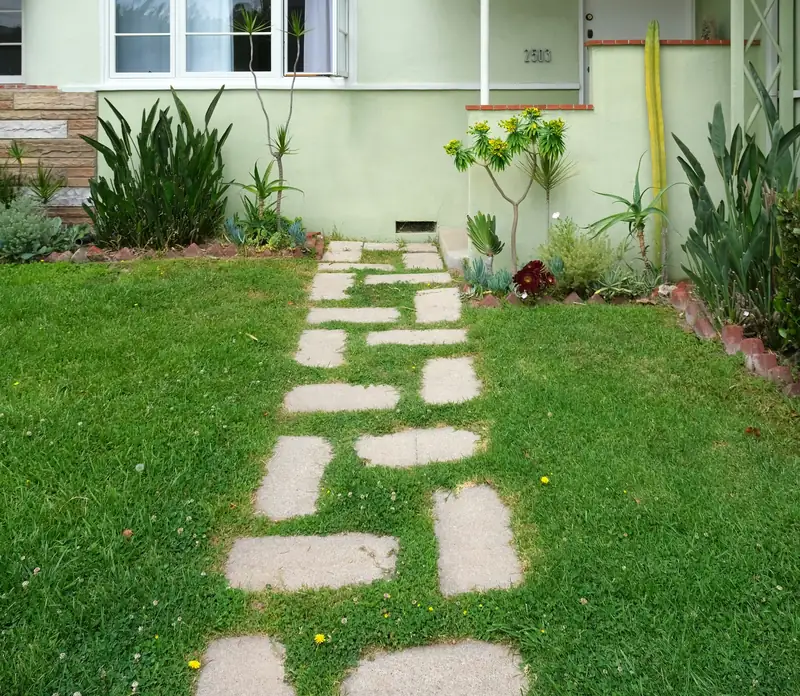
What Does a Curved Walkway Add Over a Straight One?
A gentle curve, even a shallow one that shifts a walkway just a few feet off a straight line, slows the eye down and makes a short distance from the driveway to the door feel like a planned entry rather than a direct shot across the yard. A curve also gives a path a practical reason to exist where a straight line would not: routing around an existing oak or palm's root flare, a utility pedestal or a drainage swale, rather than forcing concrete through or over an obstacle. Orlando treats any tree 6 inches or more in diameter at breast height as a protected tree, and encroaching into its required undisturbed area without a permit is unlawful, which is worth checking before a path's route near an older tree is finalized (City of Orlando Ordinance 2020-13, Tree Preservation).
Our guide to tree roots under a driveway or sidewalk covers how roots affect a path's base and what options exist once a tree is already close to an existing walk.
What Are Paver Stepping Stones With Turf or Ground Cover Joints?
Large-format concrete or paver stepping stones, spaced with a consistent gap and set into artificial turf, mulch or a low ground cover instead of a solid paved joint, create a casual, garden-path look that costs less than a full paver walk since less hard material covers the same distance. Florida's 2026 turf standard requires any synthetic turf base to be permeable and graded for positive drainage (src rule62-308-100-text), which a stepping-stone layout with turf-filled gaps already tends toward, since the joints between stones are the path's main drainage point anyway.
Spacing that matches a natural stride, roughly 24 to 30 inches center to center for most adults, keeps the path comfortable to walk rather than requiring a short hop between stones. A path meant for two people walking side by side generally needs a wider paved or paver strip rather than stepping stones at all.
What Paver Walkway Patterns Work Well at a Front Entry?
Running bond and basket weave both suit a front walkway better than herringbone does, since a walkway carries foot traffic rather than the turning and braking loads a driveway sees, so the stronger two-direction interlock herringbone offers matters less here than it does on a paver driveway. A soldier-course border along both edges of a paver or concrete walk is a simple way to define the path's width and tie its color into a paver driveway or patio elsewhere on the property.
An installed paver walkway prices in roughly the same $10–$17 per sq ft installed range as a small paver patio (src homeguide-pavers-sqft), since both are priced by similar labor and base-prep factors.
How Wide Should a Front Walkway Be, and What Changes the Width?
Width is mostly a comfort and visual-proportion call: a single-file path reads narrow and utilitarian next to a wide front porch, while a wider walk that lets two people walk side by side reads more like a deliberate entry feature. A path that splits around a landscape bed or a mailbox post generally looks better widened slightly at the split rather than narrowed down to meet it, so the two resulting legs still feel proportional to the main run. Our walkway page covers the specific width range most homes use and how it scales with porch size and driveway width.
Front Walkway Material Options Compared
| Material | Market price range | Note |
|---|---|---|
| Plain concrete | $7–$17 per sq ft installed | Cheapest; straight layouts form fastest |
| Curved concrete | Same range, more forming labor | Routes around trees and utilities |
| Paver walkway | $10–$17 per sq ft installed | Wide pattern and border choice |
| Stepping stones in turf | Lower total cost, fewer units | Needs a permeable, well-drained base |
Figures are Florida market ranges, not quotes.
Where Do Front Walkway Ideas Run Into HOA or Tree Rules?
A redesigned front walk is one of the more visible changes a homeowners association reviews, since it sits in the same sightline as the house's front elevation; our guide to HOA approval for pavers and concrete covers what that review typically asks to see. A path routed near a protected tree may also need a tree encroachment or removal permit in Orlando or a similar review elsewhere, well before the concrete or pavers go down.
Our concrete walkway cost guide and our paver patio cost guide both cover walkway pricing by material, and our clay brick vs. concrete pavers comparison is worth a look if a paver walkway's material, not its layout, is still the open question.
Frequently asked questions
Does a curved walkway cost more than a straight one?
Yes, generally, since a curve needs more forming for concrete or more cutting for pavers than a straight run of the same length covers. The added cost is usually modest compared with the overall cost of a short front walkway.
Can a front walkway be built around an existing tree's roots?
Often, by curving the path or stepping it slightly away from the trunk rather than cutting through the root zone directly, though a tree protected by a local ordinance may need a permit or an arborist's input before any excavation nearby.
Do stepping stones need a different base than a solid paver walkway?
Each individual stone still needs its own compacted base and a level setting bed, the same as a continuous paver field. What changes is that the gaps between stones are filled with turf, mulch or gravel instead of jointing sand.
What is the most budget-friendly front walkway material?
Plain poured concrete is generally the least expensive per square foot, with paver stepping stones set into turf or gravel often costing less in total than a full paved walkway of the same length, since fewer units cover the same distance.
Should a front walkway match the driveway material?
Not necessarily. Many Florida homes pair a concrete driveway with a paver or stepping-stone front walk, or the reverse, and a shared border color or paver tone is usually enough to tie the two together without matching them exactly.