
Paver Driveway Ideas for Florida Homes (Patterns, Borders and Colors)
Paver driveway ideas for Greater Orlando and Sarasota–Manatee homes mostly come down to pattern, border and color blend, all laid over the same compacted base regardless of the look chosen. As of October 2026, installed paver driveways run $10 to $30 per square foot in Florida market data depending on material, border and pattern complexity.
By the Opera Concrete & Pavers estimating team · Updated October 1, 2026
What Paver Patterns Suit a Florida Driveway?
Herringbone, laid at 45 or 90 degrees, is the pattern most often specified for a vehicle driveway because the way each unit interlocks with its neighbors in two directions resists the twisting force a turning tire puts on a paver field better than a pattern that only locks in one direction. Running bond and basket weave both work on a driveway too, but they lean more on the edge restraint at the border to keep from creeping under repeated turning than herringbone does on its own. Our paver driveway page covers the base and edge-restraint spec behind every pattern; this page is about choosing the look.
What Border and Edging Options Frame a Paver Driveway?
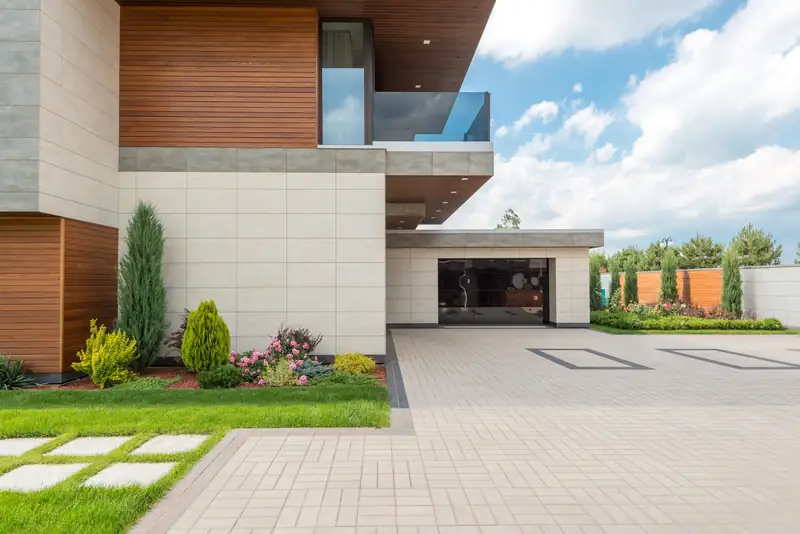
A border in a contrasting color or a different unit size, laid as a soldier course (units set end to end, perpendicular to the field) or a sailor course (units laid on their long edge), is the most common way to frame a driveway field without changing the main pattern at all. A simple single-color border reads clean and modern; a two-tone border, or a border that repeats a color from the house's trim or roofline, ties the driveway into the rest of the property more deliberately. Whichever border style gets picked, it still needs its own edge restraint underneath, invisible once the job is finished but doing the structural work of keeping the whole field from spreading outward over time, regardless of which pattern or color sits inside it.
What Paver Colors and Blends Work in Florida Light?
Lighter tans, grays and buffs absorb less heat than a dark charcoal field, consistent with the general physics behind any light-colored paving running cooler underfoot than a dark one in direct sun (EPA, cool pavements), which matters on a driveway that doubles as a place to stand while loading a car on a July afternoon. A blended run, two or three shades of the same paver mixed randomly across the field rather than laid in solid bands, also tends to hide everyday tire tracking, water spots and light staining better than a single solid color does, since the eye reads variation as intentional rather than as dirt. Before ordering material, check whether an HOA's architectural guidelines restrict paver color; our guide to HOA approval for pavers covers what that review typically looks at.
Circular, Courtyard and Motor-Court Driveway Layouts
A circular or looped driveway fits a wide lot with enough frontage to carry the curve without the radial cuts at the pattern's center eating too far into the budget; those center cuts are the main reason a circular layout costs more labor per square foot than a straight run of the same size. A courtyard or motor-court entry, a paved apron that widens in front of the garage or entry before narrowing back to the street, gives a multi-car household a place to park without lining cars up nose to tail. A landscaped island at the center of a circular drive, or a narrow turf strip splitting a wide motor court, breaks up a large paved area visually; turf set between pavers holds up to that kind of accent use without the irrigation and mowing a planted island needs.
Mixing Pavers With a Concrete Ribbon or Apron
A hybrid driveway, concrete tire ribbons running under each wheel path with pavers or turf filling the space between and around them, cuts material cost compared with an all-paver field while still breaking up the look of plain concrete. The opposite combination, a paver field with a plain concrete apron at the street, shows up where a jurisdiction specifies a particular apron thickness or finish that doesn't apply to the rest of the driveway. Our pavers vs. concrete driveway comparison covers the cost and upkeep trade-offs behind an all-paver versus all-concrete choice in more depth, and widening or extending a driveway is worth a read before adding a second strip or an RV pad next to an existing drive.
Paver Driveway Patterns Compared
| Pattern | Best for | Note |
|---|---|---|
| Herringbone, 45° | Standard vehicle driveways | Strongest interlock against turning and braking loads |
| Herringbone, 90° | Modern, rectilinear home styles | Same interlock strength, squarer visual grid |
| Running bond | Simple, budget-minded layouts | Leans more on edge restraint; fewer cuts at the border |
| Basket weave | Formal, symmetric entries | Pairs well with a soldier-course border |
| Circular or radial | Wide-frontage, looped driveways | More cutting and labor at the center than a straight run |
Any pattern can carry a vehicle load when the base and edge restraint underneath are built to the driveway spec, not the lighter patio spec.
Before You Choose a Pattern, Check Width, HOA Rules and Permit Limits
A pattern or border that works on paper can still run into a local width cap, an apron spec, or an HOA color restriction once it's time to pull a permit, so it's worth checking those limits before ordering material rather than after. Orange County and Orlando, Osceola County and Sarasota County each cover what their permitting offices actually require. Our guide to widening or extending a driveway and our guide to permeable pavers and drainage are worth reading too if the idea under consideration adds square footage or changes how water moves across the lot.
Frequently asked questions
Is herringbone the best pattern for a paver driveway?
It's the pattern most often specified for vehicle traffic because of how it interlocks in two directions, which resists the twisting force of a turning tire better than a pattern that only locks one way. Running bond and basket weave both still work on a driveway; they just depend more on a well-built edge restraint to stay in place over time.
Can I mix two paver colors in one driveway?
Yes, and a blended run of two or three shades is a common way to break up a large field and hide everyday tire tracking or light staining better than a single solid color does. A contrasting color is also commonly reserved for a border rather than mixed through the whole field, which frames the driveway without making the blend itself the focal point.
Do permeable pavers come in decorative patterns too?
Yes, permeable pavers install in most of the same patterns as standard concrete pavers, with wider joints filled by open-graded aggregate instead of sand to let water pass through. Our guide to permeable pavers and drainage covers when that drainage benefit is worth the different joint spec.
How much more does a border or multi-color pattern cost than a plain paver field?
A border or blended color run adds modest labor for the extra cuts and layout planning, without changing the per-unit material cost much on its own; the bigger cost swings come from the paver material itself, concrete versus brick versus natural stone. Our paver driveway cost guide breaks down material and labor by size.
Can an HOA reject my paver color choice?
Many master-planned communities do review paver color and pattern as part of architectural approval, separate from whatever building permit the driveway itself needs. Our guide to HOA approval for pavers covers how that review process typically works and what to submit before ordering material.