
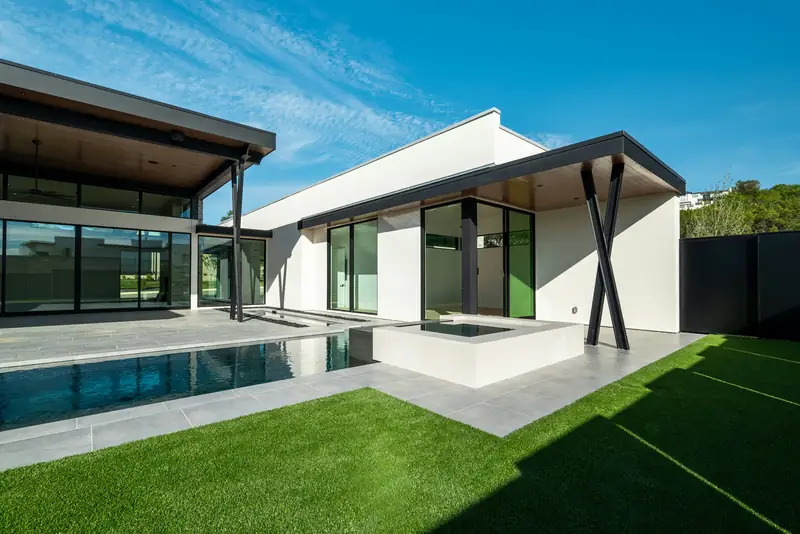
Pool Deck Pavers · Siesta Key, FL
Travertine and Paver Pool Decks on Siesta Key
Pool deck pavers or travertine on Siesta Key run $12–$30 per sq ft installed as of October 2026. A deck that steps down toward a canal or a seawall often needs a low retaining wall alongside it, and the county requires engineered drawings once that wall passes 4 feet.
By the Opera Concrete & Pavers estimating team · Updated October 1, 2026
Get a free estimate
Tell us about the project and we'll call to set up a free site visit.
Why a deck's retaining wall can trigger engineering the deck itself doesn't
Sarasota County's pool-code amendment requires engineered drawings for "all retaining walls greater than four feet in height," measured from grade at any point along the wall Sarasota County Code §22-63. A travertine or paver deck stepping down toward a seawall or a lower canal-side yard frequently needs a short retaining wall to hold the grade change, and that wall, not the deck surface itself, is usually what decides whether an engineer gets involved before the permit is filed.
What the salt load off the Gulf and the bay does to the finish
Bridge engineers classify a structure as sitting in a corrosive marine environment once it's within 2,500 feet of water testing above 2,000 parts per million chloride FDOT Structures Design Guidelines Vol. 1, §1.3.2 environmental classification, and a barrier island this narrow rarely has a lot that clears that distance from either the Gulf or the bay side. The paver base underneath a travertine deck doesn't need anything different for that reading, but the polymeric joint sand and any unprotected metal edge restraint give out sooner than the same materials would a few miles up the mainland, so resealing a Siesta Key deck is usually budgeted on a tighter schedule from day one.
Setting Pavers Directly Over an Existing Concrete Deck
Setting pavers over an existing concrete pool deck skips the excavation and compacted aggregate a ground-up install needs, but it isn't a shortcut on prep. We sound the old slab for soft or hollow spots with a hammer test, patch anything that fails, and clean the surface before a thin bedding layer, either a sand-set system on a membrane or a mortar-set bed, goes down to receive the pavers. On a Siesta Key overlay job, the old slab has to be structurally sound and draining correctly on its own, since an overlay doesn't fix a base problem underneath it, it just covers it over.
The Final Walk: Checking Drains, the Coping Joint and Every Loose Paver
With joints swept and compacted, we walk the finished deck checking every deck drain for flow, running a hose along the coping to confirm the flexible sealant joint is sealed end to end, and resetting any paver that rocks or sits proud in its sand bed before calling the job finished. On a Siesta Key deck, this final check with water running catches a slope problem a dry walk-through would miss entirely, since a flat or slightly misgraded section doesn't always look wrong until water is moving across it. Cleanup includes clearing excess joint sand off the coping and out of the pool if any blew in.
Picture a 600 sq ft travertine pool deck stepping down 5 feet to a canal-side seawall
Picture a 600 sq ft travertine pool deck stepping down 5 feet to a canal-side seawall. Pricing the overlay at $12–$30 per sq ft puts the job between $7,200 and $18,000, tightening toward $8,400 to $13,200 inside the typical $14–$22 band once the stone and pattern are set. Because the grade change to the seawall clears 4 feet, the retaining wall supporting that step needs engineered drawings before the county signs off, even though the deck surface above it doesn't carry the same requirement on its own.
Edge Restraint Where the Paver Field Meets the Coping
Every paver field needs a continuous edge restraint, and on a pool deck that includes the inside edge where the field meets the coping, not just the outer perimeter against turf or mulch. The restraint spikes into the compacted base, not into the thin bedding layer under the coping itself, so the two systems stay independently supported. On a Siesta Key deck, a paver field laid against coping with no restraint there at all tends to creep toward the pool over a season or two, since foot traffic and chairs dragged near the water's edge push outward on exactly that unsupported joint.
Settling Near the Coping Versus Something in the Pool Itself
A low spot or opening joint right along the coping is almost always paver base settling, the base under that stretch losing compaction or washing out from splash-out, rather than any movement in the pool's own structure. True structural issues in a pool shell show up inside the pool's interior finish, not as a dip in the surrounding deck. Orange County carries a higher concentration of documented sinkhole claims statewide; Sarasota and Manatee do not. A Siesta Key homeowner seeing unevenness specifically along the coping line should expect a base and drainage conversation, not a call about the pool shell itself.
Checking the Coping's Flexible Joint for Wear
The sealant in the flexible joint between coping and field pavers absorbs the independent movement of the pool and the deck around it, and like any sealant it wears out well before the pavers or the coping itself show any age. A Siesta Key homeowner who checks that joint once or twice a year for cracking, gaps or sections that have pulled free from either surface catches a failing joint while a simple recaulk still solves it. Letting that joint fail quietly lets water and debris work into exactly the gap it was built to protect, a slower problem to notice than it is to fix early.
Frequently asked questions
Does my Siesta Key pool deck need engineering for a retaining wall?
If any part of a retaining wall supporting the deck exceeds 4 feet in height, yes, under the county's pool-code amendment, measured from grade at the tallest point along the wall.
Why does salt matter more for a Siesta Key pool deck than one inland?
Bridge engineers treat anything within 2,500 feet of water that tests above 2,000 parts per million chloride as a corrosive marine environment, a reading that applies to most waterfront lots on an island this narrow and that shortens how long joint sand and metal hardware hold up before resealing.
Is travertine a good choice for a canal-side Siesta Key deck?
It's a common choice, though no verified temperature or reflectance figure exists for it against a concrete paver deck, so we price the stone on its look and upkeep rather than quoting a specific coolness claim.
Sources
- Sarasota County Code §124-48 Right-of-Way Use Permit
- Sarasota County Code §98-3 Driveway culvert / ROW use permit fees
- Sarasota County Code §124-255 Additional Provisions (culverts)
- Sarasota County Code §124-76 District Development Standards
- Sarasota County Code §124-283 Nonconforming Lots of Record
- Sarasota County Code §54-723 Gulf Beach Setback Line
- Sarasota County Code §22-63 (retaining walls > 4 ft engineered)
- Sarasota County Building (search excerpt; 403 to direct fetch)
- Sarasota County Online Permitting
- FDEP Coastal Construction Control Line Program
- FDEP — Apply for a CCCL permit
- FDOT Structures Design Guidelines Vol. 1, §1.3.2 environmental classification
- Florida Administrative Code — Rule 62-308.100, Synthetic Turf (effective May 19, 2026)
- Florida Statutes §125.572 — synthetic turf on single-family lots
- SWFWMD District Water Restrictions
- USDA NRCS — Web Soil Survey
- USDA NRCS Official Series Description — Canaveral
- Census Reporter, Siesta Key CDP FL (ACS 2020-2024 5-yr, B01003/B25035/B25024)
- Siesta Key Association — History
- Your Observer — Sarasota city commissioners vote to extend a hand to Siesta Key (Jan. 18, 2022)
- Wikipedia — Siesta Beach (Harvard University sand-composition study, TripAdvisor ranking)
- WWSB/Mysuncoast.com — Hurricane Milton landfall near Siesta Key, one year later (Oct. 9, 2025)
Ready for a price on your project?
Request a free estimate
Tell us about the project and we'll call to set up a free site visit.