
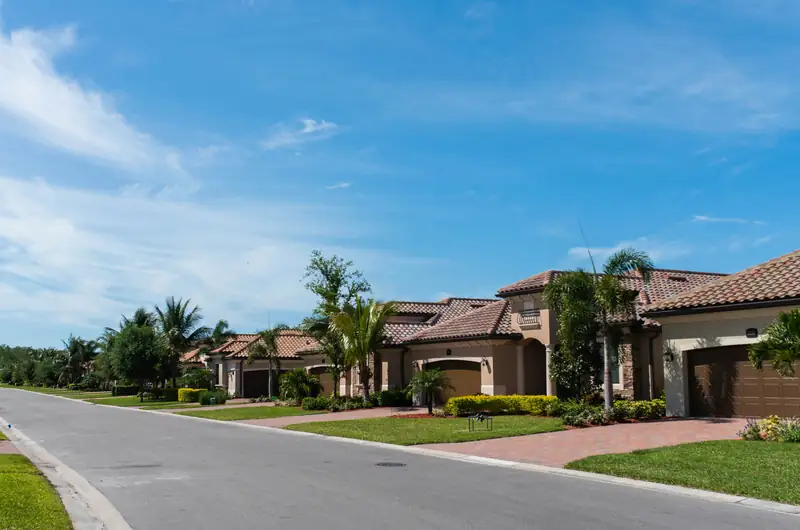
Paver Driveways · North Port, FL
Paver Driveway Installation in North Port
A paver driveway in North Port costs $10–$30 per sq ft installed as of October 2026. The city names brick pavers directly as an approved apron material, though a paver surface still has to clear the same culvert and width rules a poured driveway would.
By the Opera Concrete & Pavers estimating team · Updated October 1, 2026
Get a free estimate
Tell us about the project and we'll call to set up a free site visit.
Say a side-load garage paver driveway in North Port opens to 30 ft at the garage and narrows to 10 ft at the street, averaging out to 650 sq ft
Say a side-load garage paver driveway in North Port opens to 30 ft at the garage and narrows to 10 ft at the street, averaging out to 650 sq ft. At $10–$30 per sq ft, figure $6,500 to $19,500 across the full range, narrowing to about $7,800 to $13,000 inside the typical $12–$20 band. The trapezoid shape follows the city's own side-load dimension rule rather than the installer's preference, and the culvert crossing at the street still gets its own Public Works inspection regardless of the paver pattern chosen above it.
Pavers are a named option, not a workaround
North Port's code lists "concrete, brick paver, or other material approved by the Public Works Department" as the acceptable driveway surfaces for a one- or two-family home, and separately requires the apron section at the right-of-way to be an impervious material such as concrete, asphalt or brick pavers North Port ULDC Sec. 4.4.1. Choosing pavers doesn't change the culvert review where the driveway crosses the swale, since that permit is about the drainage structure underneath, not the surface on top North Port ULDC App. A.1.1.1.
60 mm or 80 mm: picking paver thickness for a driveway
Pavers come in two standard thicknesses for the jobs a homeowner deals with. A 2⅜-inch (60 mm) unit is the standard spec for pedestrian areas and residential driveways under normal car traffic, while a 3⅛-inch (80 mm) unit is reserved for heavier loads, like streets, industrial pavement, or a driveway that regularly carries something bigger than a sedan. The two aren't interchangeable just because they look similar from the sidewalk: the thicker unit spreads load over a larger area and resists point loading better, which matters every time a tire turns in the same spot. For a typical North Port two-car driveway, 60 mm pavers on a properly compacted base is the standard choice; the 80 mm jump is a conversation for anyone with heavier equipment.
Where the pervious-paver offset actually helps
On a lot pressed against the city's impervious surface cap, swapping a section of standard pavers for a pervious paver system lets that area offset the overall coverage calculation, as long as the material is kept functioning as a pervious surface rather than sealed over later North Port ULDC Sec. 3.6.13. That offset doesn't apply to General Development-platted lots inside the Port Charlotte Subdivision, since the city's overall coverage rule already exempts those parcels outright North Port ULDC Sec. 3.2.3.
Ridge sand versus flatwoods: two different subgrades under North Port driveways
Central Florida and the Suncoast sit on two very different subgrade types. Ridge sands such as Candler and Astatula drain excessively, with a water table that can sit 80 inches or deeper, about as forgiving a subgrade as pavers ever see. Flatwoods soils such as Myakka, Florida's official state soil, or Smyrna and EauGallie hold a water table within 18 inches of the surface for part of most years. A driveway base built the same way on both will perform differently: the sandy ridge lot drains the base almost on its own, while the flatwoods lot needs the extra depth the spec allows for wet ground. Knowing which one sits under a given North Port address changes the base plan before anything gets dug.
Tire-turning wear at the same spot, every day
A driveway sees a narrower range of tire motion than a street does: the same vehicle turning into the same garage bay, day after day, concentrates scrubbing force on a small area instead of spreading it across the whole surface. On a standard 60 mm paver sized for normal car traffic, that repeated turning and braking at one spot, especially near a garage apron, can scuff the surface finish and work joint sand loose faster than it does across the rest of a North Port driveway. It's one reason heavier vehicles, or driveways with a tight turning radius, are candidates for the thicker 80 mm paver and the stricter vehicular compaction standard rather than the standard driveway spec.
Why an overlay job runs differently than a new build
Installing pavers over sound existing concrete skips the excavation and base-compaction steps that take up most of a new driveway's schedule, but it adds steps a fresh build doesn't need: checking the old slab for cracking or settlement that would transfer through the new surface, confirming the slab actually drains, and planning for the finished grade the added layers create at a garage threshold or a North Port sidewalk tie-in. The bedding sand, paver-laying and joint-sand steps stay identical either way. What changes is the front end of the job, where an overlay trades digging for inspecting, and a bad slab underneath can turn what looked like the faster option into the slower one.
Pulling weeds and moss out of the joints
Joint sand that's thinned out from washing or wear leaves an opening for weed seeds and, in a shaded or damp section of a North Port driveway, for moss or algae to take hold between the pavers. Pulling growth by hand or with a joint-safe tool and resweeping fresh sand into the gap afterward keeps the problem from spreading to neighboring joints, since one open seam tends to collect debris that the next one catches too. A driveway with a stabilized or polymeric joint resists this far better than one with plain dry sand, which is one of the trade-offs worth weighing against the lower upfront cost of the standard spec.
Frequently asked questions
Are brick pavers an approved driveway surface in North Port?
Yes, named directly in the city's own code alongside concrete and asphalt as an acceptable material for both the driveway itself and the apron section in the right-of-way.
Can pervious pavers help on a North Port lot near its coverage limit?
Yes, as long as the pervious section is kept functioning as a permeable surface afterward; it offsets the impervious surface calculation under the city's own code, though General Development-platted lots are already exempt from that overall cap.
Does a paver driveway skip North Port's culvert permit?
No. The culvert permit covers the drainage structure under the swale crossing, a separate review from whatever surface material, paver or poured concrete, sits on top of the driveway.
Sources
- North Port Application for ROW Use Permit (rev. Aug 2022)
- North Port ULDC App. A.1.1.1 Public Works permit
- North Port ULDC §4.4.1 One-and-two-family development
- North Port ULDC §3.2.3 Standard districts dimensional standards
- North Port ULDC §3.6.13 Permeable or pervious pavers
- North Port ULDC §6.5.15.3 Retaining walls, sidewalks, driveways in floodways
- North Port Permitting (search excerpt)
- North Port Public Works (search excerpt)
- SWFWMD District Water Restrictions
- FEMA Flood Map Service Center
- NRCS OSD Myakka
- NRCS OSD Immokalee
- NRCS OSD EauGallie
- Florida Administrative Code — Rule 62-308.100, Synthetic Turf (effective May 19, 2026)
- Florida Statutes §125.572 — synthetic turf on single-family lots
- F.S. 720.3045 (2026) Installation, display, and storage of items
- Census Bureau PEP, City and Town Population Totals, Vintage 2025 (North Port city, FL)
- Census Reporter, North Port, FL (ACS 2020-2024 5-yr, B25035)
- Wikipedia, North Port, Florida
- City of North Port, Stormwater Management
- Wikipedia, Myakkahatchee Creek Environmental Park
- Wikipedia, Warm Mineral Springs, Florida
Ready for a price on your project?
Request a free estimate
Tell us about the project and we'll call to set up a free site visit.