
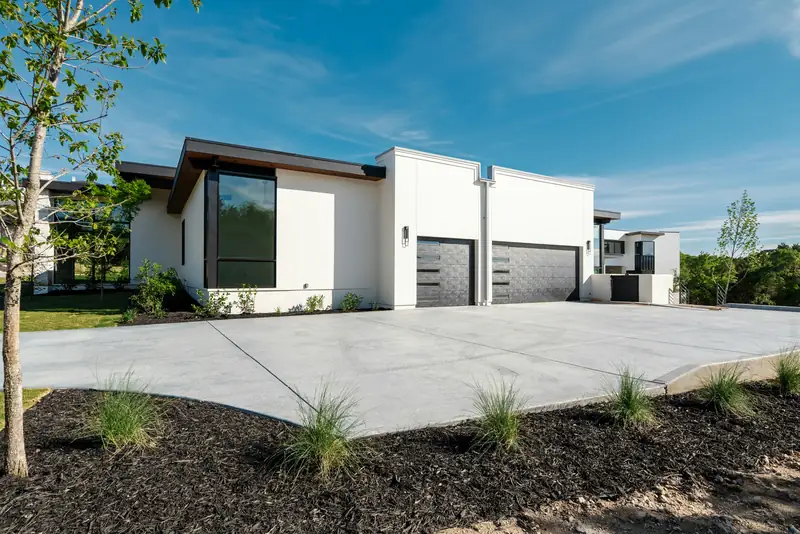
Concrete Driveways · Englewood, FL
Concrete Driveways on the Sarasota County Side of Englewood
A concrete driveway in Englewood runs $6–$15 per sq ft installed, current this October. On the Sarasota County side of the community, Sarasota County's Building Division reviews the permit, and where the drive crosses the roadside swale, a separate culvert permit comes first.
By the Opera Concrete & Pavers estimating team · Updated October 1, 2026
Get a free estimate
Tell us about the project and we'll call to set up a free site visit.
Confirming the county before confirming the permit
Because the Sarasota-Charlotte line runs irregularly through Englewood, roughly south of Dearborn Street and north of McCall Road Wikipedia, Florida State Road 776, two driveways a few streets apart can answer to two different building departments. On the Sarasota County side, a Right-of-Way Use Permit covers any work in the county right-of-way, with no carve-out for how close the parcel sits to the county line Sarasota County UDC §124-48, and that's the permit this page walks through.
Choosing a Finish Before the Truck Shows Up
A broom finish is the plain, standard surface most driveways get: a broom is dragged across the concrete while it is still workable, leaving a texture that sheds water and resists slipping. Exposed aggregate goes a step further, washing or blasting the surface cement off so the stone inside the mix shows through, which changes both the look and the grip underfoot. Both sit within the basic tier of finish work, well short of stamped or multi-color decorative treatments. The choice has to be made before the pour starts in Englewood, since a broom finish cannot become exposed aggregate after the fact without resurfacing.
Replacing a cracked mid-century driveway on the Sarasota County side, worked out in square feet
Take a 20 by 50 foot driveway, 1,000 square feet, on a lot near Dearborn Street dating to the 1970s, where the slab has settled unevenly and the old culvert pipe has partly collapsed. At $6–$15 per sq ft installed, the pour runs $6,000 to $15,000, tightening to roughly $8,000 to $12,000 inside the typical $8–$12 band. Because the culvert needs replacing anyway, the county's line-and-grade review happens before either the pipe or the new slab goes in, not after.
The culvert spec that comes before the slab
Sarasota County treats the pipe under a driveway as its own category: a 20-foot minimum and 24-foot maximum culvert, reinforced or asphalt-coated corrugated pipe, with grade and size set by the County Engineer ahead of the pour Sarasota County Code §124-255. The same section keeps a drainage easement clear of any paved surface at all, driveway or walkway Sarasota County Code §124-255 Additional Provisions (culverts), a rule that comes up often on an older Dearborn Street-area lot where the original swale has silted in over four or five decades.
The Cracking That Starts Before the Slab Even Cures
When the evaporation rate from a fresh slab climbs above roughly 0.2 pounds per square foot per hour, which happens on hot, windy, low-humidity days, the surface can dry out faster than the concrete underneath gains strength. The result is plastic shrinkage cracking: thin, usually parallel cracks spaced a few feet apart that show up within hours of finishing. A Englewood pour on a hot, breezy afternoon is exactly the kind of day this happens on, and once those cracks form they cannot be undone, only patched. Windbreaks, fog sprays and a dampened subgrade all reduce the risk, but only when the crew is watching the conditions, not just the clock.
When a Sandy Lot Still Has Clay Pockets
Not every sandy Florida lot is sand all the way down. Soils like Pomona and Felda look like typical fine sand at the surface, but a few feet down they change into a sandy clay loam or sandy clay layer that drains and compacts differently than the material above it. Grading a Englewood driveway base, we expect that kind of shift rather than treating the whole excavation as one uniform material, because a compactor set up for loose sand will not do the same job on a denser clay pocket. Missing that change is one of the quieter reasons a base looks fine at pour time and still settles unevenly a year later.
Working Around Afternoon Storms Instead of Through Them
Central Florida's rainy season typically runs from late May into October, with afternoon storms that build fast on a summer day. Scheduling a Englewood pour during that stretch, we plan around the forecast rather than hoping the rain holds off, because fresh concrete caught in a downpour before it sets can wash out the surface finish or dilute the top layer. Morning pours give the slab more time to firm up before a typical afternoon storm arrives. Outside the rainy season, the schedule has more flexibility, but we watch the forecast the same way on every job regardless.
Why the Groove in a Control Joint Needs to Stay Clear
The groove cut into a driveway's control joints has to reach at least a quarter of the slab's thickness to do its job of controlling where the concrete cracks, and that same depth is what lets sand, dirt and organic debris pack into the joint over time if nobody checks it. On a Englewood driveway, keeping those grooves swept out, especially heading into the rainy season, keeps them working the way they were cut to work instead of silting in and trapping water against the edges of each panel. It is a five-minute task with a broom, not a specialty job, and it is easy to let slide for years at a time.
Frequently asked questions
How do I find out which county reviews my Englewood driveway permit?
Search the parcel on the county property appraiser's site or call the Sarasota County Building Division directly, since the county line zig-zags near Dearborn Street and McCall Road rather than following one street.
Is there a size limit on the culvert pipe itself?
County staff size it to the ditch, generally landing somewhere between 20 and 24 feet long, and they'll call for a longer run only where that particular swale happens to run deeper than the standard cross-section.
Why does the county care so much about where exactly a driveway sits relative to the swale?
Because the swale is doing the drainage work for the whole street, not just one lot; a paved surface built into that easement blocks water the next storm needs somewhere to go, which is why the county won't permit one there.
Sources
- Sarasota County Code §124-48 Right-of-Way Use Permit
- Sarasota County Code §98-3 Driveway culvert / ROW use permit fees
- Sarasota County Code §124-255 Additional Provisions (culverts)
- Sarasota County Code §124-76 District Development Standards
- Sarasota County Code §124-283 Nonconforming Lots of Record
- Sarasota County Code §54-723 Gulf Beach Setback Line
- Sarasota County Online Permitting
- Sarasota County Building (search excerpt; 403 to direct fetch)
- FDEP Coastal Construction Control Line Program
- FDEP — Apply for a CCCL permit
- FEMA - Features of Flood Insurance Rate Maps in Coastal Areas
- SWFWMD District Water Restrictions
- NRCS OSD Immokalee
- NRCS OSD Felda
- Florida Administrative Code — Rule 62-308.100, Synthetic Turf (effective May 19, 2026)
- Florida Statutes §125.572 — synthetic turf on single-family lots
- F.S. 720.3045 (2026) Installation, display, and storage of items
- Wikipedia, Englewood, Florida
- Wikipedia, Florida State Road 776
- Wikipedia, Manasota Key, Florida
- Census Reporter, Englewood CDP, FL (ACS 2020-2024 5-yr, B01003/B25035)
- Sarasota County, Englewood Community Redevelopment Area
- Sarasota Magazine, A Look Back at Englewood's Historic Dearborn Street
- Your Sun, Blind Pass Beach reopens
Ready for a price on your project?
Request a free estimate
Tell us about the project and we'll call to set up a free site visit.