
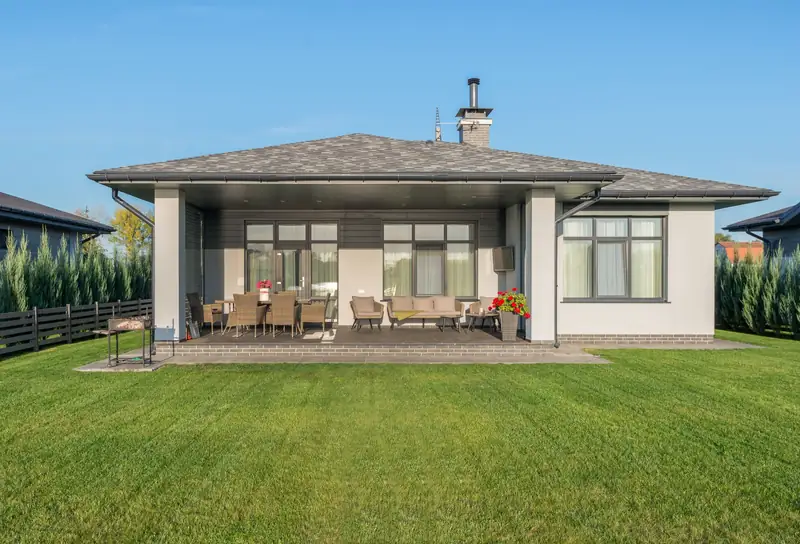
Artificial Turf · ChampionsGate, FL
Artificial Turf for ChampionsGate Yards
Turf installation around ChampionsGate is priced at $10–$25 per sq ft installed, October 2026 Florida figures. A lot of ChampionsGate's lots back onto one of the community's golf-course ponds rather than a natural lake, and the state's turf buffer treats that water the same way it treats any other pond, lake or canal.
By the Opera Concrete & Pavers estimating team · Updated October 1, 2026
Get a free estimate
Tell us about the project and we'll call to set up a free site visit.
Turf along a golf-pond lot line, worked out in square feet
A ChampionsGate backyard backing onto a golf-course pond, fenced at 600 square feet, loses roughly 80 square feet to the required 10-foot buffer, leaving about 520 square feet available for turf. At the $10–$25 per sq ft installed range, that comes to around $5,200 to $13,000 depending on pile height and infill. Because the pond's edge is a built landscape feature rather than a natural shoreline, the buffer still gets measured and marked the same way a lot backing onto a natural lake would require.
A golf-course pond counts the same as a natural lake under the state rule
Two Greg Norman-designed courses wind through ChampionsGate, and the irrigation ponds that shape those fairways border a sizable share of the community's backyards (MoveWithMomentum, ChampionsGate neighborhood guide). Florida's synthetic-turf standard doesn't distinguish a constructed golf pond from a natural lake: either way, installed turf has to stop 10 feet short of the water's edge, on a washed base with natural infill and no buried irrigation line underneath (Florida Administrative Code, Rule 62-308.100).
Why in-ground sprinkler heads can't stay live under turf
DEP Rule 62-308.100 says in-ground irrigation can't be used to water a synthetic turf area, and a local government may require existing heads in that zone to be removed and the pipe capped below grade. Leaving a head live under turf doesn't just risk a rule violation, a buried, pressurized head eventually finds a seam or a low spot and pushes water up through it. The build spec calls for capping the lateral line and plugging the head location before the base goes in, not patching around a head that's still connected. On a ChampionsGate job, that irrigation zone is then either abandoned or redirected to beds and sod that still need it.
Two watering days a week, not one, under this community's water district
ChampionsGate's portion of Osceola County sits inside the South Florida Water Management District's territory, where the standing rule allows watering twice a week, odd addresses on Wednesday and Saturday and even addresses on Thursday and Sunday, each outside the 10 a.m. to 4 p.m. window (SFWMD, Year-Round Landscape Irrigation FAQ). That's a looser calendar than Lake County's current single-day emergency order, which gives new sod on a ChampionsGate lot more of a chance to establish before turf becomes the fallback for a stubborn patch.
Grading the base around a pool deck so turf drains away from the coping
Turf set against a pool deck has one job the base has to support: moving splash-out and rain away from the coping instead of toward it. The compacted aggregate base around a ChampionsGate pool gets graded with a gentle slope off the deck's edge, and the subgrade under it follows the same washed-rock, no-fines rule as every other part of the yard. Pool equipment pads, skimmer lines and deck drains all have to stay clear and functional once the turf is in, which means the base is built around them rather than over them, with the final grade checked at the coping before the turf is rolled out.
What a hurricane season does to turf that wasn't anchored right
Wind-driven rain gets under a loose turf edge faster than most homeowners expect, and once it does, the same gust that lifted the edge can peel a seam open across a ChampionsGate yard if the nailing or seam tape underneath wasn't set to the rule's standard for anchoring against wind and flooding. Oak leaves, pine needles and other storm debris then work their way into the open seam, which both looks bad and blocks the drainage the base below is supposed to provide. Checking every seam and the full perimeter after a named storm catches a lifted edge before the next one makes it worse.
The extra steps a backyard putting green adds to the schedule
A putting green needs more passes at the base stage than a lawn panel does, since the subgrade gets screeded and checked for a true plane rather than just a consistent compacted depth. Contours, breaks or tiers built into the green are shaped at this stage, before any turf goes down, because they can't be adjusted once the surface is seamed. Cup locations and the fringe transition are marked and cut after the main green panel is placed on a ChampionsGate green, not before, so the hole positions land where the finished surface actually breaks. The fringe area around the cups is seamed and infilled last.
Why infill needs occasional top-ups, not just brushing
Infill settles and migrates over years of foot traffic, rain and brushing, and a turf panel that looked fully filled at installation can thin out at high-traffic paths or low spots in a ChampionsGate yard well before the turf fibers themselves show wear. A top-up uses the same natural material the rule requires at installation, clean silica sand, rock, shell or coated silica sand, not whatever happens to be on hand, since the material standard doesn't relax for a maintenance pass. Brushing the pile upright after a top-up redistributes the new infill evenly instead of leaving it in a pile at the low point.
Frequently asked questions
Does the state turf buffer apply to golf-course ponds in ChampionsGate?
Yes. Florida's synthetic-turf rule treats a constructed golf-course pond the same as a natural lake or canal, requiring installed turf to stay at least 10 feet from the water's edge.
How many days a week can a ChampionsGate lawn be watered?
Two, under SFWMD's standard schedule for this part of Osceola County: odd addresses Wednesday and Saturday, even addresses Thursday and Sunday, outside the 10 a.m. to 4 p.m. window.
Is turf a common choice on ChampionsGate vacation-rental lots?
It comes up often for smaller side yards and pet areas on rental homes, where low upkeep between guest turnovers matters more than it would on an owner-occupied lot.
Sources
- Osceola County, Community Development Districts directory
- MoveWithMomentum, ChampionsGate neighborhood guide
- SFWMD, Year-Round Landscape Irrigation FAQ
- SFWMD, Upper Kissimmee Basin Water Supply Plan
- Osceola County — Parking Ordinance, Ch. 22 Art. II (Sec. 22-50.6)
- Osceola County — Right-of-Way Permit Information
- Osceola County — Homeowners
- Osceola County — Permit Information
- NRCS OSD Myakka
- NRCS OSD Basinger
- NRCS OSD Pomona
- Florida Administrative Code — Rule 62-308.100, Synthetic Turf (effective May 19, 2026)
- Florida Statutes §125.572 — synthetic turf on single-family lots
Ready for a price on your project?
Request a free estimate
Tell us about the project and we'll call to set up a free site visit.