
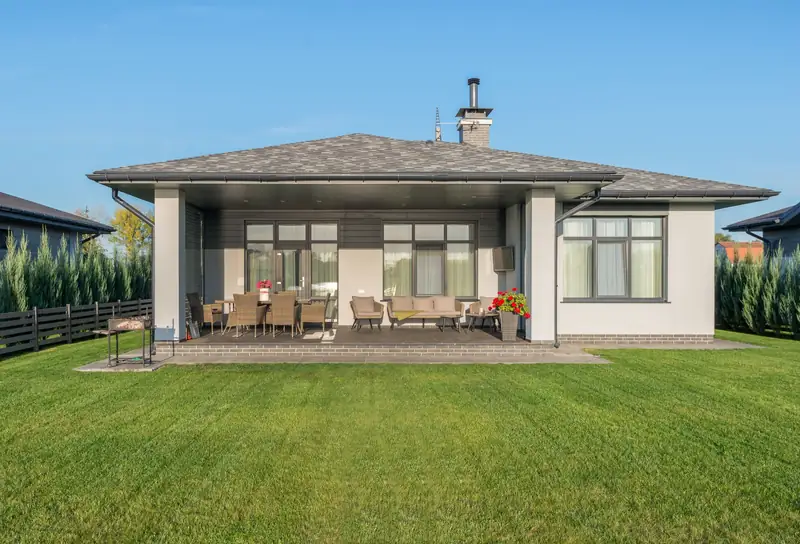
Artificial Turf · Belle Isle, FL
Artificial Turf for Belle Isle Yards
Artificial turf in Belle Isle falls in the $10–$25 sq ft installed range as of October 2026. Most of the city's oldest lots along the Conway Chain were seawalled decades ago for boat access, which in practice is also what decides whether the state's new water-body setback for turf ends up mattering on a given property.
By the Opera Concrete & Pavers estimating team · Updated October 1, 2026
Get a free estimate
Tell us about the project and we'll call to set up a free site visit.
Turf on a seawalled Conway Chain lot, worked out in square feet
Take a Belle Isle backyard with an existing concrete seawall between the pool cage and the chain, where 400 square feet of lawn between the cage and the bulkhead has gone patchy under salt spray and boat traffic. At $10–$25 per sq ft installed, turfing that strip runs roughly $4,000 to $7,200, and because the seawall already separates the yard from open water, the installer can run the turf right up to the bulkhead without measuring off the usual 10-foot buffer.
Seawalls are common here, and they change the math
Rule 62-308.100 builds in an exception that matters more in Belle Isle than almost anywhere else Opera works: the usual requirement to keep new turf 10 feet from a pond, canal or lake disappears wherever a seawall already separates the yard from the water (Florida Administrative Code, Rule 62-308.100). Because so much of the Conway Chain's original shoreline was bulkheaded for docks and boat lifts decades ago (Wikipedia, Belle Isle, Florida), a fair number of Belle Isle turf jobs skip the setback question entirely once the seawall is confirmed on site.
Laying out turf in a narrow side yard to cut down on seams
A side yard that's only a few feet wide doesn't leave much room to hide a seam, so the roll is oriented to run the full length of the space whenever the width allows it, rather than being pieced together in short sections. Edge restraint runs along both the house and the fence line, since a narrow strip has two fixed edges instead of one open perimeter. On a Belle Isle lot, gate hardware, hose bibs and utility meters in a side yard all get cut around individually, and each cut edge gets the same fastening as the outer perimeter so nothing works loose where foot traffic is heaviest.
On an open bank, the rest of the state spec still applies in full
Where a lot doesn't have a seawall, or the turf runs along a different edge of the property than the bulkhead covers, the rule's other pieces take over: a washed base rather than ordinary fill, natural infill instead of crumb rubber, and no irrigation line buried under the turf itself (Florida Administrative Code, Rule 62-308.100). F.S. 125.572 sets a ceiling on how far any local rule can go beyond that statewide spec (F.S. 125.572).
Why a backyard putting green needs a flatter, finer base than a lawn panel
A lawn panel can tolerate a little waviness; a putting surface can't. The aggregate base under a backyard green in Belle Isle gets screeded and compacted in thinner lifts than a standard lawn area, so the finished plane reads true across slopes and breaks instead of showing every ripple in the subgrade. DEP Rule 62-308.100 still governs the material: washed crushed rock or crushed concrete, not limerock with fines, and the state rule caps how tight the subgrade can be compacted so water still percolates through it. A green that's compacted hard enough to putt true but still drains is a balance the base work has to get right the first time.
What a hurricane season does to turf that wasn't anchored right
Wind-driven rain gets under a loose turf edge faster than most homeowners expect, and once it does, the same gust that lifted the edge can peel a seam open across a Belle Isle yard if the nailing or seam tape underneath wasn't set to the rule's standard for anchoring against wind and flooding. Oak leaves, pine needles and other storm debris then work their way into the open seam, which both looks bad and blocks the drainage the base below is supposed to provide. Checking every seam and the full perimeter after a named storm catches a lifted edge before the next one makes it worse.
Why a narrow side yard takes longer than its square footage suggests
Material and equipment access through a Belle Isle side yard is usually limited to a gate or a path a wheelbarrow can clear, which rules out larger compaction equipment and slows every stage down to what can be moved by hand. Base lifts go in with smaller, hand-guided plate compactors instead of ride-on equipment, and turf rolls that would normally be carried by two people get walked in sideways through a narrow gate. None of that changes what the finished base or turf has to meet, but a side yard with the same square footage as an open lawn panel routinely takes longer to finish.
Keeping leaves and storm debris from matting the turf
Oak leaves, pine needles and seed pods are a bigger issue for turf than for a natural lawn, because they don't break down into the surface the way they would in soil, they sit on top of the pile and, left long enough, mat it down and block drainage through the infill. A leaf blower or a stiff broom on a regular pass keeps a Belle Isle yard's turf clear without disturbing the infill the way a hard rake can. After a windy stretch or a storm, a full pass matters more than usual, since that's when the most debris ends up pressed into the pile at once.
Frequently asked questions
Does a Belle Isle lot need a seawall survey before a turf quote?
Checking for an existing seawall is one of the first steps, since its presence determines whether the state's 10-foot water setback applies to that stretch of yard at all.
What if part of a Belle Isle lot is seawalled and part isn't?
The setback question is answered edge by edge: a seawalled section lets turf run to the bulkhead, while an open bank elsewhere on the same property still needs the full 10-foot buffer.
Does an HOA on the Conway Chain get a say over turf placement?
Only within the limits state law sets; an association can't go further than F.S. 125.572 already allows once an install meets the state's construction standard.
Sources
- City of Belle Isle, Driveway Review Application
- City of Belle Isle, Zoning Permits
- Wikipedia, Belle Isle, Florida
- Census Reporter, Belle Isle, FL
- Census Reporter API, Belle Isle median year structure built (B25035)
- SJRWMD Watering Restrictions
- Florida Administrative Code — Rule 62-308.100, Synthetic Turf (effective May 19, 2026)
- Florida Statutes §125.572 — synthetic turf on single-family lots
- F.S. 720.3045 (2026) Installation, display, and storage of items
- USGS WRI 03-4257, Hydrogeology and Quality of Ground Water in Orange County, Florida
Ready for a price on your project?
Request a free estimate
Tell us about the project and we'll call to set up a free site visit.