
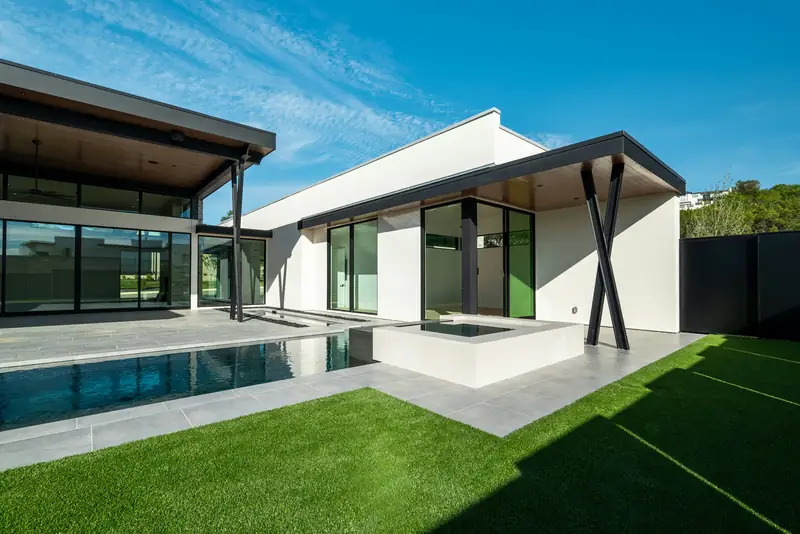
Artificial Turf · Anna Maria Island, FL
Artificial Turf for Anna Maria Island Yards
Expect $10–$25 per sq ft installed for turf on Anna Maria Island this October 2026. Between canal lots on the bay side and tight lots near the Gulf, a water-setback check belongs on nearly every layout here before the first measurement is final.
By the Opera Concrete & Pavers estimating team · Updated October 1, 2026
Get a free estimate
Tell us about the project and we'll call to set up a free site visit.
The 10-foot line that touches almost every yard on a narrow island
DEP Rule 62-308.100 keeps turf at least 10 feet back from open water, measured to a seawall where one exists or to the natural shoreline where it doesn't, and pairs that buffer with a washed-rock base, natural infill and a ban on in-ground irrigation beneath the turf DEP Rule 62-308.100. On an island this narrow, with canal frontage common on the bay side and Gulf frontage on the other, that measurement comes up on far more yards here than on a typical mainland subdivision lot, and none of the three cities can write a looser local rule around it F.S. 125.572.
What a dog run's base has to do that a lawn's doesn't
A pet area turf base starts from the same rule as the rest of the yard, washed crushed rock or crushed concrete, never limerock or road base with fines, but it carries more liquid in one place over and over. Fines-heavy base material binds and seals, which is exactly what traps urine at the surface instead of letting it drain through; a properly washed, open-graded base keeps that liquid moving down and away. On a Anna Maria Island lot, the run is also graded so rinse water drains off the pad rather than pooling at a low corner, since a dog run gets hosed down far more often than the rest of the lawn.
Why a small lot with no room for a lawn still has room for a smaller rule check
Island lots tend to run small, which often means the realistic turf footprint is a side strip, a dog run beside a cottage, or the ground around a raised pool deck rather than a broad front lawn. Florida's current shortage order still caps irrigation at one assigned day a week for whatever sod survives nearby SWFWMD district restrictions, and once turf replaces that strip, it draws nothing from a sprinkler system at all, a detail that matters on a lot where water pressure and the irrigation main are already stretched thin across the island's older infrastructure.
Why a dog run's infill has to stay natural too
A pet area doesn't get an exception to Florida's infill rule just because the use is heavier. The turf still has to use clean silica sand, rock, shell or coated silica sand as infill, the same list that applies to a front lawn, with rubber reserved only for playground equipment, not a dog run. Backing on pet-area turf is usually a more open, perforated design so urine and rinse water pass straight through to the base instead of sitting on top of the infill. On a Anna Maria Island property, that open backing and natural infill work together: the material has to let liquid through, not just look like grass.
Converting a narrow side yard to turf on a Bradenton Beach canal lot, worked out in square feet
A Bradenton Beach cottage has a side yard running 6 feet wide by 30 feet long, 180 square feet, backing onto a canal where a seawall already lines the property edge. At $10–$25 per sq ft installed, the strip runs $1,800 to $4,500, settling closer to $2,160–$3,240 inside the usual $12–$18 window once backing and pile height are picked. Because the seawall itself forms the property line, the state's 10-foot buffer condition doesn't apply, and the layout runs the full length of the yard without a setback cut into it.
Why a narrow side yard takes longer than its square footage suggests
Material and equipment access through a Anna Maria Island side yard is usually limited to a gate or a path a wheelbarrow can clear, which rules out larger compaction equipment and slows every stage down to what can be moved by hand. Base lifts go in with smaller, hand-guided plate compactors instead of ride-on equipment, and turf rolls that would normally be carried by two people get walked in sideways through a narrow gate. None of that changes what the finished base or turf has to meet, but a side yard with the same square footage as an open lawn panel routinely takes longer to finish.
The 10-foot rule for turf near a lake, pond or canal
Turf has to stay at least 10 feet from a natural or man-made waterbody under DEP Rule 62-308.100, measured from the ordinary or mean high water line, unless a seawall or bulkhead already separates the yard from the water. On a canal-front or lakefront Anna Maria Island lot, that setback can cut a meaningful strip off a planned lawn panel, and it's easy to miss if the layout is measured from the yard's edge rather than from the water itself. The seawall exception doesn't apply just because the water is close; there has to be an actual physical barrier in place, not just a slope down to the waterline.
Checking seams and edges after storm season, not just once a year
A seam or edge that was anchored correctly at installation can still work loose over a season of heat cycling, wind and the occasional named storm moving through Anna Maria Island, so a walk around the full perimeter and every seam after a significant storm catches a lifted spot before it grows. Re-securing a loose edge early is a small fix; leaving it through another storm turns it into a bigger one, since each gust that gets under an open edge peels it back a little further. This check costs nothing but time and doesn't require pulling up any turf to do it.
Frequently asked questions
Does a canal-front lot on Anna Maria Island need extra clearance for turf?
Just the standard statewide one: a 10-foot gap back from the water, measured to the seawall where the lot has one. Where a seawall already sets the property line, that distance requirement drops away entirely.
Is turf worth it on a small island lot with limited yard space?
Many owners find a small, well-placed turf panel, a side strip or a pet run, more useful than a patchy lawn that's hard to water evenly on a tight lot, especially under the district's current one-day-a-week irrigation limit.
Does which of the three cities I'm in change the turf rule itself?
No. DEP's turf rule and the state law limiting local turf restrictions apply the same way in Anna Maria, Holmes Beach and Bradenton Beach; only the building permit process, where one applies, differs by city.
Sources
- FDEP Coastal Construction Control Line Program
- FDEP — Apply for a CCCL permit
- FEMA - Features of Flood Insurance Rate Maps in Coastal Areas
- FEMA Flood Map Service Center
- FDOT Structures Design Guidelines Vol. 1, §1.3.2 environmental classification
- SWFWMD District Water Restrictions
- Florida Administrative Code — Rule 62-308.100, Synthetic Turf (effective May 19, 2026)
- Florida Statutes §125.572 — synthetic turf on single-family lots
- F.S. 720.3045 (2026) Installation, display, and storage of items
- Wikipedia, Anna Maria Island
- Wikipedia, Anna Maria, Florida
- Wikipedia, Holmes Beach, Florida
- Wikipedia, Bradenton Beach, Florida
- City of Anna Maria, Building Department
- Holmes Beach, Building Department
- City of Bradenton Beach, Building & Planning
- City of Anna Maria, Ordinance No. 24-927 (height limitation)
- The Anna Maria Islander, Bradenton Beach suspends building official in wake of 2 hurricanes
- My Suncoast, Anna Maria Island residents dealing with the hurricanes' destruction
- Anna Maria Code of Ordinances
- Holmes Beach Code of Ordinances
- Census Reporter, Anna Maria, FL (ACS 2020-2024 5-yr)
- Census Reporter, Holmes Beach, FL (ACS 2020-2024 5-yr)
- Census Reporter, Bradenton Beach, FL (ACS 2020-2024 5-yr)
Ready for a price on your project?
Request a free estimate
Tell us about the project and we'll call to set up a free site visit.